

Fractional CTO Meaning: An Executive Guide to Strategic Technology Leadership
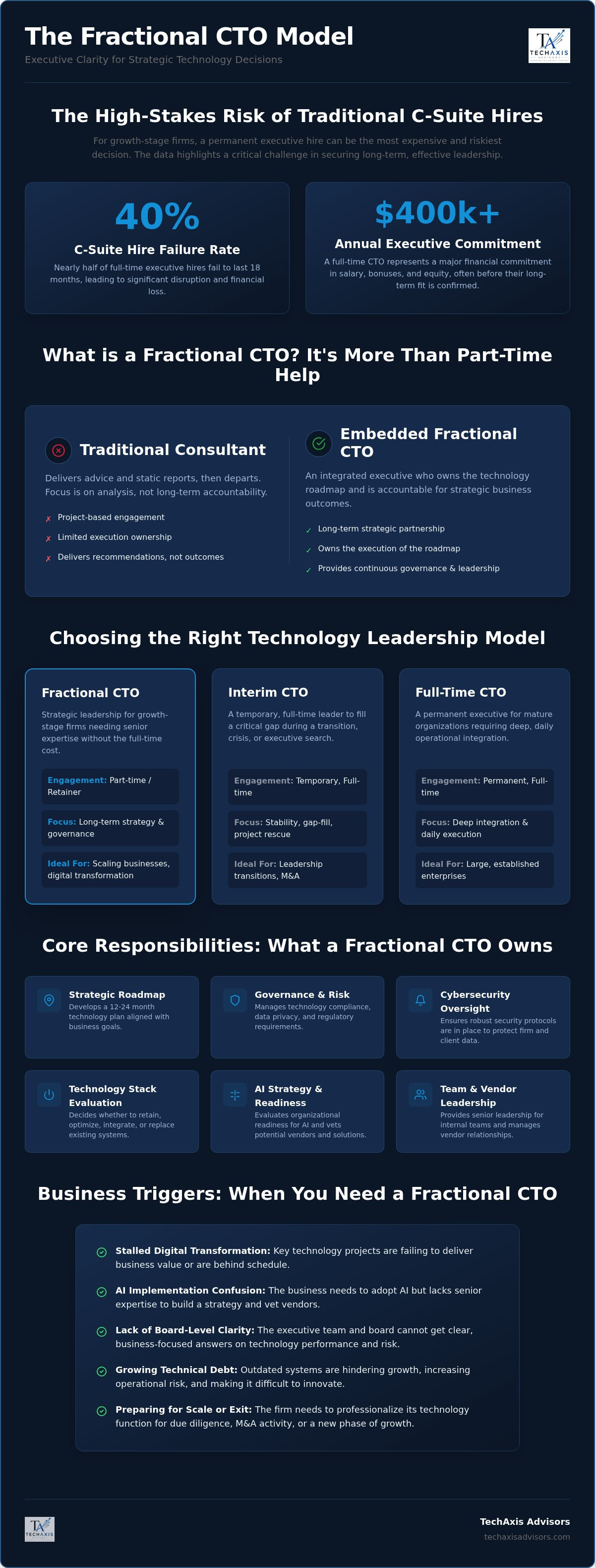
If 40% of full-time C-suite hires fail to last 18 months, the traditional executive search might be the riskiest investment your growth-stage firm can make. Understanding the fractional cto meaning is no longer just about managing costs. It's about securing senior-level strategic oversight without the $400,000-plus annual commitment of a permanent executive. You likely feel the pressure of technical debt or AI implementation confusion, yet you can't justify a full-time hire who might not fit your long-term culture.
We recognize that for wealth management and financial services firms, technology is a regulatory and operational foundation. This guide defines the fractional CTO role and explains how embedded leadership reduces execution risk for growth-stage organizations. We'll provide a clear decision framework for hiring, explore the ROI compared to full-time executives, and show how to align your technology roadmap with actual business outcomes.
Table of Contents
What is a Fractional CTO? Definition and Executive Context
A fractional Chief Technology Officer (CTO) is an embedded executive who provides strategic technology leadership on a part-time or retainer basis. While the term is gaining traction, the fractional cto meaning goes deeper than mere part-time help. It represents a shift from tactical troubleshooting to long-term governance and accountability. Unlike traditional consultants who often deliver a static report and depart, a fractional CTO owns the execution of the technology roadmap. Grasping the fractional cto meaning is the first step toward stabilizing a volatile technical environment and aligning technical investments with the CEO’s primary business objectives.
Growth-stage firms and organizations in regulated sectors often face a leadership gap. They require the wisdom of a veteran executive who has managed scale, yet they don't always have the budget for a $400,000 annual C-suite salary. The Fractional executive model allows these companies to access high-level talent for a fraction of the cost. This approach replaces organizational anxiety with a sense of controlled, disciplined progress. Instead of reacting to technical fires, the business begins to operate with a proactive, architected strategy that values tangible execution over abstract theory.
The Distinction Between Tactical IT and Strategic Leadership
It's easy to confuse a fractional CTO with a "Head of IT" or a lead developer. However, the roles are fundamentally different. A lead developer focuses on the code; a fractional CTO focuses on the business case for that code. This role is about oversight, structural integrity, and the mechanics of scaling. They ensure that every dollar spent on technology serves a measurable business outcome and mitigates technical risk. For firms in wealth management or private equity, this clarity is essential for maintaining investor confidence and meeting compliance standards. You can explore who TechAxis serves to see how this leadership model fits specific organizational profiles.
Why 2026 is the Year of the Fractional Executive
With global technology spending projected to reach $5.6 trillion in 2026, the complexity of the digital environment has outpaced the internal capabilities of many growing firms. The rise of AI and automation has created a "leadership tax" where companies feel forced to hire expensive experts just to stay relevant. The fractional model offers a pragmatic alternative. It provides the senior oversight necessary to vet AI vendors and manage data governance without a permanent headcount increase. This flexibility allows firms to scale their leadership up or down as their needs change. The fractional CTO serves as a bridge between technical debt and operational maturity.
Core Responsibilities: What a Fractional CTO Owns
Many leaders mistake a fractional CTO for a part-time engineering manager who simply oversees a development team. The true fractional cto meaning involves assuming full accountability for the technology's impact on the balance sheet. They don't just manage technical tickets; they own the strategic outcomes that drive enterprise value. This leadership model provides a disciplined framework for oversight, ensuring that technology serves as a lever for growth rather than a source of organizational friction.
A primary responsibility is the development of a 12-24 month strategic roadmap. This document isn't a wishlist of technical features. It's a prioritized sequence of investments designed to support business scale and operational maturity. In regulated sectors like financial services, the fractional CTO also manages the complexities of governance and risk. They oversee cybersecurity protocols and technology compliance, providing the structural integrity required to protect both firm reputation and client data. As organizations look toward automation, this executive evaluates organizational readiness for AI strategy, ensuring that digital transformation efforts are grounded in business value rather than industry hype.
Technology Strategy and Operational Execution
Building a scalable operating foundation requires more than just adding new software. A fractional CTO evaluates your existing stack through a pragmatic lens: should you retain, optimize, integrate, or replace? This decision-focused approach prevents the accumulation of technical debt and ensures that every dollar spent aligns with the CEO’s vision. For a deeper look at this process, see our guide on Optimizing technology spend for CEOs. By focusing on the business case for modernization, the fractional leader ensures that technology investments are predictable and measurable.
Executive Advisory and Board-Level Reporting
Technology decisions often stall because the communication gap between the server room and the boardroom is too wide. A fractional CTO bridges this gap by translating complex technical ecosystems into board-ready decisions. They provide evidence-based findings via structured assessments, allowing for objective discussions about risk and investment. This level of clarity is particularly vital during technology due diligence for acquisitions or funding rounds. If your leadership team is struggling to find this alignment, you might consider how to start a confidential executive conversation about your current roadmap.
Beyond internal reporting, the fractional CTO provides executive oversight for third-party software partners and platforms. They manage vendor relationships with a focus on accountability and transparency. This ensures that external partners deliver on their promises and that the firm remains independent of vendor lock-in. The result is a technology operating model that is both resilient and agile, capable of supporting the long-term objectives of the organization.
Fractional vs. Interim vs. Full-Time CTO: A Comparison
Choosing the right leadership model requires a clear understanding of your firm's current scale and technical complexity. While the fractional cto meaning centers on a long-term, part-time strategic partnership, other roles serve different organizational needs. An interim CTO is a full-time, temporary executive brought in to maintain momentum during a leadership search or a specific crisis. In contrast, a permanent, full-time CTO is required only when technical complexity or team size demands 40 or more hours of dedicated oversight every single week.
The financial implications of these choices are significant. A full-time CTO in North America often commands a loaded annual cost between $400,000 and $550,000. For many growth-stage firms, this represents an inefficient allocation of capital where the organization pays for a full-time resource but only requires 10 hours of high-level strategy. Research indicates that the fractional model can offer 40% to 60% cost savings compared to a full-time hire while providing the same level of senior expertise. Given that 40% of full-time C-suite hires fail to last 18 months, the fractional approach also serves as a critical risk mitigation strategy.
When to Choose the Fractional Model
The fractional model is particularly effective for firms with $5M to $50M in revenue. These organizations have outgrown their lead developer's strategic capacity but don't yet need a permanent executive suite. It allows you to access veteran talent who has navigated similar growth hurdles without the long-term equity or benefits commitment. For a detailed breakdown of these costs, see our Fractional CTO vs Full Time CTO: An ROI Analysis. This model ensures you have senior access for board meetings and strategic roadmapping while keeping your burn rate under control.
The Limitations of the Fractional Role
Every leadership model has its threshold. If your engineering team scales beyond 30 to 50 members, or if you are undergoing a massive, continuous replatforming effort, the tradeoff between cost and availability may no longer favor the fractional role. At this stage, the need for daily, hands-on leadership outweighs the efficiency of part-time oversight. We focus on ensuring a smooth transition during these periods of evolution. A successful fractional engagement often ends by helping the CEO identify and onboard the right full-time successor, ensuring that the established technology governance remains intact during the handoff.
Determining the Business Case: When Do You Need a Fractional CTO?
Identifying the right moment to hire is as critical as the hire itself. Four specific business triggers usually signal that the fractional cto meaning has shifted from a theoretical concept to an operational necessity. First, rapid growth often outpaces the existing technology foundation, leading to "duct-tape" solutions that cannot scale. Second, digital transformation or AI initiatives frequently stall because there isn't an executive leader to own the business case. Third, firms in wealth management face increasing technology risk and complex compliance requirements. Finally, the need for objective technology due diligence during M&A activity requires a senior perspective that internal teams might lack.
Solving the "Executive Gap" in Mid-Market Firms
Middle-market CEOs often feel they're flying blind when making high-stakes technology decisions. They hear technical jargon from their IT teams but don't see the direct link to the bottom line. This is an Executive Gap. A fractional CTO provides the most value here, moving the organization from a "keep the lights on" mentality to treating technology as a competitive advantage. You can see the specific problems TechAxis solves to understand how this leadership bridge functions in practice. This role ensures that technology spend is no longer a black box but a transparent, strategic investment.
Assessing Technical Debt and Execution Risk
In private equity-backed firms, the fractional leader acts as a strategic architect during the integration phase. They ensure that the acquired technology stack doesn't become a liability or a source of friction. On the AI front, they move beyond the hype to evaluate "automation readiness." This involves looking at data hygiene and process maturity before committing capital to complex implementations. They replace organizational anxiety with a structured approach to innovation.
High execution risk is often a byproduct of unmanaged technical debt. A fractional CTO identifies technology risks before they become operational failures by conducting deep-dive assessments of your current state. They help leadership teams identify high-impact AI use cases that actually drive efficiency rather than just following trends. By modernizing legacy data architecture, they ensure that reporting is accurate and that the firm can make informed, evidence-based decisions. When you understand the fractional cto meaning through the lens of risk mitigation, it becomes clear that this role is about protecting the firm's future as much as it's about building new features.
The TechAxis Approach: Executive Clarity Through Advisory
Our methodology moves beyond the static definitions of the fractional cto meaning to provide a dynamic leadership bridge. We don't operate as an outsourced IT provider or a managed service provider (MSP). Instead, we act as a trusted executive partner, leveraging 25 plus years of experience in wealth management, financial services, and private equity. Our goal is to replace organizational ambiguity with a structured, evidence-based path toward operational maturity. This process begins with identifying specific business outcomes and then architecting the technology operating model required to achieve them.
Central to our approach is the proprietary TechAxis Executive Intelligence Platform. This tool allows us to deliver evidence-based findings that are specifically formatted for board-level review. Rather than providing dense technical logs, we provide executive clarity for important technology decisions. This platform ensures that every finding is backed by data, allowing CEOs and boards to evaluate risk and ROI with the same discipline they apply to financial reporting. In regulated industries, this level of transparency is not just a preference; it is a requirement for maintaining structural integrity and compliance.
Beyond the Report: Execution and Governance
A common failure in technical consulting is the "report on a shelf" problem. TechAxis avoids this by providing ongoing Advisory Leadership services that focus on the actual mechanics of execution. We maintain an independent perspective, particularly in vendor and platform management. This independence ensures that our counsel remains objective, helping you evaluate whether to retain, optimize, or replace existing systems without the bias of vendor commissions. We provide the necessary governance to oversee qualified delivery partners, ensuring that implementations stay aligned with the original strategic intent.
Start with an Executive Assessment
Effective leadership requires a clear understanding of the current state. We typically begin our engagements with a structured Executive Intelligence Assessment. These diagnostics are designed to provide immediate clarity on specific priorities, such as AI readiness, cybersecurity risk, or data strategy. We don't believe in replacement as a default solution. Instead, we evaluate the business case for modernization, providing board-ready deliverables and prioritized roadmaps that focus on tangible progress.
The fractional cto meaning at TechAxis is defined by a commitment to your firm's long-term stability. We provide the senior oversight needed to navigate complex digital transformations while managing the technical debt that often hinders growth. This structured approach allows your leadership team to focus on core business objectives while we handle the mechanics of technology governance. To determine if your current priority requires an assessment, strategic advisory, or fractional leadership, start with a confidential executive conversation.
Securing Technology Governance for the Next Stage of Growth
Securing senior leadership is the most effective way to eliminate technical confusion and align your operating model with business growth. We've explored how a fractional partner manages risk, governs vendor relationships, and architects a multi-year roadmap. Understanding the fractional cto meaning ensures your firm accesses high-level strategy without the overhead or search risk of a permanent C-suite role. This approach allows growth-stage firms to maintain a lean executive team while benefiting from the wisdom of a seasoned professional who understands the mechanics of scaling.
TechAxis Advisors brings the perspective of a founder who has led technology for major wealth management and enterprise organizations. As a certified Women-Owned Small Business (WOSB), we use our proprietary Executive Intelligence Platform to provide the evidence-based findings and data-driven roadmaps your board requires. We replace organizational anxiety with disciplined, strategic progress that values tangible execution over abstract theory. Our focus remains on providing the executive clarity you need to make informed technology decisions.
Your technology foundation should be a lever for growth, not a source of friction. We look forward to helping you build a resilient and scalable future for your organization.
Frequently Asked Questions
What is the typical cost of a fractional CTO in 2026?
Industry data indicates that a fractional engagement typically costs significantly less than a full-time executive salary. While rates vary based on specialized expertise in fields like FinTech or AI, most firms see a reduction in leadership spend of 40% to 60% compared to a permanent hire. This model allows growth-stage firms to access veteran talent without the long-term equity or benefits commitment associated with the C-suite.
How many hours a week does a fractional CTO work?
Most fractional engagements range from 5 to 15 hours per week depending on the complexity of your strategic roadmap. This time is focused on high-impact activities such as board reporting, vendor oversight, and architectural governance. The model is designed to be flexible, allowing the engagement to scale up during intensive periods like platform migrations or down during steady-state operations.
Can a fractional CTO help with AI strategy and implementation?
Yes, a fractional CTO is essential for evaluating organizational readiness for automation and AI strategy. They provide the senior oversight necessary to vet third-party AI platforms and ensure that data governance protocols are in place before capital is committed. This role focuses on identifying high-impact use cases that drive actual business value rather than following industry trends without a clear ROI.
What is the difference between a fractional CTO and a technical consultant?
The primary difference lies in accountability and duration. A consultant is typically brought in for a specific project to deliver a report or a technical audit. In contrast, the fractional cto meaning centers on an embedded executive who owns the execution of the strategy. They maintain long-term governance over the technology operating model and are accountable for the business outcomes of technical decisions.
Does a fractional CTO manage my existing development team?
A fractional CTO provides executive leadership and accountability for your existing technical resources and third-party vendors. They don't typically handle daily task management or stand-up meetings like a lead developer or engineering manager. Instead, they ensure the team's output remains aligned with the CEO's vision and that technical debt is managed through a disciplined, multi-year roadmap.
Is a fractional CTO suitable for financial services and wealth management firms?
This model is specifically tailored for regulated industries like wealth management and financial services that require senior-level oversight. These firms face complex technology governance, risk management, and compliance requirements that often outpace the capacity of a standard IT manager. A fractional leader provides the structural integrity needed to protect client data and provide evidence-based findings for board-level review.
How do I know if my company is ready for a fractional CTO?
Your company is likely ready if your technology foundation has been outpaced by rapid business growth or if digital transformation efforts have stalled. Other triggers include increasing regulatory pressure, the need for objective due diligence during M&A, or a general sense that technology decisions are being made without executive clarity. If your technology spend feels like a black box, you require senior advisory leadership.



Comments