

Fractional CTO Guide for Mid-Market Companies
For many mid-market organizations, the primary barrier to scaling isn't a lack of technical talent, but a lack of executive-level technical leadership. You likely recognize the friction. Technical debt continues to accumulate, slowing down growth initiatives, while IT spending remains frustratingly disconnected from actual business outcomes. The anxiety surrounding AI adoption and cybersecurity risk only compounds these challenges. These aren't just operational hurdles; they're strategic risks that can stall a company's trajectory and erode enterprise value.
It's understandable to feel caught between the need for sophisticated oversight and the high cost of a full-time executive. This guide explains how a fractional CTO for mid-market companies provides the necessary bridge between day-to-day technical operations and high-level business strategy. You'll learn how to leverage this model to establish a clear technology roadmap and reduce execution risk across the organization. We'll preview a framework for evidence-based decision support that satisfies the board's need for transparency and ensures every technology dollar aligns with your long-term objectives.
Table of Contents
The Technology Ceiling in Mid-Market Organizations
Mid-market organizations often hit an invisible wall. As revenue climbs toward the $500 million mark, the technical systems that supported initial growth begin to fracture. This is the technology ceiling. It occurs when technical debt grows faster than operational capacity, turning IT from a growth lever into a bottleneck. The friction isn't just a technical issue. It is a structural one that requires a fractional CTO for mid-market companies to resolve.
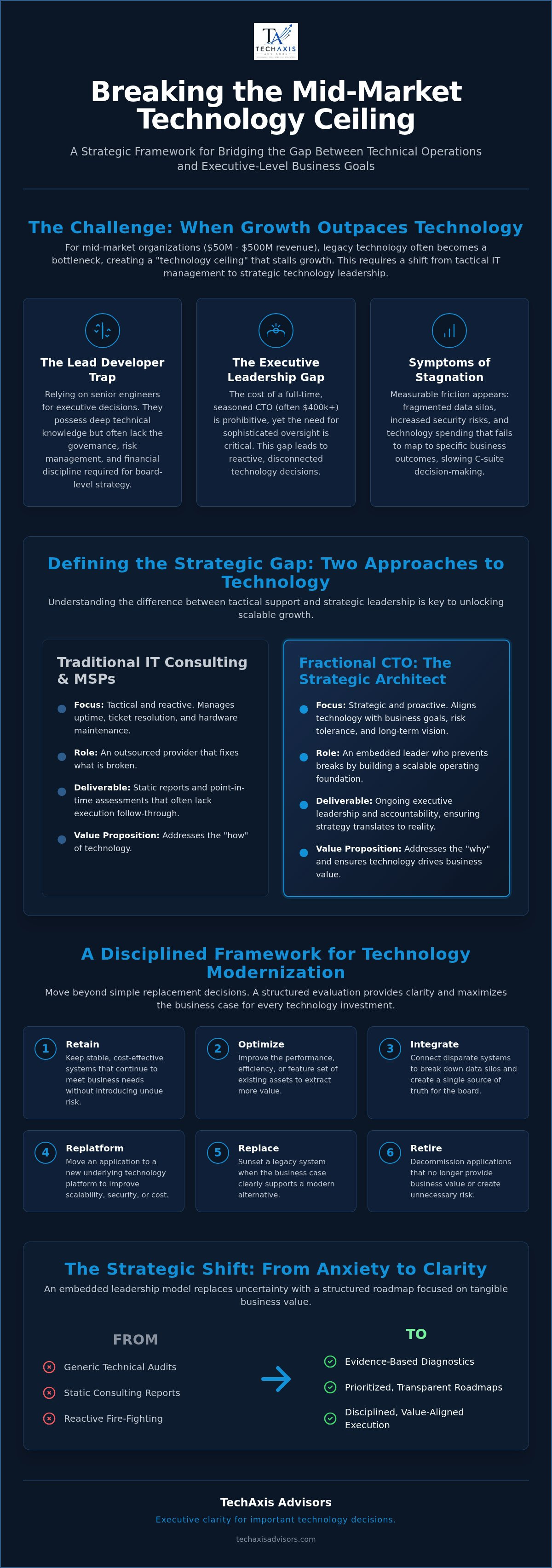
Many firms fall into the "Lead Developer Trap." They rely on their most senior engineer to make high-level business decisions. While these individuals possess deep technical knowledge, they often lack the executive experience required to align technology with board-level objectives. Scaling requires more than code. It requires governance, risk management, and financial discipline. Without this oversight, technical debt accumulates silently, eventually stalling product delivery and customer acquisition.
For companies in the $50 million to $500 million revenue range, the stakes are unique. You're too large for simple IT support but often too small to justify the $400,000+ total cost of a full-time, seasoned CTO. This gap creates a leadership vacuum where technology decisions are made reactively. Transitioning to a proactive executive technology strategy is the only way to break through the ceiling and maintain a competitive edge.
Symptoms of Technical Stagnation
Stagnation manifests in specific, measurable ways. Inconsistent data reporting is a primary indicator. If the C-suite cannot trust the numbers in their dashboard, decision-making slows to a crawl. In regulated sectors like wealth management, these gaps aren't just inefficient; they're liability risks. Organizations often find that new digital initiatives carry high execution risk because the underlying foundation is unstable. Common symptoms include:
Fragmented data silos that prevent a "single source of truth" for the board.
Security and compliance gaps that increase regulatory and audit risk.
Technology spend that doesn't map to specific, measurable business outcomes.
The Role of an Executive Technology Advisor
There is a fundamental difference between an outsourced IT provider and a strategic advisor. An IT provider fixes what is broken. An advisor prevents the break by aligning technology with your specific risk tolerance and business goals. By utilizing the fractional executive model, companies gain access to veteran leadership without the long-term overhead of a full-time hire.
A fractional CTO for mid-market companies acts as a strategic architect. This leader ensures that every software purchase or infrastructure change serves a long-term purpose. This approach addresses the specific problems we solve by moving from fire-fighting to disciplined execution. The goal is to replace organizational anxiety with a structured roadmap that supports both current operations and future scale.
Fractional CTO vs. Traditional IT Consulting: Defining the Strategic Gap
Traditional consulting models often prioritize the delivery of static reports. These documents provide a snapshot in time but frequently lack the follow-through required for complex transformations. Fractional leadership operates differently. It provides embedded execution. A fractional CTO for mid-market companies doesn't merely offer advice from the sidelines. They integrate into the leadership team to ensure strategic decisions translate into operational reality. This accountability bridges the gap between a high-level recommendation and a functional result.
The "Strategic Architect" model is about building a scalable operating foundation. Mid-market firms often face a choice: hire a full-time executive at a high cost or settle for junior-level oversight. Fractional leadership offers a third path. It provides senior-level access without the full-time executive overhead. You gain the same caliber of insight found at the Big Four strategy firms but with a focus on practical application rather than theoretical frameworks. This approach avoids the significant brand premiums of global firms while maintaining executive-grade oversight.
Strategic Advisory vs. Managed Services (MSP)
It's vital to distinguish between tactical support and strategic leadership. A Managed Service Provider (MSP) handles the "how" of technology. They focus on uptime, ticket resolution, and hardware maintenance. A fractional CTO handles the "why." They ensure technology investments align with business risk and growth targets. This distinction is critical when determining who it is for within your organization. Strategic guidance must remain independent and vendor-agnostic to protect the company's interests.
Embedded Leadership for Growth-Stage Firms
Continuity is the primary driver of value in growth-stage firms. A leader who has served as a CIO, CTO, or CISO brings a depth of experience that cannot be replicated by a rotating team of consultants. They maintain the strategic narrative from the initial assessment through to final execution. This ensures that the original intent of a project isn't lost during the implementation phase. For a deeper analysis of this inflection point, you can explore When Does a Growth Company Need a Fractional CTO? to evaluate your current trajectory.
If your organization is struggling to align technical spending with business outcomes, it may be time for a confidential executive conversation to explore a more structured leadership model.
Assessing the Business Case: The Decision Framework
Technology modernization is rarely a binary choice between keeping a legacy system or replacing it entirely. For organizations scaling toward the core mid-market range, the decision requires a nuanced evaluation of business value versus execution risk. A fractional CTO for mid-market companies provides the oversight needed to move beyond emotional attachments to legacy tools or the urge to chase every new platform. Instead, they apply a disciplined framework to determine the most capital-efficient path forward.
This decision framework categorizes every major technology asset into one of six actions: Retain, Optimize, Integrate, Replatform, Replace, or Retire. By evaluating the business case through these lenses, leadership avoids the common trap of over-investing in unnecessary replacements. For example, optimizing an existing data fabric often yields a higher ROI than a replatforming effort that takes eighteen months to realize value. This objective analysis ensures technology remains an asset that enhances enterprise valuation rather than a liability that drains cash flow.
Technology Due Diligence for Mid-Market Acquisitions
In the context of private equity or M&A, technology is a critical component of the balance sheet. Hidden technical debt can drastically impact a company's valuation during a liquidity event. A fractional leader conducts structured executive decision-support engagements to identify these risks early. They provide board-ready briefs that translate technical vulnerabilities into financial terms. For a detailed breakdown of what to look for, see this Technology Due Diligence for Growth-Stage Companies checklist. This level of transparency is essential for investors who need evidence-based findings before committing capital.
Governance-Driven AI and Data Strategy
While AI dominates the current conversation, mid-market firms must approach it with pragmatic discipline. The goal isn't just adoption; it's governance. This is particularly true for asset managers and wealth management firms where data integrity and compliance are non-negotiable. A fractional CTO for mid-market companies helps build a roadmap that prioritizes data architecture modernization before attempting complex automation. You can explore the AI in Financial Services: 2026 Strategic Framework to understand how to balance innovation with operational maturity. This structured approach replaces hype with a reliable process for scaling intelligence across the enterprise.
Implementing a Structured Executive Intelligence Framework
Mid-market technology decisions often rely on intuition or the preferences of a single technical lead. This lack of structure leads to fragmented systems and unpredictable costs. A fractional CTO for mid-market companies replaces this guesswork with a structured executive intelligence framework. This approach uses objective diagnostics to identify operational gaps before they impact the bottom line. By synthesizing technical findings into a prioritized strategic roadmap, the organization gains a clear path toward its business objectives. Accountability is maintained through action registers and continuous executive oversight, ensuring that technology remains an enabler rather than a distraction.
This framework is not about talent matching or providing a "rent-a-coder." It is a disciplined operating model designed for the C-suite. It replaces organizational anxiety with a sense of controlled, disciplined progress. By moving from reactive fixes to evidence-based decisions, leadership can justify IT spend to the board with confidence. The goal is to create a predictable cadence of improvement that aligns with the company's growth trajectory.
The Executive Assessment Process
The assessment process is methodical and highly organized. It follows a deliberate pace that respects the reader's cognitive load, breaking down complex needs into digestible steps. This process typically involves:
Step 1: Structured Diagnostic: Utilizing a proprietary intelligence platform to gather objective data on current technical operations.
Step 2: Readiness Assessment: An evidence-based evaluation of technology and AI readiness, focusing on data integrity and infrastructure stability.
Step 3: Intelligence Synthesis: Compiling findings into a concise brief for C-suite and board review, highlighting specific risks and investment requirements.
Bridging the Gap to Execution
Identifying a problem is only the first step. The real challenge for many mid-market firms is managing the execution phase without a full-time executive. A fractional leader bridges this gap by providing vendor oversight and coordinating with qualified delivery partners. This ensures that third-party implementations adhere to the company's governance standards and budget constraints. By maintaining oversight throughout the implementation lifecycle, the leader prevents project scope creep and technical misalignment. You can learn more about this process by reviewing how we work to ensure long-term operational stability.
The fractional CTO for mid-market companies acts as the strategic architect throughout this phase. They don't just offer advice from the sidelines; they're deeply invested in the mechanics of the client's success. This hands-on governance ensures that the original strategic intent is preserved from the roadmap through to final delivery.
Strategic Continuity: TechAxis Advisors as the Strategic Architect
TechAxis Advisors operates as a strategic architect for organizations that have outgrown tactical IT but aren't yet prepared for a permanent C-suite hire. This partnership rests on more than 25 years of executive experience. Having served as a CIO, CTO, and CISO, the leadership at TechAxis Advisors ensures that every recommendation is grounded in the realities of managing high-stakes technical environments. By engaging a fractional CTO for mid-market companies, leadership teams gain an advocate who understands both the mechanics of scaling and the nuances of board-level accountability.
For clients in regulated sectors, structural integrity and transparency are essential. The status of TechAxis Advisors as a certified WOSB and MWBE provides an additional layer of credibility for organizations operating under strict governance mandates. This commitment to evidence-driven guidance ensures that every strategic decision is backed by objective data. The goal is to replace organizational confusion with a sense of controlled, disciplined progress through the firm's proprietary Executive Intelligence Platform.
Tailored Advisory for Financial and Growth Firms
Wealth management firms, private equity groups, and lending institutions face distinct technology challenges. These organizations must align technology investments with specific business outcomes like increased AUM or improved deal velocity. TechAxis Advisors provides advisory leadership that speaks the language of the board. The focus remains on structural integrity, ensuring that the technology stack doesn't become a liability during an audit or a liquidity event. This specialized focus ensures that technical operations directly support the firm's long-term enterprise value.
Next Steps for Executive Leadership
Determining the right path forward begins with identifying the primary source of organizational friction. Some priorities require a structured Executive Intelligence Assessment to establish a baseline of operational maturity and identify hidden technical debt. Others require ongoing fractional leadership to oversee a major transformation or manage delivery partners. The process starts with a confidential executive conversation to explore which model best fits your current trajectory. Establishing this baseline is the first step toward moving from reactive IT management to a proactive executive technology strategy. Explore whether your current priority requires a targeted assessment, strategic advisory, or embedded fractional leadership to ensure your technology function is prepared for the next phase of growth.
Breaking Through the Technical Ceiling
Breaking through the technical ceiling requires a fundamental shift from reactive firefighting to disciplined, executive-level oversight. Mid-market organizations that leverage a fractional CTO for mid-market companies gain the strategic clarity needed to align technology spend with measurable business outcomes. This model replaces organizational anxiety with a structured, prioritized roadmap. It ensures that every investment in data, AI, or infrastructure directly supports long-term enterprise value and operational stability while reducing execution risk.
TechAxis Advisors provides this executive clarity through evidence-based findings generated by our proprietary Executive Intelligence Platform. Led by a founder with 25+ years of experience as a CIO, CTO, and CISO, the firm offers the pragmatic leadership required to navigate complex, regulated environments. As a certified WOSB and MWBE, TechAxis Advisors brings a results-oriented commitment to execution that helps your organization scale with confidence. Establishing a clear technology roadmap today prevents the accumulation of technical debt that could stall your growth tomorrow.
Explore whether your current priority requires a structured assessment or embedded fractional leadership to maintain your competitive advantage. You can establish a baseline for operational maturity that satisfies both the board and your investors.
Frequently Asked Questions
What is the primary difference between a fractional CTO and a consultant?
A fractional CTO provides embedded leadership and execution accountability, whereas a traditional consultant typically delivers static advice or reports from the sidelines. This role integrates into your leadership team to drive long-term transformation. A fractional CTO for mid-market companies ensures that technology decisions translate into operational results. They maintain continuity throughout the implementation lifecycle, whereas consultants often exit once the initial recommendation is delivered.
How many hours a week does a fractional CTO typically work with a mid-market company?
Engagement levels vary based on the complexity of your technology roadmap and the pace of your growth initiatives. Mid-market organizations often require between one and three days per week of embedded leadership. This structure allows for senior-level oversight without the overhead of a full-time executive hire. The exact duration depends on whether the priority is a specific modernization project or ongoing governance of the technology operating model.
Can a fractional CTO help with cybersecurity and compliance in financial services?
Strategic leadership in cybersecurity and compliance is a core function of this role, particularly for firms in regulated sectors. With a founder possessing 25+ years of experience as a CISO and CTO, TechAxis Advisors focuses on risk management and executive governance. We help wealth management and lending organizations identify technology risks and implement governance-driven frameworks. This ensures your technical infrastructure meets the specific compliance requirements of the financial services industry.
Does a fractional CTO manage our existing internal IT team or MSP?
A fractional leader provides essential oversight for both internal IT teams and external Managed Service Providers (MSPs). They ensure that these tactical groups align their day-to-day operations with your overarching business strategy. While the MSP handles the "how" of technology, the fractional CTO focuses on the "why." This oversight ensures accountability, manages vendor performance, and prevents technical debt from accumulating during rapid scaling phases.
What industries do TechAxis Advisors specialize in?
TechAxis Advisors specializes in wealth management, financial services, lending, and private equity-backed organizations. Our expertise is tailored for regulated and complex enterprise environments where data integrity and risk management are paramount. We also support growth-stage firms in retail and enterprise sectors that are navigating digital transformation. Our founder's background as a CIO and CTO in these industries ensures that our advisory remains pragmatic and business-aligned.
How does a fractional CTO support AI readiness and automation?
AI readiness is addressed through structured diagnostics that evaluate your current data architecture and infrastructure stability. We use the proprietary TechAxis Executive Intelligence Platform to identify high-impact automation use cases while meeting compliance requirements. This process moves beyond the hype to build a pragmatic AI roadmap. We prioritize governance-driven strategies that ensure your data is vectorized and ready for scaling intelligence across the enterprise.
Is a fractional CTO suitable for companies preparing for an exit or acquisition?
Fractional leadership is vital during the due diligence phase of an acquisition or exit. A fractional CTO for mid-market companies identifies hidden technical debt and security vulnerabilities that could impact your enterprise valuation. We create board-ready briefs for investors and private equity firms, providing evidence-based findings on technology risks. This level of transparency protects your balance sheet and ensures a smoother integration or transition during liquidity events.
What deliverables should I expect from an executive technology assessment?
You should expect a suite of artifacts designed for C-suite and board-level review. These include evidence-based findings summaries, a prioritized strategic roadmap, and a detailed action register with clear next steps. Our methodology also produces board-ready briefs and presentation decks tailored for executive meetings. Unlike generic consulting reports, these deliverables focus on traceability and accountability, providing a structured path for moving from diagnostic to execution.



Comments