

Fractional CTO for PE Portfolio Companies: Value Creation
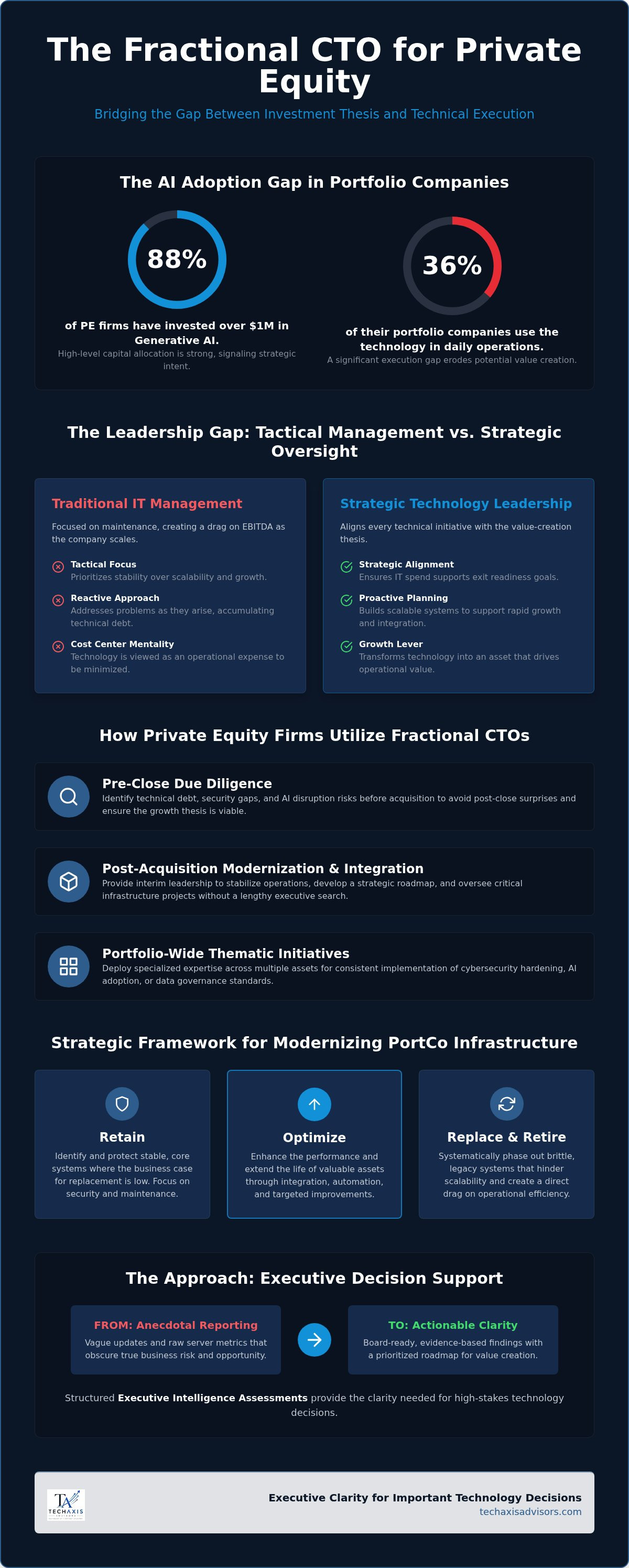
While 88% of private equity firms have invested over $1 million in generative AI as of 2026, only 36% of their portfolio companies actually use the technology in daily operations. This significant execution gap often stems from a lack of senior technology leadership capable of translating a value-creation thesis into a functional roadmap. It's the primary reason many firms now leverage a fractional CTO for private equity portfolio companies to secure executive-grade oversight without the overhead or search time required for a full-time hire.
You likely recognize that technical debt and misaligned IT spending can quietly erode EBITDA, turning a promising acquisition into a series of expensive infrastructure hurdles. It's a common frustration when technical initiatives don't move at the pace of the investment cycle or when security gaps appear post-close. This article examines how fractional technology leadership bridges the gap between acquisition and exit by aligning technical infrastructure with specific value-creation goals. We'll outline a roadmap for reducing execution risk, closing compliance gaps, and building a scalable operating model that ensures your portfolio assets are prepared for a successful exit.
Table of Contents
The Leadership Gap: Why Portfolio Companies Need Strategic Technology Oversight
Engagement Patterns: How Private Equity Firms Utilize Fractional CTOs
Fractional vs. Full-Time CTO: A Decision Framework for Operating Partners
Modernizing PortCo Infrastructure: The Strategic Framework for Growth
The TechAxis Approach: Executive Decision Support for Portfolios
The Leadership Gap: Why Portfolio Companies Need Strategic Technology Oversight
Mid-market portfolio companies often reach a critical inflection point where their existing IT infrastructure can no longer support the speed of a private equity investment cycle. Most of these organizations operate with a "Head of IT" or a director-level manager focused on tactical maintenance. While this keeps the lights on, it lacks the strategic depth required to drive a value-creation thesis. This leadership gap becomes a liability as the company scales. Bridging this divide requires a Fractional Executive Model, which provides the senior-level oversight necessary to transform technology from a cost center into a growth lever.
A fractional CTO for private equity portfolio companies moves the organization away from reactive IT support toward proactive executive leadership. Status quo management fails because it prioritizes stability over scalability. In a growth-stage environment, technology must be agile. It needs to integrate new acquisitions, automate manual processes, and provide the data transparency that operating partners demand. With 76% of private equity firms increasing their focus on technology as a lever for operational value creation in 2026, the need for specialized leadership is acute. Without this oversight, technical debt accumulates, creating a direct drag on EBITDA that often goes unnoticed until the exit process begins.
The Cost of Technical Execution Risk
Unmanaged technical debt is more than a coding issue; it's a financial risk. When infrastructure is brittle, major initiatives stall and execution risk rises. Many firms attempt to solve this by hiring large advisory groups, but they often encounter teams of inexperienced associates who lack the veteran perspective needed for high-stakes decisions. True executive clarity comes from seasoned leadership that understands how to prioritize remediation efforts based on business impact. You don't need more developers. You need a strategic architect who can identify which legacy systems to retain, optimize, or replace to ensure the hold period isn't consumed by technical friction.
Aligning Technology with the Value-Creation Thesis
Technology must serve the investment thesis. If the goal is a 3x return through operational efficiency, the technology roadmap must prioritize automation and data integration. A fractional CTO for private equity portfolio companies ensures that every dollar of IT spend directly supports these objectives. This alignment extends to reporting. Operating partners require evidence-based findings to track progress, yet many technical teams struggle to translate server metrics into board-ready intelligence. By establishing robust data foundations, a fractional leader creates a clear communication bridge between the technical staff and the Board, ensuring everyone is working toward the same exit readiness goals. For more on how we address these challenges, explore the problems we solve.
Engagement Patterns: How Private Equity Firms Utilize Fractional CTOs
Private equity firms deploy fractional technology leadership as a surgical instrument. Unlike a permanent hire, which can take six months to recruit, a fractional CTO for private equity portfolio companies can be on the ground within days. This speed is critical for pre-close due diligence. In 2026, 60% of PE firms have added specific diligence to assess AI disruption risk. A seasoned expert identifies these risks early, ensuring the investment committee isn't blindsided by legacy software that can't support the growth thesis.
Beyond the deal phase, these leaders provide interim stability. If a portfolio company loses its technical head, the fractional model prevents organizational drift. It ensures that major projects stay on track while the firm searches for a permanent replacement. In some cases, firms engage a single fractional leader to oversee thematic initiatives across multiple assets, such as a portfolio-wide AI uplift or cybersecurity hardening. This approach ensures consistency across the fund while leveraging specialized expertise that a single PortCo might not afford on its own.
Post-Acquisition Value Creation
The first 100 days post-close are pivotal for setting the tone of the investment. Strategic leaders focus on Unleashing Portfolio Value with Fractional Tech Leadership by embedding governance frameworks that the company likely lacked. This includes vetting vendor contracts and standardizing platform management to eliminate redundant spend. By directing digital transformation without the burden of a full-time executive salary, the firm preserves capital while accelerating modernization. It's about building a scalable operating model that supports the rapid growth expected by the Board.
Preparing for Exit Readiness
Exit readiness begins long before the teaser is sent. A fractional CTO's primary objective in the final 18 months of a hold is to de-risk the asset for the next buyer. They systematically clean up technical debt that would otherwise trigger a price chip during a buyer's diligence. This involves:
Standardizing data architecture to ensure reporting is transparent and verifiable.
Hardening security and compliance standards to meet the requirements of institutional or strategic buyers.
Documenting technical processes to ensure knowledge isn't trapped in the heads of a few key employees.
This structured approach ensures the technology story is a strength, not a liability, when the asset goes to market. If your current portfolio is struggling to meet these milestones, you can start a confidential executive conversation to explore your options.
Fractional vs. Full-Time CTO: A Decision Framework for Operating Partners
The financial reality of a permanent executive hire often conflicts with the lean operational mandates of a private equity hold. In 2026, the average base salary for a full-time CTO in a growth-stage company ranges from $200,000 to $300,000. When you factor in bonuses, equity, and benefits, the fully loaded cost frequently exceeds $550,000. For a mid-market portfolio company, this represents significant organizational weight. Choosing a fractional CTO for private equity portfolio companies allows operating partners to deploy senior talent without the long-term equity commitment or the six-month recruitment cycle typically required for a permanent search.
Execution speed is paramount. A permanent hire requires months of onboarding and cultural integration before they deliver tangible results. A seasoned fractional leader provides immediate impact. They arrive with a proven playbook for stabilizing technical debt and aligning infrastructure with the investment thesis. This speed ensures that value-creation initiatives begin in the first 100 days rather than being deferred until a search committee reaches a consensus. Misalignment is expensive, and a fractional model provides the flexibility to scale executive support up or down based on the specific needs of the portfolio lifecycle.
Comparing the Models
Analyzing the ROI requires looking beyond the monthly retainer. You must account for the opportunity cost of a delayed roadmap. If a permanent search takes six months, that's half a year of stalled progress. Fractional models operate on a predictable cost structure, often saving the company 50% to 70% compared to a full-time executive. This capital can be redirected into core modernization projects. Furthermore, fractional leaders don't require the "prestige" of a massive department. They focus on structural integrity and results-oriented execution rather than expanding their personal organizational footprint.
Executive Considerations for Mid-Market Firms
Determining the right model depends on the maturity of your existing technical team. If the company has capable developers who lack strategic direction, a fractional architect is the priority. If the organization requires day-to-day management of a 50-person department, a permanent hire may eventually be necessary. Understanding the role of a fractional CIO for mid-market companies helps determine if your priority is operational maturity or high-level roadmap design. A fractional leader often de-risks the eventual permanent hire by cleaning up the technical environment first. This ensures your future CTO enters a disciplined, high-performing organization rather than a chaotic one.
Modernizing PortCo Infrastructure: The Strategic Framework for Growth
Portfolio companies often face the dilemma of when to overhaul legacy systems. The default stance in many advisory circles is a wholesale replacement. This approach often destroys EBITDA without a guaranteed return. A fractional CTO for private equity portfolio companies takes a more disciplined approach. They evaluate infrastructure through the lens of the investment thesis. In regulated sectors like wealth management, this decision-making process is complicated by compliance requirements. You need a strategy that balances modernization with operational stability. This protects the bottom line while ensuring the technology remains an asset rather than a liability.
The Retain, Optimize, or Replace Methodology
We avoid the trap of assuming replacement is the only path. Instead, we utilize a structured framework to evaluate assets based on evidence-based findings. This methodology categorizes systems into six specific paths: retain, optimize, integrate, replatform, replace, or retire. This prevents "replacement for replacement's sake," which often introduces unnecessary execution risk during a short hold period. Every decision originates from structured Executive Intelligence Assessments. If a legacy platform is stable and supports current reporting needs, optimization or integration may offer a higher ROI than a disruptive replatforming project. This pragmatic focus ensures that capital is only deployed where it directly moves the needle on value creation.
AI Readiness for Private Equity Portfolios
As of 2026, the primary bottleneck for AI adoption in portfolio companies is data readiness. While investment in AI remains high across the industry, only 36% of portfolio companies use these tools in daily operations. A fractional leader bridges this gap by conducting an Executive AI Readiness Assessment. This process identifies high-impact automation use cases while establishing the governance to mitigate compliance risks. Identifying these opportunities early allows the firm to drive efficiency throughout the hold period. It also positions the asset as a modern, AI-enabled company for the next buyer.
Cybersecurity also acts as a critical value-protection mechanism. It isn't just a technical requirement; it's a prerequisite for institutional buyers. A fractional CTO for private equity portfolio companies ensures that security standards are hardened well before the exit process begins. This prevents last-minute price chips during buyer diligence. By standardizing security protocols across the portfolio, firms can demonstrate a level of operational maturity that attracts higher-quality bidders. This structured approach replaces organizational anxiety with a sense of controlled, disciplined progress.
The TechAxis Approach: Executive Decision Support for Portfolios
TechAxis Advisors delivers executive clarity for high-stakes technology decisions. We replace organizational ambiguity with a disciplined, evidence-based approach to leadership. Unlike traditional advisory firms that often stop at diagnosis, our fractional CTO for private equity portfolio companies provides a continuous bridge from initial assessment to execution oversight. We focus on the mechanics of scaling and the structural integrity of your portfolio assets. This ensures that technical decisions are always aligned with the financial objectives of the fund.
In 2026, our methodology relies on the proprietary Executive Intelligence Platform. This tool moves beyond the static, anecdotal reports typical of mid-market consulting. It provides a dynamic environment where findings are evidence-based and roadmaps are prioritized by business impact. This platform enables board-ready reporting that translates complex technical states into the operational metrics that CEOs and operating partners require. It provides the transparency necessary to hold teams accountable throughout the investment lifecycle.
Structured Executive Intelligence Assessments
We begin every engagement with structured Executive Intelligence Assessments. These are not basic technical audits. They are decision-support engagements designed to provide a clear path forward for legacy systems and growth initiatives. We deliver prioritized strategic roadmaps that categorize actions based on their impact on EBITDA and exit readiness. Every recommendation is traceable to specific business requirements. This level of detail ensures all findings are reviewed by veteran executives with over 25 years of experience in regulated industries like financial services and wealth management.
Independent Advisory and Governance
Independence is a core pillar of our advisory model. TechAxis Advisors remains vendor-neutral to ensure that our recommendations are objective and aligned solely with the client's interests. We don't perform direct implementations such as software builds or cloud migrations. Instead, we support execution through advisory leadership, governance, and vendor oversight. We leverage a network of qualified delivery partners to handle technical execution while we maintain the executive layer of accountability. This structure ensures that your technical initiatives are delivered on time and within the established budget. Explore our how we work page to see the engagement workflow.
Accelerating Exit Readiness through Strategic Oversight
Technology shouldn't be a friction point in your investment lifecycle. It's a lever for value. By utilizing a fractional CTO for private equity portfolio companies, you replace technical debt with a roadmap designed for exit readiness. We've examined how moving from diagnostic assessments to execution oversight ensures that your infrastructure supports the value-creation thesis. Our team of former CIOs, CTOs, and CISOs provides the executive clarity you need to make high-stakes decisions with confidence.
We leverage our proprietary Executive Intelligence Platform to deliver evidence-based findings that move beyond static reports. This disciplined approach provides the governance and transparency required in regulated industries like financial services. As a Certified Women-Owned Small Business (WOSB), TechAxis Advisors is committed to delivering objective, vendor-neutral advisory that protects your EBITDA. You don't have to navigate the transition from acquisition to exit alone.
Your portfolio's growth depends on disciplined execution and strategic alignment. We're ready to provide the leadership bridge your organization needs to succeed.
Frequently Asked Questions
What is the primary difference between a fractional CTO and a technical consultant?
A fractional CTO provides ongoing executive leadership and organizational accountability, whereas a consultant typically delivers a specific, time-bound project. The fractional role involves embedding within the C-suite to drive long-term strategy and oversee execution partners. Consultants focus on tactical audits or specific technical tasks. A fractional leader takes ownership of the technology roadmap and its alignment with the private equity value-creation thesis throughout the hold period.
How many hours per week does a fractional CTO typically dedicate to a portfolio company?
Engagements vary based on the portfolio company's complexity, but most fractional leaders dedicate 10 to 20 hours per week. This often translates to two or three days of focused executive oversight. This schedule allows the leader to maintain strategic momentum and provide high-level decision support without the cost of a full-time hire. The commitment can scale up during critical phases like pre-close diligence or major infrastructure migrations.
Can a fractional CTO help with technology due diligence before an acquisition?
Yes, a fractional CTO for private equity portfolio companies is frequently engaged to perform pre-close technology due diligence. They assess technical debt, security posture, and AI readiness to identify risks that could impact the acquisition valuation. This process ensures the investment committee has a clear, evidence-based understanding of the asset's structural integrity. Identifying these hurdles early allows for more accurate post-close integration planning and capital allocation.
Does a fractional CTO manage the internal IT team or outsourced vendors?
The fractional leader manages both internal technical teams and external vendors. They provide the necessary governance to ensure internal staff are aligned with the value-creation plan while holding outsourced providers accountable for performance. This oversight replaces organizational confusion with disciplined, results-oriented progress. By establishing clear KPIs and accountability structures, the fractional CTO ensures that all technical resources are working efficiently toward the same exit readiness goals.
What are the typical durations for a fractional CTO engagement in a PE context?
Engagements typically last from six months to the entire duration of the private equity hold period. Some firms utilize fractional leadership as an interim solution during a permanent executive search to prevent organizational drift. Others maintain the role until exit to ensure consistent strategic alignment and technical de-risking. The duration depends on the specific maturity of the technical team and the complexity of the modernization roadmap.
How does a fractional CTO handle cybersecurity risk and compliance?
A fractional CTO handles cybersecurity through executive governance and risk management frameworks. They ensure the company meets industry-specific compliance standards, particularly in regulated sectors like financial services, and oversee qualified delivery partners who implement security tools. This approach protects the asset's value and ensures it remains attractive to institutional buyers. They focus on structural integrity and transparency rather than just managing individual security alerts or software updates.
Is a fractional CTO responsible for writing code or software development?
No, a fractional CTO does not write code or perform direct software development. Their role is strictly focused on executive decision support, architectural oversight, and strategic roadmap design. They direct technical teams and development partners who handle the hands-on implementation. This ensures that the executive's time is spent on high-impact leadership and governance rather than getting bogged down in granular technical tasks that others can execute.
What deliverables should an operating partner expect from a fractional CTO?
Operating partners should expect board-ready deliverables, including prioritized strategic roadmaps and structured Executive Intelligence Assessments. These artifacts provide evidence-based findings on infrastructure health and AI readiness. Additionally, regular reporting on vendor performance and progress against the investment thesis ensures complete transparency for the Board. These deliverables replace anecdotal updates with data-driven insights that support the long-term goal of increasing the portfolio company's valuation before exit.



Comments