

Fractional CTO for Asset Management: Executive Guide
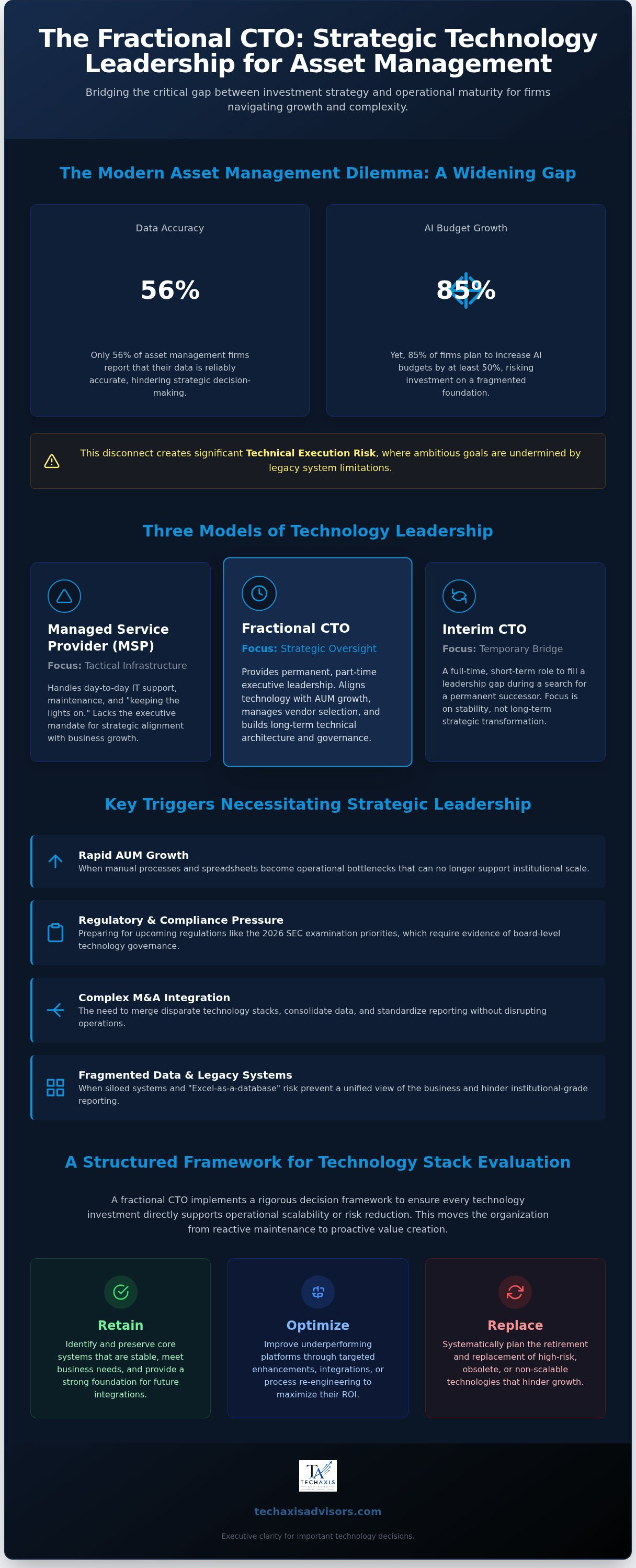
Only 56% of asset management firms report that their data is reliably accurate. This foundational gap persists even as 85% of firms globally plan to increase their AI budgets by at least 50% this year. For many leaders, the disconnect between ambitious growth targets and fragmented legacy systems creates a high level of technical execution risk. The missing link is often not more software, but the specialized leadership provided by a fractional CTO for asset management.
You likely recognize that your current technology stack feels more like a collection of silos than a unified engine for growth. The pressure to innovate while meeting the 2026 SEC Regulation S-P compliance deadline adds a layer of regulatory anxiety that many firms aren't prepared to handle alone. This guide demonstrates how a fractional CTO provides the strategic oversight and technical governance required to align your operations with institutional-grade growth. We'll examine a clear decision framework for building a technology roadmap that reduces operational risk, solves data fragmentation, and establishes the reporting foundations necessary to scale AUM with confidence.
Table of Contents
Defining the Part-Time Chief Technology Officer within Asset Management
Asset management firms often reach a threshold where technical complexity outpaces internal leadership. This isn't a failure of the existing team; it's a natural evolution of growth. A fractional cto for asset management provides the strategic bridge between investment goals and technical execution. Unlike a traditional hire, this leader focuses on high-impact governance and structural alignment rather than day-to-day troubleshooting. They bring the perspective of a veteran executive to firms that need senior-level wisdom without the $400,000 annual overhead of a full-time officer.
Fractional vs. Interim vs. Managed IT Services
Clarity in leadership roles is essential for board-level decisions. The Fractional executive model offers a permanent, part-time commitment to the firm's long-term strategy. This differs from interim management, which is typically a full-time, short-term bridge during a search for a permanent successor. Managed Service Providers (MSPs) fulfill a different need entirely. While MSPs handle tactical infrastructure and "keep the lights on," they lack the executive mandate to align technology with AUM growth or manage complex vendor selections. A fractional CTO provides the independent oversight that an MSP cannot, ensuring that technology serves the business rather than the other way around.
The Asset Management Technical Context
Generic technology advice fails in the buy-side environment. Asset managers face unique pressures, from consolidating fragmented data across legacy systems to managing the "Excel-as-a-database" risk. As firms scale, manual workarounds in spreadsheets become liability points that hinder institutional-grade reporting. A fractional cto for asset management addresses these risks by establishing a unified data foundation. This work involves more than just software selection. It requires building a technical architecture that supports complex third-party integrations and proprietary investment models. The objective is to move the organization from a reactive state of maintenance to a proactive state of strategic value creation.
The core mandate of this role is the rigorous alignment of technology spend with business outcomes. Every dollar invested in the stack must directly support operational scalability or risk reduction. This executive-level oversight ensures that the firm is prepared for the 2026 SEC examination priorities, where evidence of board-level technology governance is now a requirement. By focusing on structural integrity, the fractional CTO transforms technology from a back-office expense into a scalable asset.
Strategic Alignment: Moving from Tactical IT to Executive Advisory
Technology decisions often happen in a vacuum, detached from the firm's AUM growth targets. This disconnect creates an execution gap where expensive tools fail to deliver measurable ROI. A fractional cto for asset management shifts the focus from managing hardware to architecting outcomes. Instead of asking which tool to buy, the conversation starts with the business goal. This approach identifies hidden operational bottlenecks that prevent your team from scaling effectively.
Communication is the primary failure point in technical projects. C-suite leaders speak the language of risk and return, while technical teams focus on features and uptime. A fractional partner acts as a translator. They provide the executive clarity needed to ensure every technical project has a clear business owner and a defined success metric. This leadership ensures that technology serves as a growth lever rather than a recurring expense. You can start with a confidential executive conversation to identify where these gaps exist in your current structure.
Building a Modern Data and Reporting Strategy
Data accuracy remains a significant hurdle, with only 56% of firms reporting reliable figures as of August 2026. A fractional leader moves beyond manual reconciliations to build a unified Data Strategy for Asset Managers. This framework ensures that executive leadership has access to real-time business intelligence rather than delayed reports. By modernizing the underlying architecture, the firm can support institutional-grade reporting that satisfies both clients and regulators.
AI Readiness and Governance in Financial Services
With 70% of investment management firms deploying AI in front-office operations, the risk of uncoordinated adoption is high. Pragmatic AI implementation requires a robust IT governance strategy to manage data privacy and regulatory boundaries. A fractional cto for asset management evaluates high-impact automation use cases specifically for the mid-market, ensuring that innovation doesn't compromise compliance. This involves creating an AI in Financial Services roadmap that prioritizes security and traceability over experimental pilots.
Evaluation Framework: When to Hire a Part-Time CTO
Determining the right time to engage a fractional cto for asset management requires a cold-eyed assessment of your firm's growth trajectory. Certain trigger events signal that technical debt is no longer manageable through tactical IT support. Rapid AUM growth often stresses internal systems to the point of failure. M&A activity introduces complex integration challenges that require executive-level oversight. If your firm is facing legacy system instability or struggling to meet the June 2026 SEC Regulation S-P compliance deadline, the need for leadership is immediate.
Instead of defaulting to a total system overhaul, a fractional leader applies a disciplined framework: retain, optimize, integrate, replatform, replace, or retire. This approach evaluates the business case for each technical asset. It prevents the common error of replacing a functional system simply because it feels dated. By focusing on the business outcome, you ensure that every technology decision supports the long-term AUM strategy without unnecessary capital expenditure.
The ROI of Fractional Technology Leadership
Execution risk is the primary threat to mid-market asset managers. High-stakes software implementations often fail due to a lack of senior governance. A fractional CTO reduces this risk by providing independent vendor oversight. They ensure that platform selection is based on traceability and evidence rather than a vendor's marketing claims. This prevents the "sunk cost" of investing in tools that don't align with your data architecture. You gain access to a veteran executive with over 25 years of experience without the $400,000 to $550,000 annual overhead of a full-time CTO hire.
Identifying Organizational Readiness
Your firm may have outgrown its current structure if reporting delays are standard and manual reconciliations are the norm. These are symptoms of a low-maturity operating model. The role of a CTO is critical in improving operational maturity across the enterprise. Transitioning from an initial executive decision-support engagement to embedded fractional leadership allows for a structured transformation. This ensures that the foundation is stable before you layer on advanced capabilities like AI or automated portfolio optimization. Selecting a fractional cto for asset management provides the leadership bridge necessary to move from reactive maintenance to disciplined, institutional-grade growth.
Reducing Execution Risk: Governance and Vendor Oversight
Execution risk remains the primary cause of failed digital initiatives in the buy-side environment. Many firms accumulate unmanageable technical debt because they prioritize speed over structural integrity. A fractional cto for asset management establishes the governance frameworks necessary to prevent these costly missteps. This involves more than just a technical audit. It's a structured approach to risk management that ensures every software project aligns with long-term operational scalability and the firm's AUM growth targets.
Technology Due Diligence and Compliance
The regulatory environment for 2026 has elevated technology governance to a fiduciary duty. Smaller registered investment advisers must meet the SEC's amended Regulation S-P requirements by June 3, 2026. These mandates require written incident response programs and clear customer notification procedures for data breaches. A fractional leader ensures your firm can demonstrate board-level oversight during SEC examinations. They provide the evidence-based documentation required for a Technology Due Diligence Guide that satisfies both institutional investors and regulators.
Vendor Management Strategy for Leadership
Independence is critical during platform selection. A fractional partner provides the objective oversight needed to avoid vendor lock-in. They evaluate third-party platforms based on their ability to integrate with your existing data architecture rather than their marketing promises. This is especially vital when overseeing custom software development. By managing delivery partners through a qualified lens, a fractional CTO ensures that global projects meet their milestones without ballooning costs. This strategic architecture keeps the firm agile and prevents the accumulation of unmanageable technical debt that often plagues growth-stage managers.
Effective oversight requires a leader who understands the mechanics of technical execution. It isn't enough to select a vendor; you must actively govern the implementation process. This involves setting clear performance benchmarks, managing the delivery partner's roadmap, and ensuring the final product meets the firm's specific reporting requirements. A fractional cto for asset management acts as your internal advocate, holding external partners accountable to the agreed-upon standards. This disciplined approach replaces organizational anxiety with a sense of controlled, evidence-based progress.
The TechAxis Perspective: Evidence-Based Executive Clarity
TechAxis Advisors provides the senior-level perspective required to bridge the gap between investment strategy and technical maturity. We don't rely on abstract theory or generic frameworks. Instead, we use a proprietary Executive Intelligence Platform to deliver structured diagnostics and evidence-based findings. This platform provides the traceability needed for board-level decisions, ensuring that every recommendation is rooted in verifiable data rather than subjective opinion. By focusing on the mechanics of scaling, we move firms from a state of organizational anxiety to a state of disciplined, controlled progress.
The Trusted Advisor Model
Selecting a fractional cto for asset management should involve more than just technical proficiency. Our leadership team consists of former CIOs, CTOs, and CISOs with over 25 years of experience specifically within financial services. This background allows us to maintain executive clarity during periods of rapid change or complex M&A activity. Generic consultants often lack the industry-specific "operating scars" required to navigate the complexities of buy-side data and regulatory requirements. We focus on producing board-ready deliverables and prioritized roadmaps that provide a clear path to institutional-grade growth.
Our commitment to independent, business-aligned advisory means we don't have a bias toward specific software vendors. We evaluate the business case for each technical asset using the "retain, optimize, integrate, replatform, replace, or retire" framework. This ensures that your technology spend is always a growth lever rather than a recurring expense. You gain the wisdom of a veteran executive who is deeply invested in the mechanics of your success, providing the necessary leadership bridge that a growing firm might be missing.
Next Steps for Executive Leadership
Determining the right path for your firm depends on the maturity of your current operating model and the urgency of your growth targets. Your priority might require a structured Executive Intelligence Assessment to identify immediate risks, or you may need embedded fractional leadership to oversee a multi-year digital transformation. We support execution through advisory leadership, governance, vendor oversight, and coordination with qualified delivery partners. You can explore our Advisory Leadership approach to see how we align technology with your AUM goals.
The first step is a confidential executive conversation to define your specific challenges. Whether you're addressing fragmented data or preparing for the 2026 SEC examination priorities, we provide the independent oversight necessary to reduce execution risk. Our goal is to provide the executive clarity required to move from identifying a problem to mastering a solution without unnecessary technical overhead.
Securing Your Technical Foundation for AUM Growth
Institutional-grade scaling requires more than just adding software; it demands a disciplined alignment of technology with business outcomes. You've seen how identifying hidden operational bottlenecks and establishing a unified data strategy can transform technology from an expense into a growth lever. By implementing robust governance and independent vendor oversight, your firm can meet the 2026 SEC regulatory deadlines while reducing technical debt.
TechAxis Advisors brings evidence-based clarity to these complex decisions. Our leadership team consists of former CIOs and CTOs with over 25 years of experience in financial services. As a WOSB and MWBE Certified firm, we use a proprietary Executive Intelligence Platform to provide the traceability your board requires. Engaging a fractional cto for asset management ensures that your technology roadmap doesn't just keep the lights on, but actively supports your growth targets.
We look forward to helping you build a more resilient and scalable technical operating model.
Frequently Asked Questions
What is the difference between a fractional CTO and a part-time IT consultant?
A fractional CTO provides ongoing executive leadership and strategic alignment, whereas a part-time IT consultant typically focuses on specific tactical projects or technical troubleshooting. The CTO role is integrated into the C-suite, participating in board-level decisions and long-term planning. They ensure technology investments directly support AUM growth. In contrast, consultants often lack the mandate to oversee firm-wide governance or manage the broader technical operating model over an extended period.
How many hours a week does a fractional CTO typically work for an asset manager?
Most engagements range from five to fifteen hours per week, depending on the complexity of the firm's infrastructure and growth objectives. The focus remains on high-impact strategic windows rather than total hourly volume. A fractional cto for asset management provides the necessary oversight without the $400,000 annual overhead of a full-time executive. This flexible model allows firms to scale leadership intensity during critical periods, such as M&A activity or major platform migrations.
Can a fractional CTO help with SEC and regulatory compliance?
Yes, providing technical governance for SEC and regulatory compliance is a core responsibility. This includes preparing for the June 3, 2026, Regulation S-P deadline and managing the SEC's cybersecurity incident reporting mandates. The CTO establishes written incident response programs and ensures data classification inventories meet examination priorities. By elevating cybersecurity to a board-level responsibility, they help the firm fulfill its fiduciary duty while reducing the risk of regulatory sanctions or material data breaches.
Does a fractional CTO manage our internal IT staff or MSP?
A fractional CTO provides independent oversight of both internal IT staff and Managed Service Providers (MSPs). They don't replace these teams; they ensure their activities align with the firm's strategic business goals. By setting clear KPIs and governance frameworks, the CTO holds vendors accountable for performance and security. This leadership bridge prevents tactical teams from operating in a vacuum, ensuring that infrastructure maintenance supports institutional-grade reporting and operational scalability.
What is the typical duration of a fractional CTO engagement?
Typical engagements last between six and eighteen months, though many firms retain fractional leadership indefinitely to avoid full-time executive costs. Short-term engagements often focus on specific transitions, such as navigating a legacy system failure or preparing for an acquisition. Longer-term partnerships provide the continuous technical governance required for sustained AUM growth. The duration is always determined by the firm's specific needs, moving from initial assessment to embedded execution leadership as priorities evolve.
How do you measure the ROI of fractional technology leadership?
ROI is measured through reduced execution risk in software projects and the avoidance of technical debt. By preventing improper platform selection and "sunk cost" investments, a fractional leader saves the firm significant capital. Additional metrics include improved data accuracy for reporting and faster integration of acquired assets. Quantifying the value of senior executive access at 50% to 70% less than a full-time hire provides a clear financial justification for the model.
Can a fractional CTO oversee custom software development projects?
Yes, they manage the business case and technical architecture for custom software by overseeing qualified delivery partners. The fractional cto for asset management ensures that development projects don't suffer from scope creep or misaligned objectives. They act as the firm's internal advocate, holding external developers to high standards of transparency and accountability. This oversight reduces the high technical execution risk often associated with building proprietary investment tools or complex data integrations.
Is a fractional CTO suitable for private equity-backed portfolio companies?
This model is highly suitable for private equity-backed firms that must rapidly improve operational maturity before an exit. Fractional leaders provide the "Strategic Architect" persona required to professionalize technology stacks and consolidate fragmented data. They ensure the portfolio company is ready for due diligence by establishing robust governance and scalable architectures. This approach allows PE firms to drive value creation across multiple holdings without committing to permanent, high-cost executive headcounts at each location.



Comments