

Fractional CTO Engagement Models: How to Choose the Right Structure
The right fractional CTO engagement isn’t necessarily the one with the most hours. It’s the structure that closes a specific decision or execution gap. That’s the practical question behind comparing fractional CTO engagement models: do you need a focused assessment, ongoing strategic counsel, or an executive leader involved in continuing priorities?
Senior technology guidance can help leadership make informed choices without leaving decisions ownerless or recommendations disconnected from execution. A defined assessment clarifies options and priorities. Retained advisory provides continuing counsel. Embedded leadership adds a more active role in governance and execution.
This article compares the models by business need, decision cadence, and execution ownership. It also explains what to define before work begins, including scope, decision rights, deliverables, internal responsibilities, and measures of progress. The goal isn’t to default to the most intensive structure. It’s to choose the level of leadership your priorities require.
Table of Contents
When Does a Fractional CTO Engagement Model Address a Real Leadership Gap?
Three Fractional CTO Engagement Models, and What Each Produces
Define Scope, Decision Rights, and Deliverables Before Work Begins
Choose a Fractional CTO Model Using Your Decision and Execution Needs
How TechAxis Connects Executive Assessment to Fractional CTO Leadership
When Does a Fractional CTO Engagement Model Address a Real Leadership Gap?
Start with the leadership gap, not the contract. Is the organization facing a specific technology decision that needs evidence and executive judgment, or does it need an accountable leader to guide work over time? The answer points to support concentrated around a decision, maintained as counsel, or embedded in ongoing leadership.
An engagement model is the defined combination of scope, authority, cadence, and accountability. It sets what a fractional CTO will address, which decisions they can make, how often they participate, and who owns follow-through.
Growth can expose gaps in technology oversight. Modernization can require choices across systems, vendors, and teams. AI adoption raises questions about readiness and governance. A transformation initiative may need sustained leadership rather than occasional input. Let the work determine the level of support, rather than assuming every organization needs the same arrangement. The overview of a fractional executive offers context on how this role differs from a conventional full-time appointment.
Which leadership gap are you trying to close?
First separate a bounded decision from an ongoing leadership need. If executives need an evidence-based view of a platform choice, technology priorities, or a proposed investment, a focused decision-support engagement may fit. If they need recurring counsel to connect technology choices with business strategy and risk tolerance, retained advisory may be more appropriate.
For an initiative requiring regular prioritization, governance, and coordination, determine whether someone must lead across its lifecycle. Map current responsibilities before adding support. An internal technology lead might own delivery and team operations while an executive partner provides strategic direction, challenges assumptions, and escalates decisions. The goal is to complement existing capability, not create parallel authority.
What should a fractional engagement not be expected to solve?
A fractional CTO provides executive direction. The role should not automatically be treated as an extra developer or a general IT operations team. Strategy, architecture choices, vendor oversight, and delivery capacity are related but distinct responsibilities. Define who recommends, who approves, who manages implementation, and which internal teams or delivery partners carry the work forward.
Be explicit about the boundaries. If hands-on implementation is part of the need, name the required capacity and ownership in the scope rather than assuming executive availability will supply it. If systems require urgent, continuous operational oversight or daily firefighting, a part-time leadership arrangement may not provide the necessary coverage. That need may call for a different staffing structure. Clear boundaries help executives select among fractional CTO engagement models based on the gap they actually need to close.
Three Fractional CTO Engagement Models, and What Each Produces
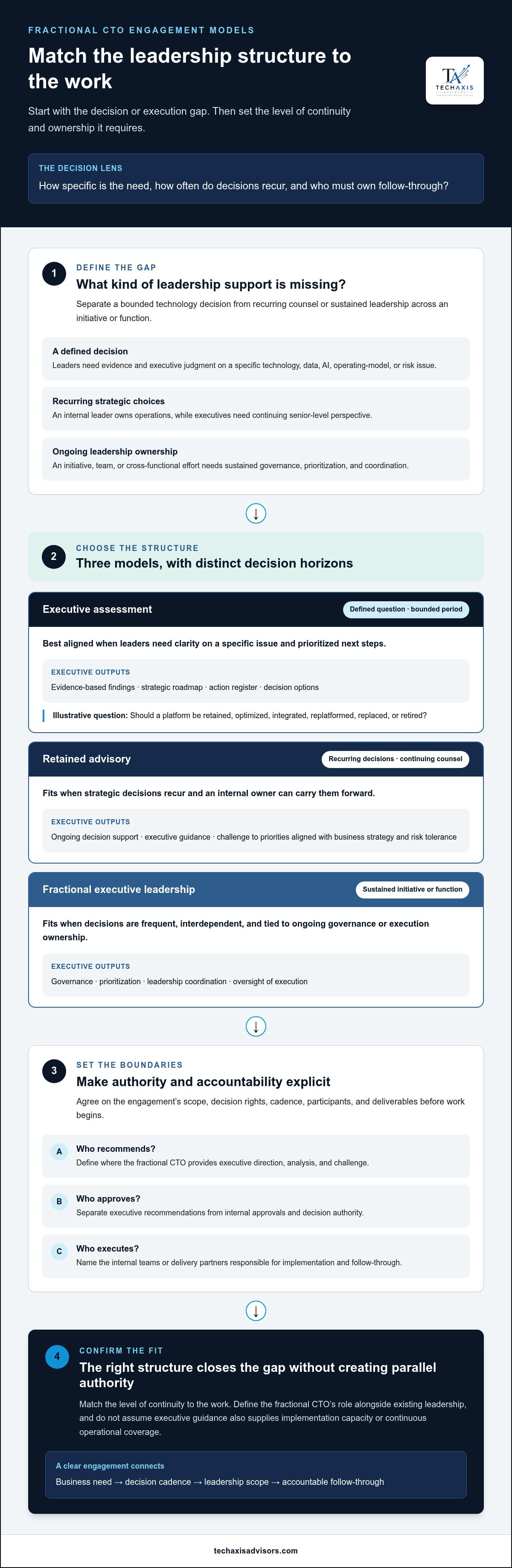
The models differ less by title than by the work they authorize and the decisions they support. An executive assessment produces a bounded analysis. Retained advisory provides continuing counsel. Fractional leadership adds an embedded executive role across governance and execution. These distinctions help prevent a diagnostic from being mistaken for implementation, or an advisor from being treated as the accountable delivery owner.
The comparison below focuses on decision horizon and expected outputs. Agree on the specific scope and cadence before work begins.
Executive assessment: a defined decision-support engagement
An assessment examines a specific question, such as whether a platform should be retained, optimized, integrated, replatformed, replaced, or retired. It may also evaluate data readiness, AI adoption, operating structure, or technology risk. The purpose is executive decision support, not an automatic commitment to implementation. Board-ready findings, a strategic roadmap, and an action register give leaders a basis for deciding what happens next.
Retained advisory or embedded fractional leadership?
Retained advisory fits when decisions arise periodically and an internal owner can carry them forward. Embedded leadership fits when decisions are frequent, interdependent, and tied to sustained governance or execution ownership. A role overview, such as Fractional CTO Meaning and Role, can help distinguish fractional responsibility from full-time or interim leadership. For organizations that need the embedded model, fractional CTO leadership connects executive direction with governance and execution oversight.
These fractional CTO engagement models can also form a sequence rather than a permanent choice. An assessment may clarify the mandate; advisory can support ongoing decisions; embedded leadership can provide accountability when execution requires it. Start with the least intensive structure that still gives the work clear executive ownership.
Define Scope, Decision Rights, and Deliverables Before Work Begins
A fractional CTO engagement needs a working agreement that translates executive priorities into clear responsibilities. Without one, an advisor may be expected to approve decisions they can only recommend, or a leader may be held accountable for delivery without control over the people or resources involved. Document the operating boundaries before work starts.
What belongs in a practical engagement charter?
Keep the charter concise enough to use in governance discussions. Identify the business outcome, technology domains in scope, decisions the engagement will support, and forums where those decisions are made. Define the reporting cadence and an escalation route for issues that cannot wait until the next review.
Assign responsibilities by role, not assumption. Name an executive sponsor, an internal technology owner, and the stakeholders responsible for implementation. Record expected outputs and how vendor oversight, governance, and qualified delivery partners fit into the work.
Objectives: State the business priority and the decision or operating need the engagement addresses.
Authority: Distinguish recommendations from approvals, delegated decisions, and executive sign-off.
Participants: Identify the sponsor, internal owner, decision-makers, and delivery stakeholders.
Cadence: Set working sessions, executive reviews, reporting, and escalation expectations.
Outputs and boundaries: Specify deliverables, what is out of scope, and who owns delivery work.
For example, if vendor selection is in scope, state whether the fractional CTO will define evaluation criteria, assess proposals, recommend a direction, or oversee the selected vendor. These are distinct responsibilities. A structured executive engagement moves from assessment to prioritized actions and gives leaders a clear basis for decisions.
How should leaders define evidence of progress?
Choose measures that reflect the mandate rather than applying universal benchmarks. For a decision-support engagement, evidence might include documented options and tradeoffs, along with a decision record. For an initiative, it might include roadmap milestones, assigned owners, visible risks, or established governance routines. These measures show whether the engagement is producing the outputs leadership authorized.
Record the starting position first. If the goal is clearer ownership, document current roles and unresolved decisions. If it is improved risk visibility, establish what information leaders receive today and which gaps need attention. Review progress at an agreed cadence, and revise measures if business priorities or scope change.
Measurable engagement outcomes should reflect the scope leadership agreed to, not a universal scorecard imposed after work begins. This makes accountability fair and helps distinguish a delivery delay from an unclear mandate or a decision awaiting executive approval.
Before finalizing any of the fractional CTO engagement models, leaders can discuss the right engagement structure in light of the decisions, authority, and delivery ownership the organization needs.
Choose a Fractional CTO Model Using Your Decision and Execution Needs
Use a decision sequence rather than starting with a preferred schedule. Align executive support with the question at hand, the continuity required, and the person accountable for moving work forward. Continuity depends on an agreed cadence, clear authority, and named internal ownership, not simply on the number of days someone is present.
Define the decision. Identify the choice leadership must make and the evidence it needs.
Assess continuity. Determine whether the need is bounded, recurring, or sustained across an initiative.
Assign ownership. Name who approves decisions, leads internal work, and coordinates delivery.
Match the engagement. Select an assessment, advisory, or embedded leadership structure that fits those conditions.
Use the criteria below to compare the available fractional CTO engagement models:
Match common executive situations to an engagement structure
If leaders need to determine whether an existing platform should be integrated with another system or replaced, a defined assessment can organize the evidence and tradeoffs. If technology choices arise repeatedly but an internal leader owns delivery, retained advisory can provide counsel. If a transformation requires sustained prioritization, governance, and coordination, embedded leadership may better fit the mandate.
Check organizational readiness before committing
Before selecting a structure, confirm that executives agree on priorities and risk tolerance, and that the sponsor can make or escalate decisions. Identify internal delivery owners and dependencies involving vendors or qualified partners. Organizations that need executive technology oversight alongside existing teams can benefit from fractional technology leadership. For software initiatives, separate executive direction from build and implementation ownership so neither is assumed to cover the other.
Readiness is a practical test. If leaders cannot agree on the intended outcome or identify who will act on decisions, settle those responsibilities before increasing the engagement’s scope. That preparation gives the chosen model a workable basis for continuity and accountability.
How TechAxis Connects Executive Assessment to Fractional CTO Leadership
An assessment can clarify what leaders should decide next. TechAxis Advisors connects structured diagnostic work to executive assessment and intelligence synthesis, then uses the findings to shape a strategic roadmap. Leadership can then determine whether internal teams can take the work forward, continuing counsel would help, or the priorities call for embedded executive leadership.
This sequence creates a choice, not an automatic commitment to a longer engagement. The appropriate next step depends on the decisions ahead, the organization’s capacity to act, and the level of governance required to maintain progress.
What leaders can expect from the assessment pathway
An Executive Technology Assessment is an executive decision-support engagement, not simply a technical audit. Its focus is tailored to the leadership question, which may involve technology priorities, operating structure, data, AI readiness, or risk. The assessment frames the issue in business terms so executives can evaluate options and decide which priorities warrant action.
TechAxis Advisors founder Aarati Dikshit brings more than 25 years of CIO, CTO, and CISO executive experience to the firm’s advisory work. That perspective informs how assessment findings are interpreted for leadership review and connected to business priorities.
Move from findings to the right level of ongoing support
After reviewing the assessment, leaders can identify which decisions remain, who should own them, and whether additional executive involvement would help. If internal leaders can carry the work forward, the organization may proceed without ongoing fractional leadership. If strategic choices continue to arise, retained counsel can support decision-making. If priorities depend on sustained governance and coordination, embedded leadership may be appropriate.
Execution support can include advisory leadership, governance, vendor oversight, and coordination with qualified delivery partners. The engagement should make clear which responsibilities remain with internal teams and which require executive oversight. That clarity helps turn findings into accountable next steps without blurring implementation ownership.
For organizations weighing ongoing counsel against embedded responsibility, executive advisory and leadership support connects the level of technology leadership to the work ahead. A confidential executive conversation can help clarify the decision and support structure that fits your priorities.
Make the Next Technology Decision Easier to Own
The structure you choose should reflect what leadership needs to decide now and how the organization will carry that decision forward. Treat the engagement as a deliberate operating choice, not a permanent label. As priorities evolve, revisit whether the agreed scope and responsibilities still fit.
Before moving ahead, capture the immediate business priority, the decision it requires, and the executive sponsor who can keep it moving. That preparation gives your leadership team a clearer basis for discussing fractional CTO engagement models and defining an appropriate next step.
A focused mandate helps turn an important technology decision into work your organization can own and advance.
Frequently Asked Questions
Is a fractional CTO the same as an interim CTO?
No. The terms often describe different arrangements, though titles alone don’t define the role. An interim appointment generally signals temporary coverage of a leadership position, while fractional leadership usually means executive involvement allocated across an organization’s needs. These distinctions aren’t universal definitions. Before work begins, document the expected duration, decision authority, responsibilities, and reporting relationships so executives and internal teams understand how the role operates.
Can a fractional CTO work alongside an internal technology leader?
Yes. A fractional CTO can complement an internal CTO, CIO, or technology director when the remit is distinct. For example, the external executive might advise on a transformation’s governance while the internal leader manages delivery and team operations. Overlapping authority can slow decisions, so specify who recommends, approves, communicates decisions, and follows through. Give the internal leader a clear route to raise conflicts or seek executive resolution.
Does a fractional CTO write production code?
Not necessarily. Executive leadership should not be presumed to replace a senior developer. A fractional CTO may set technical direction, review architectural choices, and guide a delivery team without personally writing production software. If coding is part of the engagement, define the tasks, time allocation, review process, and responsibility for maintaining the software after delivery.
How many hours does a fractional CTO work each week?
There’s no single weekly schedule that suits every organization. Required involvement depends on how often decisions arise, the governance forums involved, stakeholder access, and the level of execution oversight expected. Define availability around the responsibilities in scope, including meeting cadence and how urgent decisions are handled. Review whether that rhythm remains adequate as priorities, dependencies, or organizational needs change.
How long should a fractional CTO engagement last?
Engagement length should reflect the work, not an assumed standard term. A defined assessment can conclude once its agreed outputs are delivered and reviewed. Ongoing counsel or embedded leadership may need periodic review as priorities and responsibilities evolve. Set review points, continuation criteria, and transition responsibilities at the outset. These terms make fractional CTO engagement models easier to adjust without leaving decisions, relationships, or active work without an accountable owner.
How should a board evaluate progress in a fractional CTO engagement?
Review progress against the agreed scope and baseline, using evidence such as roadmap milestones, decision records, risk visibility, and named action owners. Keep recommendations distinct from completed implementation and business outcomes, which can depend on internal capacity and other factors. A concise reporting rhythm helps directors see what has advanced, what is blocked, and which decisions require attention without implying that one advisor controls every result.



Comments