

Fractional CTO Consulting for Wealth Management: A 2026 Executive Framework
For a growth-stage firm, a fractional CTO for wealth management is not a technical resource. They are a strategic architect who builds the operational foundation required for sustained AUM growth. You likely recognize that your current technology stack, often a fragmented collection of CRM, portfolio management, and reporting tools, is no longer keeping pace with your business goals. The pressure is mounting as the June 3, 2026, SEC Regulation S-P compliance deadline approaches and AI governance becomes a board-level mandate.
We agree that the gap between high-level strategy and technical execution is often where growth stalls. This guide provides an objective framework for leaders to evaluate, select, and leverage specialized leadership to drive operational maturity and reduce execution risk. We will examine how to align technology spend with business outcomes, manage inconsistent vendor performance, and establish a scalable operating model that respects both regulatory requirements and your firm's bottom line.
Table of Contents
The Evolution of Technology Leadership in Wealth Management
Wealth management technology has moved past the era of the "cost center." In 2026, firms that view IT as a mere utility are losing market share to competitors who treat technology as a growth multiplier. This shift requires more than just technical support; it demands executive leadership that can align platform capabilities with business objectives. Many firms rely on Managed Service Providers (MSPs) for their daily needs, but MSPs are fundamentally designed for maintenance, not strategy. They lack the mandate to oversee your data ecosystem or guide your firm through complex digital transformations.
The rise of a fractional executive model allows firms to access this high-level leadership without the overhead of a full-time hire. A fractional CTO for wealth management bridges the gap between your vision and your technical reality. They bring discipline to a fragmented tech stack, ensuring that your CRM, portfolio management, and reporting tools work in concert rather than in isolation. This level of oversight is essential as firms move away from siloed systems toward unified, cloud-based platforms that provide a holistic view of both public and private market assets.
The Gap Between Strategy and Execution
CEOs frequently report a sense of disconnection from their technical roadmaps. Without a dedicated leader, firms often fall into the trap of "random acts of technology." This involves purchasing software to solve isolated problems without considering the broader architecture. This lack of oversight creates technical debt and operational friction. High enterprise value is rarely built on top of a broken foundation. Instead, operational maturity is the direct result of deliberate, executive-level technology governance that aligns every dollar of IT spend with a specific growth outcome.
2026 Regulatory and Cybersecurity Pressures
The regulatory environment has become significantly more demanding. The SEC's June 3, 2026, deadline for amended Regulation S-P requires firms to have documented incident response programs and strict customer data protection protocols. Cybersecurity is no longer a back-office concern; it's a board-level strategic priority. Additionally, firms must manage massive vendor sprawl. A recent Fidelity survey indicated that more than two-thirds of wealth management firms are already using Generative AI, yet many lack the governance frameworks to manage the associated risks. A fractional CTO for wealth management ensures your firm meets these standards while leveraging AI to drive the 25% to 40% productivity gains projected for the sector. You can explore how these leadership roles function within our technology advisory services.
What is a Fractional CTO for Wealth Management?
A fractional CTO for wealth management is an embedded executive who provides strategic leadership, governance, and transformation support on a retained basis. Unlike a traditional consultant who often delivers a static report and exits, a fractional CTO leads from within the organization. They assume accountability for technical outcomes. This role is designed for growth-stage firms that require senior-level expertise to manage complex digital transformations but don't yet require a full-time executive. It's a pragmatic solution for balancing high-level oversight with cost efficiency.
This model aligns with the TechAxis Advisory Leadership framework, where the focus remains on business-aligned technology decisions. The fractional CTO acts as a "Strategic Architect." They don't just fix broken systems; they build technical roadmaps that support AUM growth. They ensure that every investment in the tech stack is a deliberate step toward operational maturity. By bridging the gap between business goals and technical execution, they replace organizational confusion with a sense of controlled, disciplined progress.
Key Responsibilities in a Financial Context
The primary duty involves designing and overseeing a technology operating model that scales with the firm. This includes creating AI strategy and governance frameworks that meet 2026 compliance requirements. It also involves rigorous vendor and platform management. In a sector where fragmented data across custodians is the norm, the fractional CTO ensures interoperability across your CRM, portfolio management, and reporting tools. They turn a collection of siloed products into a cohesive ecosystem that improves advisor productivity.
Executive Clarity vs. Technical Jargon
Board members don't need to understand the mechanics of API integrations. They need to understand how those integrations impact the firm's risk profile and operational efficiency. A fractional CTO for wealth management translates technical complexity into "board-ready" decisions. They provide evidence-based findings through structured assessments, ensuring that technology investments remain anchored to the firm's specific risk tolerance and business objectives.
This level of governance is critical given the rigorous standards set by the Cybersecurity and Infrastructure Security Agency (CISA) for the financial services sector. By maintaining a professional distance and an executive perspective, these leaders help firms move from technical anxiety to strategic mastery. If you're ready to bridge the gap between your business strategy and technical execution, start a confidential executive conversation to explore how fractional leadership fits your firm's goals.
An Executive Decision Framework for On-Demand CTO Consulting
Decisions regarding technology leadership shouldn't be based on sentiment. They require an objective analysis of your firm's current scale and future trajectory. Many CEOs struggle to determine when a full-time hire is justified versus when it is premature. Research indicates the fully-loaded cost of a full-time CTO in 2026 ranges from $270,000 to over $550,000 annually. For many growth-stage firms, this is a heavy burden that diverts capital from core client acquisition. A fractional CTO for wealth management can be 50% to 70% more cost-effective while providing the same level of strategic oversight found at the enterprise level.
Leaders must also weigh the value of boutique advisory expertise against the significant brand premiums charged by global strategy firms. Large firms often assign junior staff to wealth management engagements, leading to generic advice that lacks practical execution. In contrast, a fractional model provides direct access to veteran executives who have successfully managed the mechanics of scaling. This approach focuses on risk mitigation and tangible ROI rather than abstract theory. You can see how this model fits different firm profiles by reviewing who TechAxis is for.
Comparing Leadership Models
Determining the right fit depends on your AUM and operational complexity. A full-time CTO is typically necessary when your organization reaches a scale where technology strategy requires 40+ hours of executive attention every week. Conversely, a fractional CTO for wealth management is ideal for firms with $1B to $10B in AUM that need strategic oversight without the full-time overhead. While Managed IT (MSP) services are suitable for tactical support and maintenance, they lack the business alignment required to turn technology into a growth multiplier.
Assessing Your Current Operational Maturity
Scalability is often hindered by technical debt, which is the accumulated cost of previous quick-fix solutions. If your current leadership lacks the capacity to manage a major digital transformation, your execution risk increases. You must evaluate whether your existing team can handle the 2026 regulatory environment and the nuances of platform integration. Understanding when a growth company needs a fractional CTO is the first step toward moving from organizational anxiety to disciplined, evidence-based progress. This framework ensures your technology investments are always anchored to your firm's specific risk tolerance and growth objectives.
Modernizing Wealth Tech: The TechAxis Perspective
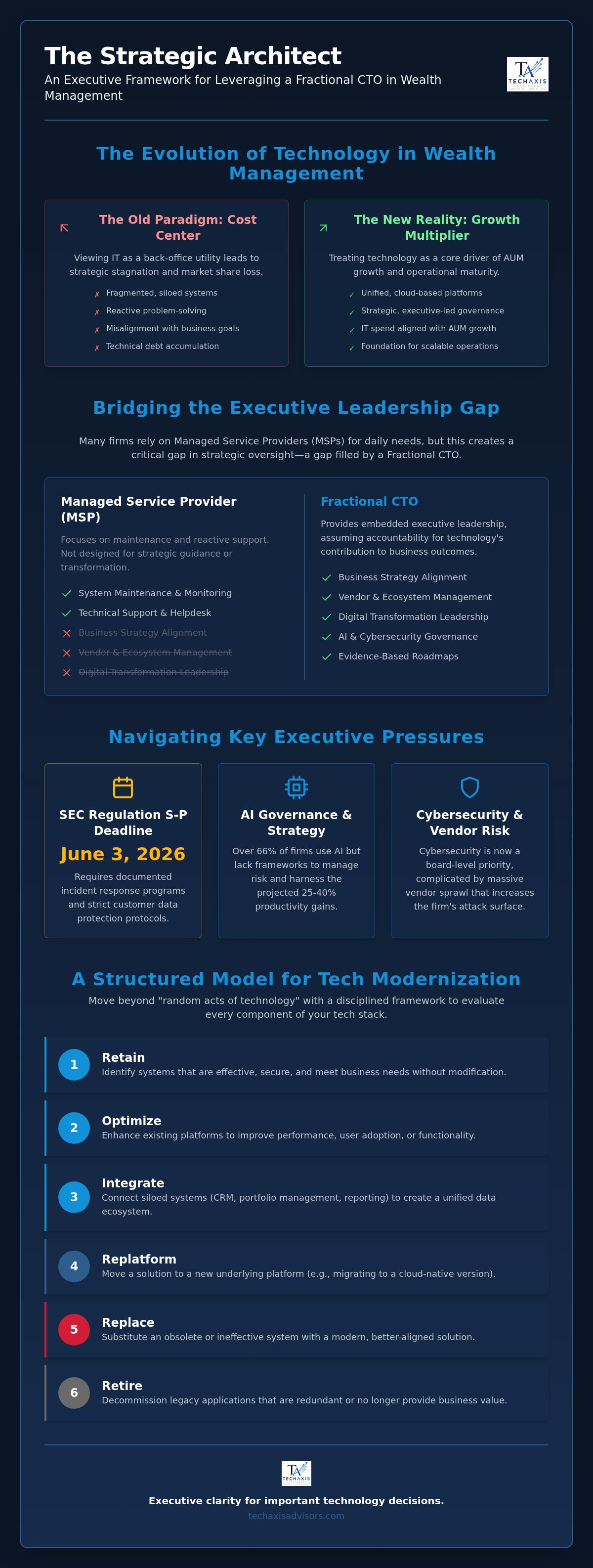
Modernizing a wealth tech stack shouldn't automatically mean a total replacement of legacy systems. TechAxis utilizes a disciplined framework: Retain, Optimize, Integrate, Replatform, Replace, or Retire. This objective approach ensures that the business case drives the technical decision. It prevents unnecessary capital expenditure on systems that simply need better integration or optimization. Unlike global strategy firms that often deploy less experienced staff to manage complex wealth management needs, we provide direct access to former CIOs and CTOs. A fractional CTO for wealth management from TechAxis functions as a senior peer who understands the mechanics of scaling. We use our proprietary Executive Intelligence Platform to eliminate guesswork. This platform allows us to deliver evidence-based diagnostics and data-driven roadmaps that align with your firm's specific risk profile and long-term AUM growth targets.
The Executive Intelligence Assessment
We define our initial reviews as executive decision-support engagements rather than technical audits. The goal is to provide the C-suite with the clarity needed to make high-stakes decisions. These assessments result in board-ready summaries and prioritized action registers that define the timing and accountability of every technical initiative. This structure ensures that IT spend isn't a black hole. Instead, it's a transparent investment in operational maturity. You can explore our Executive Assessment Portfolio to see how we structure focus areas into strategic blocks that resonate with board members and private equity stakeholders.
Pragmatic AI Integration
AI adoption requires a pragmatic strategy. Many firms fall into the trap of hype-driven investments without a clear path to ROI. We focus on high-impact use cases, such as leveraging agent-based models to boost productivity by the 25% to 40% projected for the sector. This integration must meet 2026 SEC and FINRA standards for data integrity and algorithmic governance. Our perspective is further detailed in our AI in Financial Services: 2026 Strategic Framework. A fractional CTO for wealth management ensures that your implementation is explainable, auditable, and secure. This disciplined progress replaces organizational confusion with a sense of mastery over new technologies.
Securing Your Firm’s Technical Future
Securing a firm's technical future requires moving from organizational anxiety to disciplined progress. This transition begins by establishing a scalable operating foundation that supports rapid growth rather than hindering it. A fractional CTO for wealth management provides the necessary leadership bridge to manage execution risk through rigorous vendor oversight. Complexity often masks inefficiency. By addressing these hidden costs, you can reallocate resources toward client-facing initiatives. They ensure that your technology investments are strategic assets rather than perpetual liabilities. Oversight ensures that every platform in your stack is accountable for its performance. By using evidence-based roadmaps, leaders can secure board approval with confidence. These roadmaps provide clear alignment between IT spend and business growth. They replace confusion with a structured, predictable path forward.
Questions to Ask Potential Advisory Partners
Selecting the right partner is a critical executive decision. You must evaluate whether potential advisory partners have deep experience in financial services and wealth management. Generalist knowledge is insufficient for the 2026 regulatory environment. Ask if their deliverables are designed for executives or for IT managers. Technical audits often fail because they lack the business context required for C-suite decision-making. You must ensure they have a proven method to anchor technology strategy to your broader business strategy. A partner who understands the mechanics of scaling provides a level of structural integrity that generalist consultants cannot replicate.
The Path to Operational Excellence
The journey toward operational excellence follows a deliberate pace. It starts with a diagnostic phase to identify technical debt and regulatory gaps. This leads into a strategic alignment phase where roadmaps are prioritized based on business impact. Finally, the execution phase provides the necessary leadership to oversee delivery partners and ensure milestones are met. Oversight is not optional. It is a requirement for scaling. Maintaining continuity through retained advisory support prevents the re-emergence of technical debt. The presence of a fractional CTO for wealth management turns technical complexity into a predictable cadence of improvement. This methodical flow suggests a well-defined process that reinforces your firm's identity as a reliable partner for your clients.
Start with a confidential executive conversation here.
Aligning Technology Strategy with Long-Term AUM Growth
The transition from viewing technology as a utility to treating it as a growth multiplier is the defining shift for wealth management firms in 2026. Sustainable scaling requires more than just operational maintenance; it demands executive-level governance that aligns every IT dollar with business outcomes. By utilizing our proprietary Executive Intelligence Platform, leaders can replace organizational anxiety with evidence-based diagnostics and prioritized roadmaps. This disciplined approach ensures your firm meets rigorous regulatory standards while capitalizing on productivity gains from AI integration.
Deploying a fractional CTO for wealth management provides the structural integrity needed to navigate complex vendor ecosystems and digital transformations. TechAxis Advisors brings the wisdom of a founder with over 25 years of experience as a CIO, CTO, and CISO. As a certified WOSB and NJ MWBE/SBE, we provide the senior-level access and pragmatic oversight that growth-stage firms require to reduce execution risk. You can secure your firm's technical future by moving from fragmented systems to a unified, scalable operating model.
Your technical infrastructure should be a bridge to your vision, not a barrier. We look forward to helping you build that foundation.
Frequently Asked Questions
What is the typical engagement length for a fractional CTO in wealth management?
Engagement lengths vary based on organizational needs, typically ranging from six to eighteen months for specific transformation projects. For firms requiring ongoing strategic oversight, a long-term retained advisory model is more common. This timeline allows the executive to establish governance, oversee major platform migrations, and mentor internal staff. The goal is to move the firm toward operational maturity before transitioning to a full-time hire or a lighter advisory touch.
How does a fractional CTO work with our existing IT team or MSP?
A fractional CTO for wealth management functions as the strategic leader who directs the activities of your existing IT team or Managed Service Provider. While the MSP handles tactical maintenance and help-desk support, the CTO ensures their efforts align with your business growth objectives. This relationship eliminates the strategic gap often found in MSP-only models. The CTO provides the high-level oversight required to hold vendors accountable for performance and security standards.
Can a fractional CTO help with technology due diligence during an acquisition?
Yes, technical due diligence is a core competency of this role, particularly for private equity-backed firms. The executive evaluates the target firm's technical debt, security posture, and platform scalability to identify potential integration risks. This evidence-based assessment ensures that the acquisition price reflects the actual cost of modernization. By providing a clear view of the target's operational maturity, the CTO helps leadership avoid costly post-merger surprises during the integration phase.
What is the cost structure for on-demand CTO consulting vs. a full-time hire?
On-demand consulting typically operates on a monthly retainer or project-based fee, providing a significantly lower total cost of ownership than a full-time executive. A full-time CTO in 2026 often commands a total compensation package between $270,000 and $550,000. Fractional leadership allows growth-stage firms to access the same caliber of expertise at a fraction of that cost. This model permits you to reallocate capital toward client acquisition while maintaining high-level technology governance.
Does a fractional CTO handle the actual software development and implementation?
The fractional CTO focuses on leadership, governance, and vendor oversight rather than direct software development. They define the requirements and select the right delivery partners to execute the build. While they don't write code, they ensure the implementation follows the strategic roadmap and meets all regulatory standards. TechAxis supports this execution through advisory leadership and qualified delivery partners who handle technical migrations or custom builds under our executive supervision.
How does a fractional CTO ensure our firm remains compliant with SEC and FINRA tech regulations?
Compliance is managed through structured governance frameworks that align with current SEC and FINRA priorities. The CTO oversees the implementation of incident response plans required by Regulation S-P and establishes auditable AI governance policies. They ensure that data integrity and vendor oversight protocols are documented and tested regularly. This proactive approach replaces regulatory anxiety with a disciplined, evidence-based program that stands up to rigorous examination during any regulatory audit or examination.
What is the difference between an Executive Technology Assessment and a standard IT audit?
An Executive Technology Assessment is a decision-support engagement focused on aligning technology with business strategy, whereas a standard IT audit is typically a compliance-focused checklist. The assessment evaluates the business case for modernization using the framework to retain, optimize, or replace systems. It results in a prioritized action register and a board-ready roadmap. While an audit identifies gaps, our assessment provides the strategic context and financial justification required for major technology investments.



Comments