

Executive Clarity: The Strategic Role of a Data Strategy Consultant in 2026
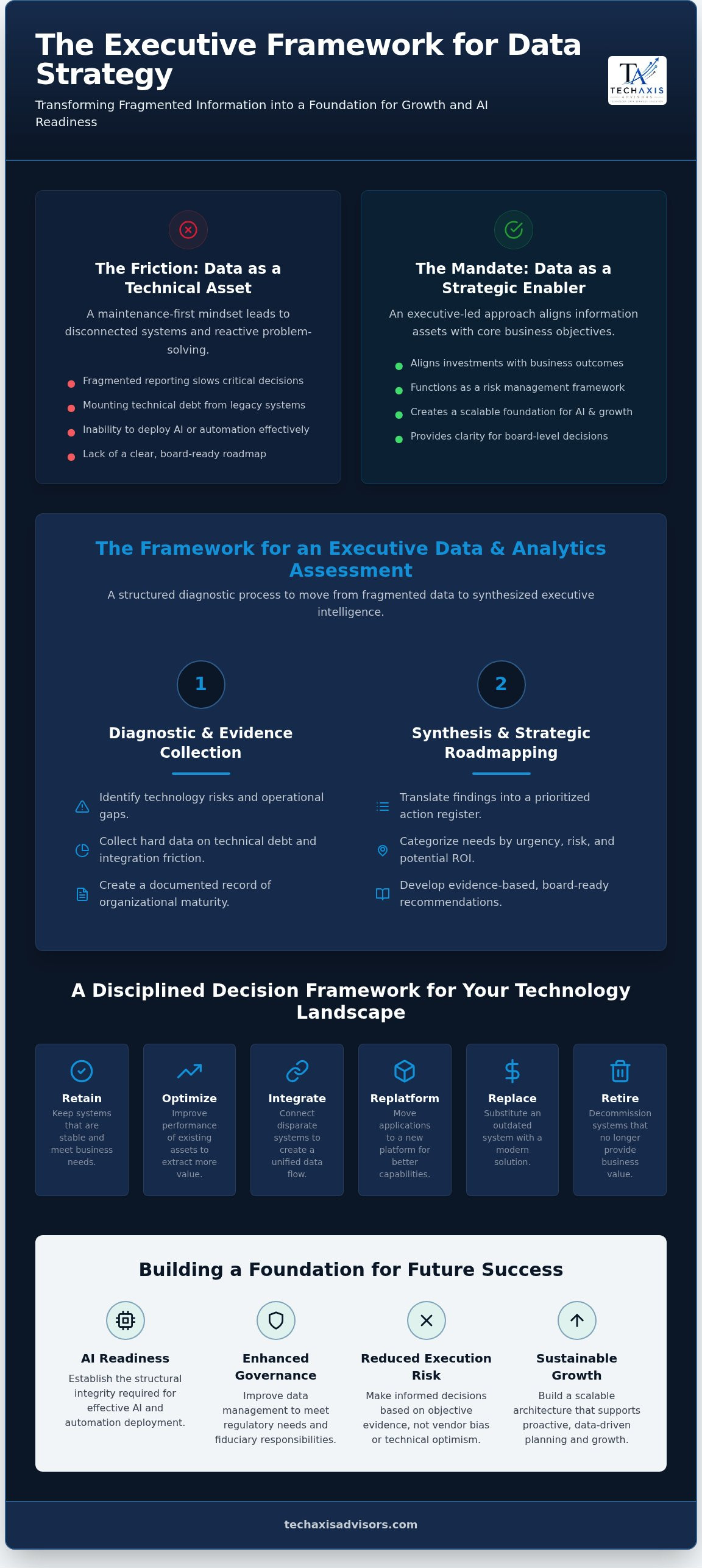
By 2026, the gap between companies that treat data as a technical asset and those that treat it as a strategic mandate will define market leadership. You likely recognize the friction of fragmented reporting that slows critical decision making. Perhaps you face mounting technical debt from years of rapid, disconnected growth. It's a common struggle for executive teams who feel the pressure of AI readiness but lack a clear, board-ready roadmap to get there. Engaging a data strategy consultant isn't about hiring a technical auditor; it's about securing the executive leadership necessary to align your architecture with your business goals.
This article explores how an executive-led approach transforms disjointed information into a scalable foundation for both AI and sustainable growth. We'll examine a structured framework for data modernization that prioritizes evidence-based findings over technical hype. You'll learn how to evaluate your current landscape through the lens of retain, optimize, or replatform to improve operational maturity. We conclude with a practical look at how strategic oversight provides the clarity needed to manage technology risk while driving measurable business value.
Table of Contents
Defining the Strategic Value of an Executive Data Strategy
An executive data strategy defines the precise alignment between your information assets and your core business objectives. It's a risk management framework, not a technical project. While tactical data management focuses on maintaining databases and fixing broken reports; strategic advisory informs board-level decisions regarding growth and capital allocation. By 2026, this distinction is critical. Organizations without a structured data foundation will find it impossible to deploy AI effectively. A data strategy consultant provides the executive clarity needed to bridge this gap, ensuring that technology investments map directly to your risk tolerance and operational goals. This clarity replaces organizational anxiety with a disciplined path toward maturity.
The Shift from Data Collection to Executive Intelligence
Simply accumulating data no longer provides a competitive edge. Most growth-stage firms already have more data than they can process. The challenge lies in intelligence synthesis. This is the process of distilling vast amounts of fragmented information into actionable insights that a CEO or CFO can use. A business-first perspective on data architecture prioritizes the "why" before the "how." It ensures that your reporting structures support your strategic initiatives rather than just listing historical metrics. This shift allows leadership to move from reactive troubleshooting to proactive, data-driven planning. When your architecture is built for intelligence rather than just collection, you gain the ability to scale without losing visibility.
Why Growth-Stage Firms Require Independent Advisory
Relying solely on internal IT teams for a strategic roadmap often leads to a maintenance-first mindset. Internal teams are frequently bogged down by daily operations and legacy technical debt. An independent data strategy consultant brings an objective lens to the organization. They provide evidence-based findings that are free from internal politics or vendor bias. This independence is vital for reducing execution risk during digital transformation. By identifying technology risks early through structured Executive Intelligence Assessments, leadership can make informed decisions about whether to retain or replace existing systems. This oversight ensures that the roadmap is grounded in reality rather than technical optimism. Independent advisors act as a bridge, translating complex technical risks into business trade-offs that the board can evaluate.
The Framework for an Executive Data & Analytics Assessment
Executive assessments provide the objective evidence necessary to secure board approval for modernization. The TechAxis Advisors framework utilizes a structured diagnostic to move beyond fragmented reporting and into intelligence synthesis. This methodology relies on a proprietary Executive Intelligence Platform to ensure repeatable, evidence-based results. Unlike generic technical reports, these deliverables are board-ready. They focus on the business impact of data architecture rather than the underlying code. By treating the assessment as a decision-support tool, leadership can confidently align technology spending with operational maturity. A data strategy consultant ensures this process remains focused on business outcomes rather than technical minutiae.
Step 1: The Structured Diagnostic and Evidence Collection
The process begins with a rigorous identification of technology risks and operational gaps. In regulated environments like financial services or wealth management, evidence-based findings are non-negotiable. We examine the structural integrity of your current reporting frameworks and data architecture. This isn't just about what systems you use; it's about how those systems support or hinder your fiduciary responsibilities. We collect hard data on technical debt and integration friction. This phase replaces anecdotal complaints from staff with a clear, documented record of organizational maturity. It provides the foundation for any subsequent technology decisions.
Step 2: Intelligence Synthesis and Strategic Roadmapping
Once evidence is gathered, the focus shifts to synthesis. An experienced data strategy consultant translates complex findings into a prioritized action register. This register categorizes needs based on urgency, risk, and potential ROI. A critical component of this step is the executive brief. These briefs are designed for the C-suite and board members. They communicate technology needs in terms of business outcomes rather than technical specs. This ensures that the board understands the trade-offs involved in every investment.
Prioritization of high-impact modernization projects based on business value.
Alignment of technology investments with three to five year growth plans.
Clear identification of technology risks that require immediate mitigation to maintain compliance.
This strategic roadmapping ensures that every dollar spent on data infrastructure brings you closer to your long-term goals. If your team is struggling to define these priorities, you may benefit from a structured Executive Intelligence Assessment to gain the necessary clarity for your next move.
Evaluating Data Maturity vs. Technical Debt in Growth-Stage Firms
Growth-stage firms often accumulate technical debt as a byproduct of rapid expansion. This debt isn't merely a technical concern. It's a fundamental risk to operational performance and firm valuation. A data strategy consultant helps leadership evaluate the trade-offs between maintaining legacy systems and investing in full replatforming. Instead of assuming total replacement is the only path, we utilize a disciplined decision framework: Retain, Optimize, Integrate, Replatform, Replace, or Retire. This approach aligns technology spend with your actual stage of growth. It ensures you aren't over-investing in complex systems before your operational foundation can support them. Understanding these trade-offs is essential for improving operational maturity through technology.
Identifying High-Impact Data Risks
Data silos represent one of the most significant risks for wealth management firms and asset managers. When business intelligence isn't available in real time, leadership relies on fragmented reporting that lags behind market shifts. These silos often result from disparate platforms that don't communicate, creating a "single source of truth" problem. Executive technology assessments are designed to uncover these maturity gaps by examining the flow of information across the organization. By identifying where data friction occurs, you can mitigate risks before they impact client reporting or regulatory compliance. This evidence-based approach replaces guesswork with a prioritized roadmap for remediation.
The ROI of Data Architecture Modernization
Modernizing your data architecture doesn't always require a "rip and replace" strategy. Often, the highest ROI comes from optimizing existing assets or integrating disparate systems to create a scalable foundation. A well-structured architecture reduces long-term operational costs by automating manual data reconciliation and improving reporting accuracy. For asset managers specifically, this structural integrity is a prerequisite for scaling assets under management without a linear increase in headcount. You can explore these nuances further in our data strategy for asset managers executive framework. This pragmatic approach ensures that every modernization effort has a clear, evidence-based business case. By focusing on scalability, you ensure your data foundation supports future initiatives rather than becoming a bottleneck.
Governance and AI Readiness: Bridging Strategy and Execution
AI initiatives often fail because they lack a structural foundation. You can't automate chaos. A data strategy consultant ensures that your data engine is capable of supporting advanced automation before you commit capital. In regulated sectors like financial services, AI readiness isn't just about technical capability; it's about governance. This involves establishing clear guardrails for data usage, model transparency, and auditability. Without this groundwork, AI deployments introduce unacceptable technology risks that can lead to regulatory scrutiny. You can explore these requirements in detail within our AI in financial services strategic framework. This focus on structural integrity replaces organizational uncertainty with a disciplined path toward automation.
Building an AI-Ready Data Engine
Data governance ensures that your AI initiatives are ethical, compliant, and accurate. High-quality data is the fuel for generative AI. If the input is fragmented, the resulting automation will be flawed. We identify high-impact use cases through a structured AI Readiness Assessment, positioned as an executive decision-support engagement. This process evaluates your existing data quality and structural integrity to determine if your systems are prepared for the cognitive load of AI. It ensures that your automation initiatives deliver measurable business value rather than just technical complexity. By focusing on governance-driven strategy, you mitigate the risks of biased outputs or data leaks in sensitive financial environments.
Executive Oversight and Vendor Management
Strategic oversight is critical when managing third-party delivery partners and complex platforms. A data strategy consultant acts as your representative, ensuring that technical builds align with your executive risk tolerance. They provide the necessary leadership bridge between the board's vision and the vendor's execution. Using fractional leadership allows growth-stage firms to gain this expertise without the overhead of a full-time C-suite hire. This oversight includes managing vendor selection, contract negotiations, and platform implementation to prevent vendor lock-in. It ensures that your technology ecosystem remains flexible, scalable, and transparent as your firm grows. This disciplined approach to vendor management protects your long-term operational interests.
Selecting a Data Strategy Consultant: The Case for Fractional Leadership
Choosing a partner for your data modernization is a high-stakes decision that impacts firm valuation and operational scalability. Global strategy firms offer scale, but they often lack the senior executive access that growth-stage firms require. A boutique data strategy consultant provides a different value proposition. You work directly with veterans who've sat in the CIO or CTO chair. This ensures your strategy isn't just theoretically sound but operationally viable. It's about finding a partner who understands the mechanics of scaling within complex, regulated environments. You can learn more about our specific process by reviewing how TechAxis Advisors works.
Senior Access vs. Traditional Consulting Models
Traditional models often involve a senior partner selling the engagement while junior staff perform the actual work. This creates a gap in executive intelligence. Fractional leadership solves this by providing continuity from the initial diagnostic to the final roadmap. When your advisor is a former CIO or CTO, they bring decades of experience in technology governance and vendor oversight. They don't just identify problems; they understand the political and operational hurdles of solving them. This level of senior access is vital for companies that aren't yet ready for a full-time technology executive. It bridges the leadership gap during critical growth phases. Explore the specific criteria for this model in our guide on when a growth company needs a fractional CTO.
The TechAxis Advisors Approach to Strategic Partnership
The goal is executive clarity. We prioritize business-first alignment, ensuring that every data initiative supports a specific operational outcome. This approach relies on evidence-based insight rather than technical trends. For firms in wealth management and financial services, regulatory experience is a critical filter. Our certifications, including SBA WOSB and MWBE, serve as trust markers for clients who require high standards of accountability and transparency. We don't just offer advice from the sidelines. We operate as a fractional partner, deeply invested in the structural integrity of your organization. We invite you to explore our advisory leadership to see how veteran experience can transform your data strategy into a scalable asset.
Securing Structural Integrity for the 2026 Competitive Landscape
By 2026, the distinction between organizations that merely manage data and those that master it will be undeniable. Successful leadership teams recognize that structural integrity isn't a technical byproduct but a strategic mandate. Aligning your data architecture with business outcomes requires more than just new tools; it demands executive-grade oversight and a disciplined roadmap. Whether you're evaluating legacy technical debt or preparing for advanced automation, the focus must remain on evidence-based findings that support board-level decisions.
Engaging a data strategy consultant provides the necessary leadership bridge to move from fragmented reporting to executive clarity. With a proprietary Executive Intelligence Platform and over 25 years of executive experience, TechAxis Advisors delivers the strategic architect your growth-stage firm needs. As a certified WOSB and MWBE, we provide the independent advisory required to mitigate technology risk while driving operational maturity. You don't have to navigate these complex transitions alone.
Order replaces chaos when you have the right partner to guide your important technology decisions.
Frequently Asked Questions
What is the difference between a data strategy consultant and a data engineer?
A data strategy consultant focuses on aligning information assets with business outcomes and executive risk tolerance. In contrast, a data engineer is responsible for the technical construction of pipelines and databases. While the engineer builds the infrastructure, the consultant provides the strategic architecture and governance required to ensure those systems deliver measurable value. This distinction ensures that technology investments are driven by business strategy rather than technical trends.
Why do wealth management firms need a specialized data strategy?
Wealth management firms operate in highly regulated environments where data integrity is a fiduciary requirement. A specialized strategy addresses the specific needs of asset managers, such as real-time business intelligence and consolidated client reporting. Without a structured framework, firms often struggle with fragmented silos that increase compliance risk and slow down critical decision-making. A strategic approach ensures that data foundations are both scalable and compliant with industry standards.
How long does an Executive Data & Analytics Assessment typically take?
The duration of an assessment depends on the complexity of your technology ecosystem and the scope of the diagnostic. These engagements are designed to be efficient, leveraging the proprietary Executive Intelligence Platform to accelerate evidence collection. Each assessment follows a methodical process from structured diagnostic to intelligence synthesis. This ensures that leadership receives board-ready findings and a prioritized roadmap within a timeframe that supports agile decision-making.
Does a data strategy consultant perform the actual software implementation?
A data strategy consultant typically focuses on advisory leadership, governance, and vendor oversight rather than direct software builds or cloud migrations. TechAxis Advisors supports execution by providing the strategic roadmap and qualified delivery partners necessary for implementation. This independent model ensures that the advice remains objective and focused on your firm's long-term interests. We act as the bridge between your executive vision and technical execution.
How does data strategy impact a company’s AI readiness?
Data strategy is the fundamental prerequisite for AI readiness because you can't automate disjointed or low-quality information. A robust strategy establishes the governance guardrails and structural integrity needed for successful AI adoption. By identifying high-impact use cases and ensuring data quality, a consultant helps you avoid the risks of biased outputs or failed implementations. This groundwork ensures that your firm is prepared for the cognitive load of advanced automation.
What are the key deliverables of a TechAxis Advisors executive assessment?
Every TechAxis Advisors executive assessment delivers a suite of board-ready artifacts designed for clarity and accountability. These include evidence-based findings, a prioritized strategic roadmap, and a detailed action register with clear next steps. Additionally, leadership receives presentation decks tailored for C-suite and board meetings. These deliverables focus on translating complex technical risks into business trade-offs, providing a clear path forward for your digital transformation initiatives.
Can a fractional CTO help with data governance and compliance?
Yes, a fractional CTO provides the embedded leadership necessary to oversee data governance and compliance initiatives. This model allows growth-stage firms to access veteran executive experience without the cost of a full-time hire. The fractional leader ensures that your technology operating model remains compliant with regulatory standards while scaling. They provide ongoing governance and vendor management, bridging the gap between high-level strategy and day-to-day operational execution.
How do you measure the ROI of a data strategy engagement?
The ROI of an engagement is measured through improved operational maturity and reduced technology risk. Concrete indicators include the reduction of technical debt, faster decision-making cycles through automated reporting, and the ability to scale assets under management without proportional headcount increases. By providing executive clarity, these engagements prevent costly misalignments and ensure that technology spending maps directly to value creation. This disciplined approach replaces organizational anxiety with measurable progress.



Comments