

Enterprise Data Management Strategy: An Executive Framework for 2026
If 90% of your workforce can now generate their own analytics content through AI, who is ultimately responsible for the integrity of the underlying source? In 2026, an effective enterprise data management strategy is no longer a back-office technical requirement. It's a fundamental pillar of corporate governance. Data silos persist. Technology costs rise. ROI remains elusive. You've likely felt the pressure of reporting accurate metrics to the Board while navigating a patchwork of 20 different state privacy laws and new California DROP requirements.
We understand that the gap between accumulating data and activating it often feels insurmountable. This guide provides an evidence-based framework to align your data architecture with business strategy and risk tolerance. You'll gain a clear, prioritized roadmap for modernization that moves beyond abstract theory to deliver executive-grade clarity. We'll explore how to transition from reactive data handling to a disciplined, compliance-ready governance model that supports both AI readiness and operational maturity.
Table of Contents
Why Most Enterprise Data Strategies Fail to Deliver Executive Clarity
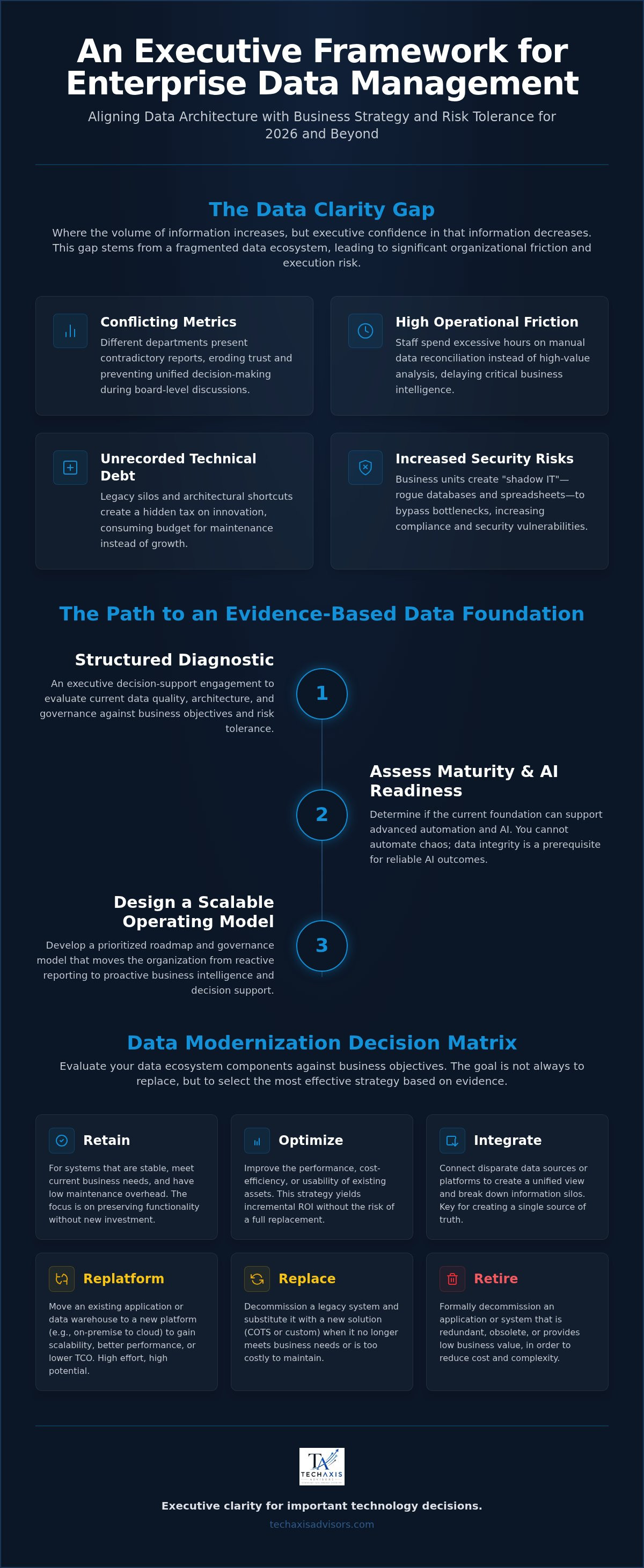
An effective enterprise data management strategy is not a technical stack. It is a business-alignment framework. Many organizations mistake the purchase of a new data warehouse or analytics tool for a strategy. This tool-first approach ignores operational maturity and results in high technology spend with low visible ROI. When leadership prioritizes software over structure, the organization inevitably falls into the "Data Clarity Gap." This is a state where the volume of information increases, but executive confidence in that information decreases. You have more reports than ever, yet you still can't answer fundamental questions about client retention or capital allocation with absolute certainty. You can explore the specific organizational challenges this creates for growth-stage firms.
The core objective of a modern data strategy is the reduction of execution risk.
The Symptoms of a Fragmented Data Ecosystem
Organizational anxiety often stems from a lack of transparency. You see this when different departments present conflicting metrics during Board meetings. One team reports growth based on CRM data, while another shows stagnation based on the financial ledger. This fragmentation creates high operational friction. Staff spend hours on manual data reconciliation instead of high-value analysis. In wealth management or private equity, this delay is costly. The firm lacks the real-time business intelligence required for agile decision support, making it difficult to pivot when market conditions shift.
The High Cost of Technical Debt in Data Architecture
Legacy silos do more than just slow down operations. They create a hidden tax on innovation. For a CFO, technical debt is best understood as an unrecorded liability. It represents the future cost of fixing structural shortcuts taken today. When central systems fail to provide the necessary data management controls, business units often resort to "shadow IT." They build their own rogue databases and spreadsheets to bypass perceived bottlenecks. This behavior increases security risks and inflates maintenance costs across the enterprise. A fragmented enterprise data management strategy ensures that a significant portion of your technology budget is spent simply maintaining outdated infrastructure rather than scaling the business for 2026 and beyond.
Building an Evidence-Based Data Foundation for Growth and AI
Committing to a new data platform without a diagnostic is a high-risk gamble. An effective Enterprise Data Management (EDM) framework starts with evidence, not vendor promises. This diagnostic phase ensures your technology spend aligns with long-term business outcomes and your specific risk tolerance. For firms in specialized sectors, a tailored Data Strategy for Asset Managers is required to handle unique regulatory and reporting complexities. By basing decisions on objective findings, you avoid the common trap of overspending on brand-name consulting that relies on junior staff and abstract theory. A structured enterprise data management strategy ensures that every dollar invested in infrastructure is tied to a measurable operational improvement.
Assessing Operational Maturity and AI Readiness
AI requires a clean foundation. You can't automate chaos. An assessment evaluates current data quality, accessibility, and security protocols to determine if your organization is truly ready for large-scale automation. Without this clarity, AI projects often stall or produce unreliable results. You can explore a more detailed strategic framework for AI in financial services to understand how data integrity impacts these initiatives. The goal is to identify whether your current architecture can support the cognitive load of AI agents or if structural remediation is required first.
Designing a Scalable Data Operating Model
Moving from reactive reporting to proactive business intelligence requires more than just a dashboard. It demands a shift in your enterprise data management strategy toward a model where data integrity is maintained through executive governance. This transformation often lacks a clear owner. A Fractional CTO provides the necessary leadership bridge, ensuring that technology decisions remain subservient to business goals. This structured approach moves the firm away from manual firefighting and toward a scalable, governed environment. If you're ready to evaluate your current state, you might consider starting with a structured Executive Intelligence Assessment to identify your highest-priority gaps.
For a more direct discussion on aligning your architecture with your growth goals, you can schedule a confidential executive conversation to explore your specific roadmap.
The Decision Matrix: Retain, Optimize, or Replatform Your Data Ecosystem
"Rip and replace" is rarely the most efficient path to modernization. While software vendors often push for total migration, a pragmatic enterprise data management strategy evaluates the business case for every asset individually. You need a structured matrix to determine which systems offer competitive advantages and which are merely functional utilities. This decision hinges on your operational maturity and long-term scaling goals. If you're unsure where your current infrastructure sits on this spectrum, you can explore our executive decision-support services to gain objective clarity.
Evaluating the Business Case for Replatforming
Replatforming is a high-stakes investment that requires a rigorous calculation of the total cost of ownership (TCO). It's not just about subscription fees. You must account for the indirect costs of business disruption, staff retraining, and data integrity audits during the migration process. Cloud-based data lakes offer agility, but legacy on-premise systems may still be necessary for specific high-security or low-latency requirements common in wealth management. When legacy technical debt exceeds the cost of a new build over a three-year horizon, the case for replatforming becomes clear. However, without a thorough understanding of enterprise data management principles, a new platform may simply replicate the silos of the old one. The risk of business disruption often outweighs the perceived benefits of a "fresh start" if the underlying data quality isn't addressed first.
The Retain and Optimize Framework
Many legacy systems are functionally sound but lack modern accessibility. The "retain and optimize" approach focuses on extending the life of these assets through middleware and robust APIs. This strategy allows you to integrate siloed data into modern reporting frameworks without the risk of a full rebuild. It provides "quick wins" in data visibility that build the executive buy-in necessary for larger transformation projects. By optimizing what already works, you preserve capital and reduce execution risk. This methodical progression ensures that your enterprise data management strategy remains grounded in fiscal reality rather than technical idealism. It's about achieving the desired outcome with the least amount of organizational friction. For many private equity-backed firms, this optimization phase is the most direct route to improving the "single version of the truth" without ballooning the technology budget.
In wealth management, asset management, and private equity, your data is a liability until it's governed. An effective
enterprise data management strategy
must integrate compliance directly into the architecture. This approach mirrors the principles in our framework for
. Governance ensures that every data point is traceable and every report is defensible. Accountability starts at the executive level and extends to every automated process. Cybersecurity risk is now a data management problem. If you can't secure your data, you can't govern it. In 2026, the intersection of these disciplines is where executive clarity is either won or lost. You need a system that doesn't just store information but validates its integrity at every touchpoint.
Data Privacy and Regulatory Alignment
SEC and FINRA standards in 2026 demand more than just passive compliance. They require evidence of active oversight and documented data lineage. The Board is increasingly responsible for technology governance and data privacy. "Compliance by design" ensures that your data architecture enforces these rules automatically. This reduces the risk of manual errors and ensures that your firm is always audit-ready. It's about building a foundation where transparency is the default state, not a requested feature. When you embed compliance into the design, you remove the "prestige tax" of reactive consulting and replace it with a disciplined, automated framework that satisfies both regulators and stakeholders.
Vendor and Platform Oversight
Growth-stage firms often rely on a patchwork of third-party providers and cloud platforms. This creates significant risks regarding data sovereignty and the validity of vendor claims. A formal enterprise data management strategy must include rigorous vendor oversight to protect against third-party failures. You need to verify that your providers meet your internal standards for data integrity and security. Independent technology advisory provides the "second set of eyes" required to validate these platforms. This oversight ensures that your data remains your most valuable asset, rather than a hidden source of third-party risk. By implementing robust vendor management, you ensure that your firm retains control over its information, regardless of where it is hosted or who manages the underlying hardware.
Moving from Insight to Execution: The Role of Strategic Advisory
A roadmap without execution is merely a list of unfulfilled promises. For C-suite leaders, the challenge isn't just defining an enterprise data management strategy but ensuring it survives the transition to daily operations. Strategic advisory provides the necessary bridge between high-level intent and measurable outcomes. This process begins with an Executive Data & Analytics Assessment. This engagement serves as the catalyst for change, replacing organizational guesswork with evidence-based findings. It identifies the exact structural gaps preventing your data from becoming a strategic asset. By starting with a diagnostic, you ensure that subsequent technology investments are grounded in reality rather than vendor hype.
The TechAxis Executive Intelligence Platform
Findings must be board-ready to be effective. Our proprietary TechAxis Executive Intelligence Platform generates deliverables that prioritize clarity and traceability. Instead of dense technical audits, we provide a prioritized action register. This allows the C-suite to see exactly where resources should be allocated to reduce risk and improve ROI. Every finding is linked to a specific business outcome, ensuring that technology remains a servant to your growth objectives. This platform-driven approach ensures that our findings are objective, repeatable, and directly aligned with the mechanics of scaling a financial services or private equity-backed firm.
Fractional Leadership: Bridging the Execution Gap
Growth-stage companies often face a specific leadership vacuum. They need veteran executive wisdom but aren't yet ready for the overhead of a full-time, permanent hire. This is where Fractional CTO services provide an "embedded executive" presence. A Fractional CTO doesn't just offer advice from the sidelines. They operate within your leadership team to oversee vendor management, enforce governance, and ensure the enterprise data management strategy is executed with discipline. You can explore our specific client profiles at Who It’s For to see how this model fits your current operational stage. This leadership bridge ensures that the momentum gained during the assessment phase isn't lost to internal inertia.
Execution is a choice. You can continue to manage data as a series of isolated technical projects, or you can treat it as a core executive discipline. The path to clarity begins with an objective look at your current state. Explore whether your priority requires an assessment, strategic advisory, or fractional leadership by starting with a confidential executive conversation.
Aligning Data Architecture with Executive Intent
Transitioning from data accumulation to true activation is the defining challenge for growth-stage firms in 2026. A disciplined enterprise data management strategy replaces organizational anxiety with a structured path toward operational maturity. By prioritizing evidence-based diagnostics over vendor-led hype, you ensure that technology remains a servant to your strategic business outcomes. This shift moves the firm away from manual data reconciliation and toward a state of controlled, proactive intelligence.
Our founder brings over 25 years of CIO, CTO, and CISO experience to every engagement. As a certified WOSB, MWBE, and SBE firm, we utilize our proprietary Executive Intelligence Platform to deliver board-ready findings that prioritize your highest-impact decisions. We provide the senior leadership bridge necessary to turn technical potential into realized executive clarity. Whether you're optimizing legacy assets or preparing for a large-scale AI initiative, the goal remains the same: reducing execution risk while scaling with confidence.
We invite you to move beyond abstract theory and start building a data foundation that supports the long-term integrity of your business.
Frequently Asked Questions
What is the difference between data management and a data strategy?
Data strategy defines the business objectives and risk parameters, while data management involves the technical execution and maintenance of those standards. Think of the strategy as the architectural blueprint and management as the ongoing facility operations. A robust enterprise data management strategy ensures that your technical infrastructure remains subservient to your commercial goals, preventing technology spend from outstripping actual business value. It provides the framework for deciding which data to prioritize for growth.
How long does an executive data assessment typically take to complete?
Most executive decision-support engagements take between four and eight weeks to deliver a complete strategic roadmap. We utilize the proprietary TechAxis Executive Intelligence Platform to accelerate the diagnostic phase without sacrificing depth. This structured approach provides board-ready findings and a prioritized action register quickly. The timeline depends on the complexity of your current ecosystem and the availability of key stakeholders. Our goal is to provide clarity, not to linger in a discovery phase.
Does our firm need to replace our current BI tools to implement a new strategy?
You don't always need to replace your existing tools to achieve executive clarity. We follow a framework to evaluate your current assets based on whether you should retain, optimize, integrate, replatform, replace, or retire them. Often, the issue isn't the tool itself but the underlying data architecture or a lack of proper integration. Optimizing your current BI stack can frequently deliver the necessary visibility at a lower cost and with significantly less business disruption.
How does an enterprise data strategy support AI readiness?
AI models are only as effective as the data they consume. An enterprise data management strategy establishes the necessary data quality, security, and accessibility standards required for reliable automation. It identifies whether your organization is ready to leverage AI or if structural remediation is needed first. By building a clean, governed foundation, you ensure that your AI initiatives produce trustworthy insights rather than amplifying existing data errors or creating new regulatory risks.
What role should the Board play in data governance and strategy?
The Board should focus on oversight, risk management, and ensuring that technology investments align with long-term business strategy. They aren't responsible for technical implementation but must hold leadership accountable for data integrity and privacy compliance. In 2026, Boards are increasingly expected to demonstrate active governance over data assets. They should review prioritized roadmaps and action registers to ensure the firm is mitigating technical debt and addressing emerging regulatory requirements across the organization.
How do we measure the ROI of a data management modernization project?
ROI is measured by tangible improvements in operational efficiency and the reduction of execution risk. You should track metrics like the time saved on manual data reconciliation, the speed of executive decision-making, and the reduction in total cost of ownership for data systems. Additionally, staying compliance-ready avoids the significant costs associated with regulatory fines or data breaches. We focus on identifying quick wins that provide immediate value while building toward long-term structural mastery.
Can a Fractional CTO help with data strategy for a private equity portfolio company?
Yes, a Fractional CTO is particularly effective for private equity portfolio companies navigating rapid growth or digital transformation. They provide the embedded executive leadership required to oversee complex modernization projects without the expense of a full-time hire. This model ensures that the portfolio company has the governance and technical oversight needed to improve operational maturity. A Fractional CTO acts as a bridge, aligning the company's technology roadmap with the investor's exit or growth strategy.
What are the specific data compliance requirements for wealth management firms in 2026?
Wealth management firms must navigate a patchwork of 20 different state privacy laws and the new California DROP platform requirements effective in 2026. Additionally, updated COPPA rules and SEC oversight demand stricter data retention and parental consent protocols. Compliance now requires traceability and accountability in all reporting. An effective strategy builds these requirements into the architecture by design, ensuring the firm remains audit-ready as the regulatory landscape continues to shift for firms operating nationally.


Comments