

Digital Transformation: 2026 Roadmap for Growth Companies
Most CEOs view technology as a tool for efficiency, but for a scaling business, it's actually your primary risk vector. If your infrastructure cannot keep pace with your vision, your growth will eventually stall under the weight of technical debt. Successful digital transformation for growth stage companies is not about chasing trends. It's about restructuring your technology operating model to match your strategic risk tolerance. You likely feel the friction of legacy systems and the absence of executive-level technology leadership every day. These are not just IT problems; they're business bottlenecks that hinder speed and create dangerous information silos.
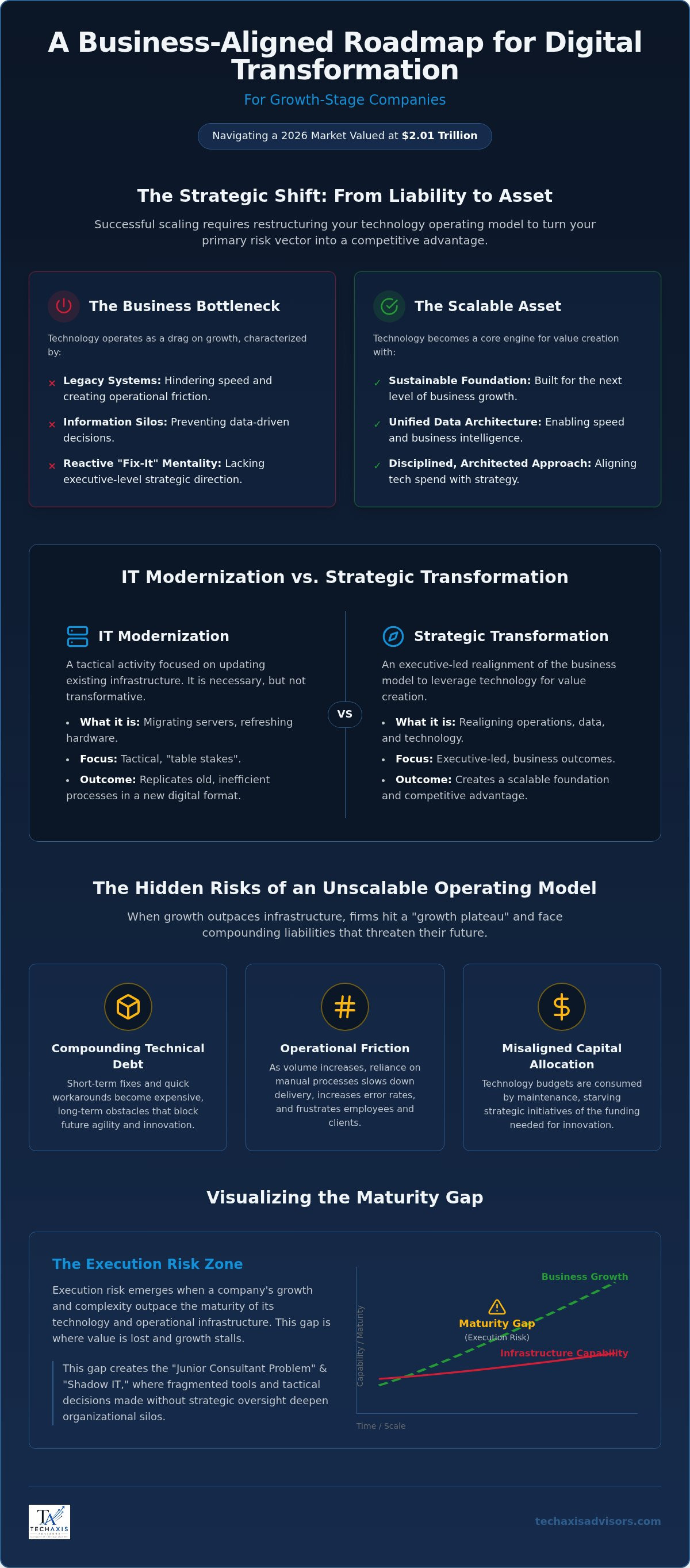
We agree that making expensive, incorrect technology bets is a risk you cannot afford in a 2026 market valued at $2.01 trillion. This roadmap provides a pragmatic, business-aligned framework to scale your operations and ensure your tech spend matches your strategy. You'll learn how to reduce execution risk and achieve operational maturity while navigating new requirements like the NIST CSF 2.0 revisions. We'll outline the specific phases required to build a sustainable foundation that turns technology from a liability into a scalable asset.
Table of Contents
Defining Digital Transformation for Growth-Stage Companies
Digital transformation is often misunderstood as a simple technical upgrade. In reality, it's the strategic realignment of technology, data, and operations to drive specific business outcomes. For a company in the scaling phase, this means moving beyond the reactive "fix-it" mentality of a startup and toward a disciplined, architected approach. True Digital Transformation involves changing the fundamental business model to leverage technology as a primary engine of value creation rather than a back-office utility.
Growth-stage companies face unique pressures that differ significantly from early-stage ventures or established enterprises. Startups can pivot quickly because they lack legacy baggage; large corporations have the capital to absorb the cost of slow moving projects. Growth-stage firms have neither luxury. They must execute with precision while managing increasing complexity. Effective digital transformation for growth stage companies in 2026 requires an AI-first mindset, where automation and unified data architecture are embedded into the core business logic from the outset to ensure scalability.
The Difference Between IT Modernization and Strategic Transformation
IT modernization is tactical. It involves updating infrastructure, such as migrating legacy servers to the cloud or refreshing hardware. While these steps are necessary, they're merely table stakes. Strategic transformation is executive-led and focuses on how the company creates value. Growth-stage firms often confuse the two. They spend significant capital on new tools that simply replicate old, inefficient processes in a digital format. This results in wasted investment and a failure to achieve the operational maturity needed to support rapid expansion.
Why Growth-Stage Firms Fail Without a Scalable Operating Model
Many companies hit a "growth plateau" when their legacy processes can no longer support their volume of business. This isn't a lack of effort; it's a lack of structural integrity. Information silos develop as departments adopt fragmented tools, leading to a breakdown in data-driven decision-making. Without a scalable operating foundation, several risks emerge:
Compounding Technical Debt: Quick fixes made during early growth become expensive obstacles that hinder future agility.
Operational Friction: Manual workarounds slow down delivery and increase error rates as volume increases.
Misaligned Capital Allocation: Technology budgets are drained by maintenance and "keeping the lights on" rather than strategic innovation.
To scale successfully, your technology roadmap must align directly with your long-term business strategy. It's about building a framework that supports speed while drastically reducing execution risk. This alignment ensures that every dollar spent on technology directly contributes to the firm's ability to handle the next level of growth.
Assessing the Maturity Gap: Identifying Execution Risks
Execution risk is the silent killer of scaling firms. When growth outpaces infrastructure, the resulting gap creates a fragile foundation that cannot support increased volume. Identifying this maturity gap requires moving away from anecdotal IT reports and toward evidence-based assessments. Decisions based on gut feelings lead to expensive mistakes. A structured evaluation replaces organizational anxiety with a clear roadmap for progress.
Many firms fall into the "Junior Consultant Problem." Without executive-level technology leadership, technical decisions are made by well-meaning but inexperienced staff or external vendors with limited business context. The result is a fragmented tech stack that solves immediate pain points but fails to integrate into a cohesive strategy. This lack of oversight is a primary driver of failed digital transformation for growth stage companies. It creates a landscape of "shadow IT" where departments purchase software independently, further deepening organizational silos.
Technical Debt: The Hidden Tax on Growth
Technical debt is a liability on the balance sheet of operational efficiency. In an executive context, it represents short-term fixes that increase long-term operational costs. As you scale, this debt compounds. Silent technical debt often hides in legacy software or disjointed data architectures that function but require manual intervention to produce accurate reports. Identifying these liabilities early is crucial to prevent them from becoming insurmountable obstacles. For a deeper dive into these concepts, review our guide on Improving Operational Maturity Through Technology: An Executive Framework.
Operational Maturity as a Competitive Advantage
High operational maturity is a tangible competitive advantage. It directly impacts your valuation and investor confidence. Private equity and venture capital partners look for technology governance that reduces execution risk. This means having standardized data reporting frameworks that drive informed decision-making rather than guesswork. Maturity also dictates your readiness for advanced technologies like agentic AI. If your data is siloed and your processes are manual, your organization is not yet ready for automation. Assessing your current state ensures your foundation can handle the weight of future innovation.
A pragmatic approach to growth involves knowing exactly where your structural weaknesses lie before they break. If you're unsure where your maturity gaps reside, it's time to schedule a strategic technology assessment to baseline your current capabilities and identify your highest-impact risks.
The Executive Decision Framework: Retain, Optimize, or Replace
Every technology asset in your portfolio is either an engine for growth or a drag on performance. For digital transformation for growth stage companies, the goal isn't simply to buy the newest SaaS platform. It's to align your current ecosystem with your strategic risk tolerance and scaling objectives. This requires a cold, analytical look at your current tools. Don't assume replacement is the only path. Often, optimization or better integration provides a higher ROI with lower execution risk. We categorize every technology asset into one of six strategic buckets: Retain, Optimize, Integrate, Replatform, Replace, or Retire. This categorization forces leadership to justify the existence of every line item in the technology budget.
Retain: Assets that provide high value and require minimal maintenance.
Optimize: Tools that are fundamentally sound but underutilized or poorly configured.
Integrate: Siloed systems that need unified data flows to provide executive-level visibility.
Replatform: Moving stable applications to more scalable infrastructure, such as cloud-native environments.
Replace: Systems that are no longer fit for purpose or represent a significant security risk.
Retire: Redundant or obsolete tools that drain budget without adding value.
Evaluating Tradeoffs: The Cost of Replacement vs. The Cost of Inaction
The license fee of a new platform is only the tip of the iceberg. You must account for data migration, staff retraining, and the inevitable dip in productivity during the transition. This is the Total Cost of Ownership (TCO). Inaction has a cost too. It's measured in lost man-hours, missed data insights, and security vulnerabilities. When assessing new vendors, prioritize those that offer clear integration paths into your existing stack. For more on making these high-stakes decisions, consult our Strategic Technology Advisory for CEOs: Buying Guide.
Building a Prioritized Strategic Roadmap
Proactive planning replaces the frantic "firefighting" that characterizes many scaling firms. Effective digital transformation for growth stage companies requires a roadmap that aligns directly with your 2026 growth milestones. If you plan to double your headcount by year-end, your onboarding systems must be addressed now. We use an Action Register to maintain this momentum. It's a living document that tracks specific tasks, owners, and deadlines. It ensures that strategic intent translates into tangible execution. This level of accountability prevents your transformation from becoming another abandoned initiative. It moves the conversation from "what's broken" to "what's next."
A 5-Step Roadmap for Growth-Stage Digital Transformation
Successful scaling requires more than just a vision; it demands a repeatable, disciplined process. Most digital transformation for growth stage companies fails because it lacks a structured sequence. We've developed a five-step framework designed to bring executive-level order to the scaling process. This roadmap moves your organization from reactive firefighting to a state of controlled, data-driven progress.
Step 1: The Diagnostic Phase
A structured Executive Intelligence Assessment is superior to a generic technical audit. While an audit might tell you if your servers are running, a diagnostic assessment tells you if your technology is actually supporting your business goals. We use our proprietary Executive Intelligence Platform to baseline your current capabilities against industry standards. This phase identifies high-impact use cases for AI and automation early, ensuring you don't waste capital on low-value projects. For a comprehensive look at how to evaluate your current infrastructure, review our Technology Due Diligence for Growth-Stage Companies: An Executive Checklist.
Step 2 involves aligning your technology governance with your specific business risk tolerance. You don't need to secure every asset with the same intensity; you must prioritize the systems that drive your competitive advantage. Step 3 focuses on defining a data strategy that supports real-time business intelligence. We eliminate information silos to ensure your leadership team has a single version of the truth. Step 4 is the phased implementation. We avoid "big bang" deployments that threaten operational stability, choosing instead to execute in controlled waves that minimize disruption to your daily operations.
Step 5: Sustaining Transformation Through Governance
Transformation isn't a one-time project; it's a continuous organizational capability. Sustaining these gains requires ongoing executive oversight and board-ready reporting. These reports must translate technical milestones into business value, showing exactly how tech spend is driving growth or reducing risk. This level of transparency keeps stakeholders aligned and maintains momentum during the complex phases of scaling. Effective governance also includes active vendor and platform management. By proactively managing these relationships, you avoid vendor lock-in and ensure your tech stack remains agile enough to adapt as new regulations or market opportunities emerge.
Managing this level of complexity requires a partner who understands the mechanics of scaling. If your current leadership is stretched thin, it's time to consider an expert perspective.
Strategic Governance: The Role of Fractional Technology Leadership
Growth-stage firms often face a difficult paradox. They require executive-grade technology oversight to manage the increasing complexity of scaling, yet the cost of a full-time, high-caliber CTO can be prohibitive at this stage of the lifecycle. This leadership gap is where Fractional CTO Services provide a decisive strategic advantage. A fractional leader offers the same level of sophistication and experience as a veteran corporate CIO but at a fraction of the cost, allowing the business to reinvest capital into core growth initiatives while maintaining structural integrity.
The Fractional CTO acts as the vital bridge between the CEO’s vision and technical execution. Without this bridge, strategic intent is often lost in translation when it reaches the development or IT teams. This misalignment is a primary reason why digital transformation for growth stage companies frequently fails to deliver the promised ROI. By providing a clear narrative of action, accountability, and transparency, a fractional leader ensures that every technical decision serves the overarching business strategy. This approach moves the organization from a "Strategic Architect" model to one of embedded, results-oriented leadership.
When to Engage a Fractional CTO
Recognizing the need for external leadership is a sign of operational maturity, not a failure of current staff. You might notice that your internal teams are excellent at maintenance but struggle with high-level architecture or proactive technology planning. Other signs include a lack of technical depth during board meetings or an inability to quantify the business value of your tech spend. An objective, third-party perspective is essential for uncovering "silent" technical debt and identifying systemic risks that internal staff might overlook. This leadership is particularly critical during M&A activity, where technology integration can make or break the deal's valuation and long-term success.
The TechAxis Perspective: Executive Clarity for Transformation
At TechAxis Advisors, we don't rely on intuition or generic technical audits. We leverage our proprietary Executive Intelligence Platform to deliver evidence-based assessments and strategic roadmaps. This platform provides the data-driven clarity needed to support high-stakes decisions, moving your organization from a state of organizational anxiety to one of controlled, disciplined progress. Our focus is always on business-first alignment, ensuring that your technology operating model is robust enough to handle the weight of future scaling. We provide board-ready deliverables that clearly communicate progress, risk, and value to all stakeholders, ensuring your digital transformation for growth stage companies remains on track for 2026 and beyond.
Your vision for expansion deserves a technology foundation that's built for the long term. Let's start the conversation and build that foundation together.
Frequently Asked Questions
What is the difference between digital transformation and digitizing my business?
Digitizing is the tactical conversion of manual processes into digital formats, such as moving paper records to a cloud storage system. Transformation is a strategic shift in your business model to leverage technology as a primary driver of value. For digital transformation for growth stage companies, the focus is on re-architecting operations to support scale. It's the difference between simply buying new tools and changing how your company creates value.
How much should a growth-stage company spend on digital transformation?
Investment levels depend on your current maturity gap and specific strategic objectives. Rather than following a generic percentage of revenue, you should prioritize spending that directly reduces execution risk or removes bottlenecks to scaling. A common mistake is over-allocating budget to maintenance instead of strategic initiatives. Your spend must align with your risk tolerance and the specific growth milestones you intend to reach by 2026.
Does digital transformation always require replacing legacy systems?
No, replacement is only one of several strategic options available to leadership. You can often retain or optimize existing systems by improving their configuration or integrating them more effectively into your data flow. The decision should be based on a total cost of ownership analysis. If a legacy system remains reliable and supports your current volume, optimization is frequently a lower-risk path than a full-scale replacement that might disrupt operations.
How do I measure the ROI of a digital transformation initiative?
You measure ROI by tracking specific business outcomes like reduced operational friction, increased delivery speed, and improved data accuracy. While cost savings are a factor, the primary return often comes from increased scalability and reduced technical debt. High-performing firms use standardized reporting to link technology spend to strategic achievements. This evidence-based approach replaces guesswork with clear metrics that demonstrate how technology drives the company's bottom line.
What is the role of the CEO in a digital transformation project?
The CEO acts as the primary architect of alignment between business strategy and technical execution. You don't need to understand the underlying code, but you must define the strategic objectives and hold the leadership team accountable. Your role is to remove organizational silos and foster a culture that values disciplined, data-driven progress. Without active CEO sponsorship, transformation initiatives often stall because of conflicting departmental priorities and a lack of clear direction.
How long does a typical digital transformation take for a mid-market firm?
Transformation is a continuous process, but a typical roadmap for a mid-market firm often spans 12 to 24 months. This timeline includes the diagnostic phase, governance alignment, and phased implementation. Quick wins can be achieved in the first 90 days to build momentum for the project. However, achieving full operational maturity and a sustainable foundation for growth requires a disciplined, multi-year commitment to strategic governance and continuous improvement.
Can a growth-stage company handle digital transformation without a full-time CTO?
Yes, many firms successfully navigate digital transformation for growth stage companies using fractional technology leadership. A fractional CTO provides the same executive-grade oversight as a full-time hire but at a fraction of the cost. This model allows you to access veteran-level expertise for strategic decisions while your internal teams handle daily operations. It bridges the gap between your vision and technical execution without the significant overhead of a permanent C-suite salary.
How does AI fit into a digital transformation roadmap in 2026?
In 2026, AI is a core component of business logic rather than an isolated tool. Your roadmap must prioritize automation readiness and unified data architecture to support agentic AI systems that can execute tasks autonomously. With new regulations like the NIST CSF 2.0 revision, your AI strategy must also include robust governance and compliance controls. AI should be used to automate complex workflows and drive real-time intelligence across all departments.


Comments