

Deloitte Alternatives for Technology Consulting: An Executive Decision Framework
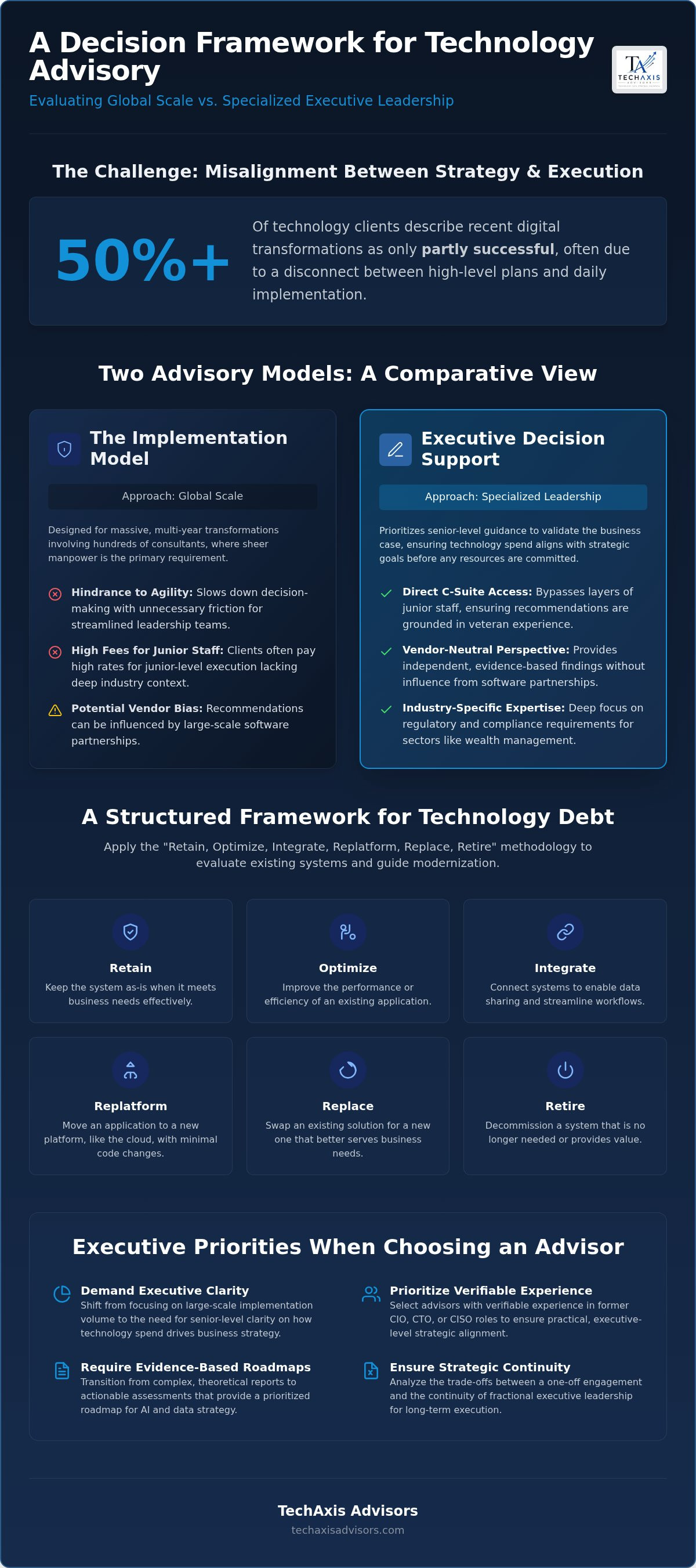
The most expensive consulting engagement is the one that delivers a 200-page slide deck but fails to move the needle on operational execution. A 2025 survey revealed that over half of technology clients describe their recent digital transformation programs as only partly successful. This gap often stems from a misalignment between high-level strategy and the mechanics of daily implementation. While global integrators offer immense scale, many wealth management and private equity executives find themselves paying high fees for junior-level staff who lack the industry context required to drive change. It's a common frustration when technology spend feels disconnected from core business strategy.
This guide provides a decision framework for evaluating Deloitte alternatives for technology consulting, helping you find the right balance between global reach and embedded executive leadership. You'll learn how to secure senior-level advisory that functions as a true strategic partner rather than a detached vendor. We will examine the trade-offs between different advisory models to ensure your organization gains the clarity needed for complex technology decisions, from AI readiness to long-term data strategy. This approach replaces organizational anxiety with a structured, evidence-based roadmap for growth.
Table of Contents
The Business Case for Evaluating Deloitte Alternatives
The global technology consulting market is projected to exceed $400 billion in 2026. While revenue figures suggest a preference for massive global integrators, many C-suite leaders are shifting their focus toward targeted executive advisory. Growth-stage and mid-market organizations often require senior-level access that a large-scale firm can't consistently provide. For these leaders, the primary goal isn't just a technical upgrade; it's achieving executive clarity on how technology spend aligns with business strategy. This clarity ensures that every dollar invested in data or AI directly supports the firm's long-term operational goals.
Evaluating Deloitte alternatives for technology consulting becomes a strategic necessity when the complexity of a global firm outweighs the agility required for your specific stage of growth. Large firms are built for massive, multi-year transformations that involve hundreds of consultants. However, mid-market firms often need rapid, evidence-based decisions rather than prolonged implementation cycles. This shift in demand has created a market for specialized advisors who prioritize strategic partnership over implementation volume. These firms offer the same level of intellectual rigor without the bureaucratic overhead associated with global integrators.
When Scale Becomes a Hindrance to Agility
The engagement models used by the Big Four are often designed for Fortune 500 environments with deep layers of management. For a more streamlined leadership team, these models can introduce unnecessary friction and slow down decision-making. Direct communication between the advisor and the executive is critical for maintaining momentum. When you work with specialized firms, you bypass the layers of junior staff that often handle the bulk of execution. This ensures that every recommendation is grounded in veteran experience rather than a template-driven approach. Specialized models offer several distinct advantages:
Reduced communication lag between advisors and the C-suite
Direct access to senior partners with deep executive experience
Elimination of high fees for junior-level execution
Vendor-neutral perspectives that aren't influenced by large-scale software partnerships
The Need for Specialized Regulatory Expertise
Wealth management and asset management firms operate in highly regulated environments where generic technology advice falls short. Specialized Deloitte alternatives for technology consulting maintain a deep focus on industry-specific risks and compliance requirements. These firms understand the nuances of fiduciary duty and data privacy in a financial services context. Utilizing structured Executive Technology Assessments allows leadership to identify specific gaps in their tech stack. These assessments provide a prioritized roadmap that addresses regulatory pressure without the overhead of a global consulting firm. By focusing on evidence-based findings, executives can make informed decisions about modernization without the fear of misaligned technology spend.
A Decision Framework for Technology Consulting: Scale vs. Specialization
Choosing the right advisor requires a clear distinction between the "Implementation Model" and "Executive Decision Support." Global integrators typically follow the former, deploying large teams to execute high-volume technical tasks. This model is effective for massive infrastructure migrations where sheer manpower is the primary requirement. However, growth-stage firms often need the latter: senior-level guidance that validates the business case before any resources are committed. Selecting Deloitte alternatives for technology consulting allows executives to move away from generic consulting reports toward evidence-based findings that prioritize organizational impact over implementation hours.
The trade-off between a global brand name and embedded leadership is often a matter of accountability. While a Big Four firm offers a recognized name for board reporting, an embedded advisor provides the continuity necessary to see a strategy through to execution. This partnership model ensures that technology decisions aren't made in a vacuum. Instead, they're integrated into the broader business strategy to ensure that technology spend directly facilitates operational scaling. This approach replaces the anxiety of "black box" technology projects with a transparent, disciplined process.
The Retain vs. Replace Framework
Modernizing legacy systems isn't a binary choice. Executives must evaluate the business case for each asset using a structured framework: retain, optimize, integrate, replatform, replace, or retire. This prevents the common mistake of replacing a system that only requires better integration or optimization. Engaging a Fractional CTO provides the technical oversight needed to manage these transitions without the overhead of a full-time hire. This leadership role focuses on reducing execution risk by ensuring that the chosen path aligns with the firm's long-term goals.
Evidence-Based Insight via Intelligence Platforms
Static PDF reports often fail to provide the dynamic clarity required for C-suite alignment. Modern advisory models replace these documents with structured intelligence platforms that offer data-driven insights. These "board-ready" deliverables provide a transparent view of the technology landscape, making it easier to secure buy-in for major shifts. For instance, Executive Data & Analytics Assessments move beyond surface-level observations to provide evidence-based roadmaps. If you're unsure which model fits your current maturity, you might start with a confidential executive conversation to clarify your priorities.
Comparing Strategic Models: Global Integrators vs. Fractional Leadership
The Big Four engagement structure is fundamentally built on project-based milestones. While this provides a clear start and end date, it often results in a knowledge vacuum once the consultants depart. In contrast, the fractional executive model focuses on continuity and long-term business alignment. For organizations seeking Deloitte alternatives for technology consulting, the value lies in having an embedded advisor who understands the firm's specific operational DNA. This advisor doesn't just deliver a report; they provide ongoing oversight that ensures technology initiatives remain synchronized with evolving business goals.
Embedded advisors function as a leadership bridge. They provide the wisdom of a veteran executive without the overhead of a full-time hire. This model is particularly effective for managing the "retain vs. replace" transitions discussed earlier. Instead of an outsourced IT approach, which focuses on maintenance, a strategic architect focuses on structural integrity and scalability. This ensures that the organization's technology infrastructure is built to support growth rather than just maintain the status quo.
Embedded Execution vs. Outsourced IT
It's important to distinguish strategic advisory from Managed IT Services (MSP). TechAxis does not sell managed services or tool implementation. Instead, it provides the leadership layer required to oversee those functions. A strategic architect ensures that vendor management and delivery partners are held accountable to the organization's standards. This oversight prevents the common misalignment between technology spend and business strategy. Fractional leaders operate with the agility of a modern innovator, bridging the gap between high-level concepts and practical application.
Governance-Driven AI Strategy
A 2025 survey found that 74% of organizations are investing in AI and generative AI. However, generic enterprise implementations often fail to account for the strict compliance requirements of wealth management. A tailored AI strategy and automation readiness plan is essential for regulated firms. Governance must be the foundation of any AI initiative to mitigate risk and ensure data integrity. By utilizing structured AI Governance Frameworks, firms can move beyond the hype and focus on tangible automation that drives ROI. This disciplined approach ensures that AI adoption is a controlled, strategic progression rather than a reactionary experiment.
Executive Considerations for Choosing a Technology Advisor
Selecting Deloitte alternatives for technology consulting requires a shift in evaluation criteria. While prestige's often cited as a reason to stick with global giants, it doesn't guarantee the senior-level access required for complex decision-making. Executives must prioritize advisors who bring verifiable experience in former CIO, CTO, or CISO roles. This ensures the advice is grounded in the reality of managing a corporate balance sheet and navigating regulatory pressure. It's about moving beyond theoretical models to find a partner who understands the mechanics of your specific industry.
The Value of Practitioner-Led Advisory
It's a fundamental difference between a consultant who studies a problem and an executive who's lived it. Advisors with over 25 years of experience provide a level of strategic alignment that junior-led teams cannot match. They understand the nuances of board-level technology advisory and its direct impact on Operational Maturity. This practitioner-led approach ensures that recommendations aren't just technically sound but are practical and prioritized by business value. It replaces organizational anxiety with the steady hand of a veteran professional.
Regulatory and Compliance Credentials
For wealth management and private equity firms, credibility's often reinforced through specific certifications. Credentials such as NJ MWBE and SBA WOSB are more than just diversity markers. They demonstrate a commitment to rigorous standards, accountability, and transparency that's essential for regulated clients. These certifications provide additional assurance in both the public and private sectors, suggesting a level of discipline that mirrors the client's own compliance needs. Our process is defined by a structured, repeatable methodology that you can explore through our How We Work framework. This transparency ensures that every finding is evidence-based and every roadmap is actionable for the C-suite.
A disciplined advisor uses a repeatable process rather than a customized, "black box" approach for every client. This consistency allows for better benchmarking and more predictable outcomes. Senior-level access shouldn't be a luxury; it's a requirement for success. It must be a constant throughout the entire engagement, not just a feature of the initial sales process. This level of accountability's what distinguishes a strategic partner from a temporary vendor who provides reports without taking ownership of the results. When you choose an advisor, you're investing in a leadership bridge that supports your organization's long-term scaling objectives.
The TechAxis Perspective: Evidence-Based Executive Advisory
The TechAxis model is built on the principle that technology should be an enabler of business strategy, not a separate silo. While many Deloitte alternatives for technology consulting focus on technical audits, our approach centers on structured Executive Intelligence Assessments. These engagements are powered by our proprietary Executive Intelligence Platform, which provides a data-driven foundation for all strategic recommendations. This platform allows us to bypass the generic reports often associated with global integrators, replacing them with evidence-based findings that prioritize organizational impact. This disciplined approach ensures that technology spend is never a reactionary expense but a controlled, strategic investment.
Our Executive Assessment Portfolio consists of six structured diagnostics designed to evaluate various aspects of your technology landscape. These include assessments for AI readiness, data and reporting strategy, and technology governance. Each diagnostic follows a disciplined process that identifies specific gaps and provides a clear path forward. Growth-stage firms looking for Deloitte alternatives for technology consulting often require more than just technical observations. They need the structural integrity that only a veteran executive can provide. This methodical identification phase is critical for moving from organizational confusion to a state of controlled, disciplined progress.
Structured Intelligence Synthesis
Findings from our assessments aren't buried in static reports. Instead, they're translated into actionable, "board-ready" artifacts such as Action Registers and Executive Briefings. These documents provide the clarity needed for C-suite alignment and board-level reporting. We synthesize complex technical data into clear, punchy business imperatives that drive decision-making. We invite you to explore advisory leadership models that bridge the gap between high-level strategy and practical execution.
Long-Term Strategic Partnership
The transition from a diagnostic phase to execution's often where traditional consulting models fail. TechAxis addresses this by offering a Fractional CTO leadership model that provides continuity beyond the initial assessment. This retained strategic partnership model ensures your organization has access to ongoing counsel for vendor oversight, governance, and technology compliance. We remain deeply invested in the mechanics of your success, focusing on operational performance and transformation delivery. This provides the necessary leadership bridge that a growing company might be missing.
Securing Strategic Alignment for Future Growth
Navigating the complexity of modern technology requires more than a standard implementation team. It demands executive decision support. By adopting a structured framework to evaluate legacy systems, organizations replace operational anxiety with disciplined progress. Choosing Deloitte alternatives for technology consulting allows firms to move beyond generic reports. They gain evidence-based roadmaps that drive actual performance and long-term business value.
TechAxis Advisors provides this clarity through the wisdom of a founder with over 25 years of experience as a CIO, CTO, and CISO. Our proprietary Executive Intelligence Platform ensures that every finding is data-driven and actionable for the board. As a certified SBA WOSB and NJ MWBE/SBE firm, we bring a level of accountability that mirrors the needs of regulated financial services. You don't have to manage these strategic transitions alone.
We look forward to helping you build a technology infrastructure that supports your next phase of scaling with confidence.
Frequently Asked Questions
How do boutique technology advisors compare to the Big Four in terms of cost?
Boutique advisors typically provide more predictable cost structures by removing the overhead of massive global networks. While Big Four rates often include high margins for junior associates, specialized Deloitte alternatives for technology consulting focus your budget on veteran expertise. This shift ensures that every dollar spent contributes to executive clarity rather than funding an army of implementation staff. It's a more efficient way to secure board-level guidance without the bureaucratic bloat.
Can a fractional CTO provide the same level of security oversight as a global firm?
Security oversight depends more on the advisor's specific practitioner experience than the size of their firm. A fractional CTO who is a former CISO provides the same level of intellectual rigor as a global integrator. They focus on embedded governance and structural integrity rather than just checking boxes. This model ensures that security is integrated into the business strategy, providing a steady hand to manage organizational risk and compliance.
What industries benefit most from alternatives to Deloitte for tech consulting?
Regulated sectors such as wealth management, financial services, and private equity gain the most from specialized advisory. These industries require more than generic technical advice; they need a deep understanding of fiduciary duties and industry-specific risks. Specialized firms maintain a narrow focus on these environments, ensuring that technology modernization remains compliant. This targeted expertise is a primary reason firms seek Deloitte alternatives for technology consulting to support their growth.
Do alternative advisory firms perform direct software implementation?
Many alternative advisory firms prioritize independent oversight over direct implementation. For example, some firms act as a Strategic Architect, managing vendor selection and providing governance over third-party developers. This model ensures that software builds or cloud migrations are executed correctly without the advisor having a vested interest in the implementation volume. It provides a necessary leadership bridge between the C-suite and technical delivery partners to ensure project success.
How do I know if my company is ready for a Fractional CTO instead of a full-time hire?
Growth-stage firms are ready for a fractional CTO when they face complex technology decisions but don't yet require a permanent full-time executive. If your technology spend feels disconnected from your business strategy, a fractional leader can provide the necessary oversight. This model offers the wisdom of a veteran professional with the agility of a modern innovator. It allows you to stabilize your infrastructure and build a prioritized roadmap before committing to a full-time hire.
What certifications should I look for in a technology consulting alternative?
Credibility is often established through practitioner-led experience and recognized certifications such as SBA WOSB or NJ MWBE/SBE. These credentials demonstrate a commitment to professional standards and accountability that is essential for regulated organizations. You should also verify that the advisor has prior experience in former CIO, CTO, or CISO roles. This ensures the advice is grounded in executive reality rather than theoretical consulting models often used by larger firms.
How does an AI Readiness Assessment differ from a standard IT audit?
An AI Readiness Assessment is a structured executive decision-support engagement that focuses on data strategy and automation potential. Unlike a standard IT audit, which often checks for compliance and security gaps, an AI assessment evaluates how automation can improve operational performance. It provides a prioritized roadmap for leveraging data as a strategic asset. This approach replaces organizational confusion with a clear, evidence-based plan for integrating intelligent systems into your workflow.
Why is independent, vendor-neutral advisory important for growth-stage firms?
Independent, vendor-neutral advisory prevents the bias often found in firms with large-scale software partnerships. When an advisor is independent, their primary loyalty is to your organization's business strategy rather than a specific platform's sales targets. This neutrality ensures that technology decisions are based on objective evidence and actual organizational needs. It protects growth-stage firms from vendor lock-in and ensures that technology spend is always aligned with long-term scalability goals.


Comments