

Data Strategy for Asset Managers: 2026 Executive Framework
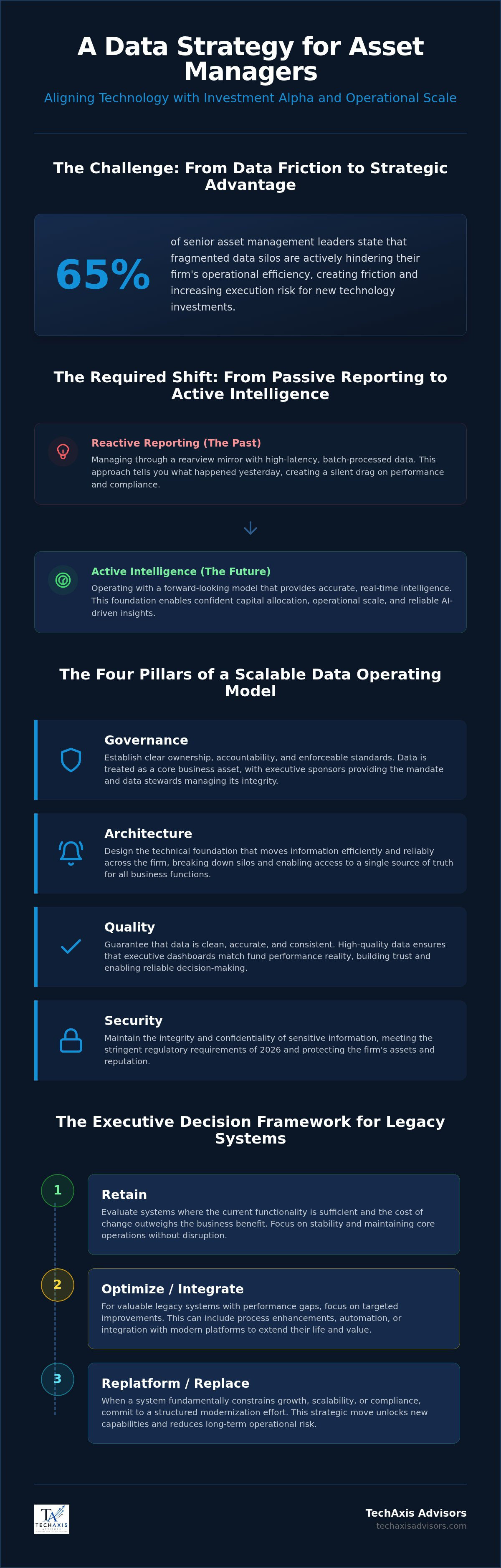
In 2026, a data strategy for asset managers is no longer a technical architecture; it is your firm's primary business operating model. You likely recognize that while the promise of AI and real-time business intelligence is compelling, the reality of fragmented data silos remains a constant source of friction. Recent industry research indicates that 65% of senior asset management leaders believe these silos are actively hindering their operational efficiency. It's difficult to justify large-scale technology investments when the risk of execution failure looms over every project.
This guide provides a pragmatic, evidence-based framework designed for executives to align data architecture with investment alpha and operational scale. We'll move past technical jargon to focus on the mechanics of scaling and the business value of accurate, real-time intelligence. We will examine how to navigate 2026 regulatory shifts, such as the final implementation phase of the GENIUS Act, and provide a structured decision framework to help you transition from fragmented reporting to a scalable, disciplined operating foundation.
Table of Contents
Beyond Reporting: The Strategic Role of Data in Asset Management
In 2026, the distinction between operational survival and market leadership in the asset management industry often comes down to how a firm treats its information. A data strategy for asset managers isn't merely a technical architecture or a collection of cloud tools. It's a deliberate alignment of technology, corporate governance, and business objectives. For many firms, data remains a fragmented byproduct of legacy systems. This fragmentation creates high execution risks, especially as the SEC implements stricter reporting timelines for Form N-PORT and the GENIUS Act implementation progresses.
Simple reporting tells you what happened last month. Strategic business intelligence tells you what to do tomorrow. Transitioning from one to the other requires a robust foundation. Without it, any attempt to adopt AI will likely fail. AI requires clean, governed, and accessible data to generate reliable insights. If your foundation is cracked, your AI outputs will be useless. A strategic approach ensures your data is an asset that drives alpha rather than a liability that creates friction.
The Shift from Passive Reporting to Active Intelligence
Traditional reporting often fails because it's inherently reactive. When executives rely on manual spreadsheets or batch processed data, they're managing through a rearview mirror. Data latency is a silent drag on investment performance. A 2025 survey of 200 senior leaders found that 69% of asset managers view the speed and accuracy of fund data as a primary differentiator for winning distribution partners. Moving to a proactive operating model means shifting from passive observation to active intelligence. It's about having the right data at the right time to make informed capital allocations.
Why Data Strategy is an Executive Leadership Priority
Data has historically been relegated to the IT cost center. This is a strategic error. In a modern firm, the C-suite must define data risk tolerance and set the vision for how information drives business outcomes. Executive leadership ensures that data investments aren't just technical upgrades but are tied to long-term operational scale. When the board views data as a strategic asset, the firm can move with precision.
Effective governance requires three core components:
Accountability: Leaders must establish who owns the data at each stage of its lifecycle.
Transparency: Real-time visibility into fund data reduces organizational anxiety and improves compliance posture.
Scalability: A disciplined strategy allows a firm to grow assets under management without a linear increase in headcount.
Seeking advisory leadership can help bridge the gap between technical potential and tangible business results. This clarity is essential for navigating the high stakes of a regulated financial environment.
Core Pillars of a Scalable Data Operating Model
A successful data strategy for asset managers rests on four structural pillars: governance, architecture, quality, and security. Without these foundations, investments in advanced analytics or AI will likely result in fragmented outputs and high execution risk. Governance ensures that data has a clear owner. Architecture provides the pipes that move information across the firm. Quality guarantees that the numbers in your executive dashboard match the reality of your fund's performance. Security maintains the integrity required in a highly regulated 2026 environment.
Understanding the fundamentals of a data strategy requires moving beyond tool selection to organizational design. It's about building a system that scales with your assets under management. When these pillars are aligned, the firm moves from managing technology to managing outcomes. This shift is what allows a mid-market firm to compete with global strategy firms by operating with greater agility and precision.
Establishing Executive Governance and Accountability
Governance is not a committee; it's a set of enforceable standards. To succeed, you must distinguish between executive sponsors and data stewards. Sponsors provide the capital and strategic mandate. Stewards manage the day-to-day integrity of specific data domains like client onboarding or trade execution. Building a culture of data literacy is essential. Every department must understand how their inputs affect the firm's total intelligence. For a deeper look at this mandate, explore our guide on Data Driven Decision Making for Executives.
Architecting for Scalability and Integration
Modern architecture requires a choice between centralized data warehouses and decentralized data fabrics. While a warehouse offers a single source of truth, a fabric allows for greater flexibility across disparate systems. The goal is interoperability. Your investment, risk, and marketing data shouldn't live in isolation. This integration is the prerequisite for automation. If you're struggling to bridge these gaps, it may be time to discuss your specific architectural challenges with a partner who understands the mechanics of scaling.
Quality and accuracy remain the ultimate metrics of success. In 2026, real-time business intelligence is the standard. This requires automated validation checks that flag errors before they reach an executive report. Security and compliance must be baked into the architecture, not added as an afterthought. Meeting the rigorous standards of financial services means ensuring that data privacy is maintained as information flows through your ecosystem. This disciplined approach replaces organizational anxiety with controlled, professional progress.
The Executive Decision Framework: Retain, Optimize, or Replatform
A data strategy for asset managers must address the reality of legacy infrastructure. Many firms fall into the trap of assuming that modernization requires a total replacement of existing systems. This is often an expensive mistake. Instead, executives should adopt a disciplined framework to evaluate whether to retain, optimize, or replatform their current technology stack. The goal is to maximize operational scale while minimizing execution risk. Decisions should be driven by business outcomes, not technical novelty.
Strategic architecture is about trade-offs. Sometimes, keeping an older system is the most pragmatic choice. If a platform provides reliable fund data and isn't blocking your 2026 roadmap, retention preserves capital for higher-impact initiatives. Optimization involves integrating existing silos through modern APIs to improve data flow without the trauma of a full migration. Replatforming should only occur when technical debt becomes a measurable drag on growth or a compliance liability. This evidence-based approach ensures that technology serves the business, not the other way around.
Evaluating the Business Case for Modernization
Assessing technical debt requires more than a software audit. It requires an analysis of business value. You must quantify the hidden costs of "business as usual," such as manual data reconciliation and delayed reporting. These inefficiencies often represent a significant percentage of operational spend. For a detailed guide on navigating these choices, see our framework on How to Modernize Legacy Technology for Growth. A clear business case replaces organizational anxiety with a structured path forward.
Navigating the Trade-offs of Technical Execution
Speed-to-market often conflicts with long-term structural integrity. Executives must balance these competing priorities with care. Risk mitigation strategies, such as phased migrations and parallel processing, are essential for complex data transitions. Avoid the "prestige tax" of over-engineered solutions that don't align with your specific scale. Effective execution relies on a Data & Reporting Strategy that prioritizes tangible results over abstract technical perfection. This focus on mechanics over theory is what distinguishes a successful transformation from a costly project failure.
Modernization is a journey of disciplined progress. By focusing on the business case, you can avoid the high execution risks associated with unnecessary technology projects. Whether you choose to optimize or replatform, the decision must lead to executive clarity and a more scalable operating foundation. This is the hallmark of a seasoned professional approach to technology leadership.
Bridging the Gap: From Strategic Roadmap to Operational Execution
Transitioning from a strategic vision to operational reality requires a methodical, disciplined approach. Many firms struggle because their roadmap is a list of technical desires rather than a prioritized action register. A successful data strategy for asset managers begins with a structured diagnostic phase. This evidence-based assessment identifies specific gaps in your current architecture, governance, and reporting accuracy. By using objective diagnostics, you replace organizational guesswork with executive clarity and a defined path forward.
Execution is where most technology projects face high risk. Without a clear bridge between the board's objectives and the technical team's output, projects often drift into over-engineered solutions that fail to deliver business value. Success requires a focus on the mechanics of scaling. You must ensure that every technical milestone is tied to a measurable business outcome, such as reduced data latency or improved regulatory transparency for 2026 compliance mandates.
Building a Prioritized Action Roadmap
A prioritized roadmap identifies "quick wins" to build organizational momentum. These are high-impact, low-complexity actions that demonstrate immediate value to stakeholders. For example, automating a single manual fund data reconciliation can save hours of operational effort and reduce error rates. Once momentum is established, you can sequence long-term structural changes to minimize disruption to the daily investment process. This approach ensures the roadmap remains board-ready and transparent, providing a clear view of progress and ROI at every stage.
Managing Execution Risk and Vendor Oversight
Execution risk is often a byproduct of poor vendor oversight. Implementation projects frequently fail when vendors are left to manage themselves without independent advisory oversight. Independent leadership ensures that technical delivery remains aligned with the firm's strategic interests. This is why many firms utilize structured Executive Intelligence Assessments to maintain a clear, evidence-based view of project health. These assessments provide the necessary diagnostics to course-correct before small issues become costly failures.
Maintaining structural integrity during a transformation is a leadership challenge. It requires a deep understanding of Technology Due Diligence for Growth-Stage Companies to ensure that new systems don't introduce fresh technical debt. Independent advisory leadership provides the executive-level perspective needed to manage complex vendor ecosystems and ensure that the final architecture supports your long-term growth objectives.
Advisory-Led Data Transformation: Achieving Executive Clarity
Achieving a functional data strategy for asset managers requires more than just a well-defined roadmap; it requires the right leadership model to oversee execution. Many firms find themselves caught between the high cost of a full-time executive hire and the risks of leaving technical decisions to junior staff or biased vendors. Advisory-led transformation offers a middle path. It provides the seniority needed to manage complex data ecosystems while maintaining the agility of a growth-stage firm. This approach ensures that every technology investment is directly tied to the CEO's strategic vision.
Execution is a leadership function. It isn't just a technical one. Independent advisory serves as a bridge between high-level strategy and the delivery partners who build the systems. This oversight ensures that your data architecture remains focused on business value rather than technical novelty. In the high-stakes environment of 2026, where regulatory shifts like the GENIUS Act demand absolute transparency, executive clarity is your most valuable asset. It replaces organizational anxiety with a sense of controlled, disciplined progress.
The Role of the Fractional CTO in Data Strategy
A fractional CTO provides executive-level perspective without the full-time cost of a permanent C-suite hire. This model is particularly effective for asset managers navigating complex modernizations or AI readiness initiatives. An embedded leader ensures long-term transformation support by aligning technical execution with broader business goals. They manage the trade-offs between speed and structural integrity, ensuring that the firm doesn't over-engineer solutions. To understand if this model fits your current scale, consider When Does a Growth Company Need a Fractional CTO?
TechAxis Executive Data & Analytics Assessments
Our structured diagnostic engagements are designed to provide rapid executive decision support. Utilizing the proprietary TechAxis Executive Intelligence Platform, we conduct evidence-based assessments of your current state. These aren't technical audits; they're strategic evaluations of how data flows through your firm. The deliverables are concise. You receive board-ready briefs and prioritized strategic roadmaps that identify exactly where to invest for maximum impact.
These assessments provide the evidence needed to move forward with confidence. By identifying gaps in governance, architecture, and reporting accuracy, we help you build a scalable operating foundation. This disciplined process ensures that your data strategy for asset managers is rooted in reality. You gain a clear view of the mechanics of your business, allowing for more accurate capital allocation and improved distribution partnerships. Clarity is the prerequisite for scale. With the right leadership and evidence-based diagnostics, your firm can transform data from a source of friction into a driver of investment alpha.
Moving from Strategy to Disciplined Execution
A robust data strategy for asset managers is a prerequisite for scaling in a regulated 2026 market. Success depends on moving beyond technical silos to establish executive-led governance and clear accountability. By applying a structured framework to evaluate legacy systems, you can ensure that technology investments drive measurable business outcomes rather than technical debt. This disciplined approach replaces organizational anxiety with a sense of controlled progress.
TechAxis provides executive clarity through structured assessments led by former CIOs, CTOs, and CISOs. Our proprietary Executive Intelligence Platform delivers evidence-based findings and board-ready roadmaps to guide your transformation. We bridge the gap between technical potential and tangible results, ensuring your operating model is built for long-term structural integrity.
Aligning data with investment alpha starts with an evidence-based roadmap. With the right oversight, your firm can transform data from an operational hurdle into a primary driver of scale and distribution success.
Frequently Asked Questions
What is the primary goal of a data strategy for asset managers?
The primary goal is the alignment of data architecture with investment alpha and operational scale. It ensures that information is treated as a strategic business asset rather than a back-office byproduct. This alignment is essential for meeting 2026 regulatory requirements, such as the SEC's proposed amendments to Form N-PORT, by providing accurate, real-time business intelligence across the enterprise.
How long does it take to see ROI from a new data strategy?
ROI typically manifests in phases, with initial "quick wins" appearing within three to six months. These early results often involve automating manual reconciliations or reducing data latency in reporting. Long-term structural ROI, such as the ability to scale assets under management without a linear increase in headcount, generally matures over a twelve to eighteen month period as the roadmap is executed.
Do we need to replace our legacy systems to build a modern data architecture?
Replacement is rarely the only solution and is often the most expensive path. Executives should evaluate the business case to retain, optimize, integrate, or replatform existing systems based on technical debt and business value. Integrating legacy silos through modern APIs often provides a faster, more pragmatic route to a modern data strategy for asset managers than a total replacement.
What is the difference between a technical audit and an executive data assessment?
A technical audit focuses on software code and hardware functionality, while an executive assessment is a decision-support engagement. Executive assessments evaluate how your data strategy for asset managers supports specific business objectives. These engagements provide board-ready findings and a prioritized roadmap, moving the conversation from granular technical issues to high-level strategic progress and risk mitigation.
How does a fractional CTO support data strategy execution?
A fractional CTO provides executive-level leadership and independent oversight on a part-time or project basis. They bridge the gap between the CEO's strategic vision and the technical teams or vendors performing the work. This model ensures that transformations remain focused on business outcomes while avoiding the significant cost and commitment of a full-time C-suite hire.
What are the risks of ignoring data governance in wealth management?
Ignoring governance leads to fragmented data silos and significantly higher execution risk in technology projects. A 2025 survey revealed that 65% of senior asset management leaders believe fragmented data is actively hindering their operational efficiency. Without clear ownership and accountability, firms face increased regulatory scrutiny and a lack of reliable data for critical investment decisions.
Can a data strategy improve our AI readiness for 2026?
A robust data foundation is the mandatory prerequisite for any successful AI or automation initiative. AI models require clean, governed, and accessible data to produce reliable investment insights or operational efficiencies. A disciplined strategy ensures your architecture can handle the data complexity required for AI, preventing the "garbage in, garbage out" problem that plagues over-engineered projects.
What is the cost difference between a boutique advisory and a Big Four firm?
Boutique advisories generally offer a more efficient cost structure by providing direct access to senior experts without the high overhead of global strategy firms. While we don't quote specific industry fees, boutique models prioritize high-impact advisory leadership over the large teams of junior consultants often deployed by the Big Four. This ensures that you pay for executive experience rather than a prestige tax.



Comments