

Data Governance Consulting for Financial Firms: A 2026 Executive Framework
While 96% of financial firms report having AI governance principles, only 31% have a framework that's actively enforced. This gap represents a significant risk for executives who must balance the promise of automation with the strict reality of the Financial Data Transparency Act (FDTA) standards arriving in October 2026. You likely recognize the frustration of fragmented data across legacy systems; it's a structural barrier that prevents accurate real-time reporting and stalls your most ambitious technology initiatives. Specialized data governance consulting for financial firms is the bridge between this current state of organizational anxiety and a future of disciplined, scalable growth.
We've designed this executive framework to help you move beyond the compliance burden mindset. You'll gain an evidence-based roadmap to transform your data architecture into a reliable foundation for AI and operational excellence. This guide previews the 2026 regulatory landscape, evaluates the trade-offs of various technology investments, and provides a clear path toward verifiable data maturity. By the end, you'll have the clarity needed to make informed decisions that satisfy both the board and the regulators.
Table of Contents
Beyond Compliance: Data Governance as a Driver of Financial Operational Maturity
Data governance isn't a technical cleanup project. It's the structural integrity of your decision-making data. In finance, where precision is the baseline, governance ensures that the numbers on an executive dashboard represent a unified reality across the enterprise. While many leaders look for a foundational understanding of What is Data Governance?, the C-suite must view it through the lens of execution risk. Tactical "IT cleanup" focuses on fixing the plumbing; strategic governance focuses on the integrity of the flow. This is why data governance consulting for financial firms has evolved from a compliance checkbox into a core component of operational maturity.
When data is fragmented across legacy systems, the organization's ability to scale is limited by its manual reconciliation processes. A disciplined governance framework reduces the risk of failed technology implementations. It ensures that your technology operating model is built on a foundation of accountability and transparency. For CEOs and investors, this translates to predictable outcomes and a significant reduction in the technical debt that often stalls growth-stage firms.
The ROI of Disciplined Data Oversight
Fragmented data isn't just a nuisance; it's a measurable cost center. In asset management and wealth management, inaccurate reporting leads to reconciliation delays that eat into operational margins. Effective governance mitigates risk during complex cloud transformations and platform migrations. It provides a structured approach to technology due diligence, ensuring that any new investment integrates seamlessly with existing data standards. By establishing clear oversight, firms avoid the "rework tax" that occurs when data quality issues are discovered late in a project lifecycle.
Shifting from Tactical IT to Executive Clarity
Boards now demand more than anecdotal evidence of technology performance. They require evidence-based findings that demonstrate how data supports the firm's strategic goals. Proactive firms are moving away from reactive troubleshooting toward structured Executive Intelligence Assessments. These assessments provide the board-ready clarity needed to prioritize technology investments. By utilizing an Executive Intelligence Platform, leaders can transition from "best guess" budgeting to data-backed strategic roadmaps. This shift ensures that every technology decision is aligned with the firm's long-term vision for scale and efficiency.
Key Components of a Modern Financial Data Governance Framework
A modern framework requires more than just policy documents. It needs a defined technology operating model that clarifies lines of accountability across the entire organization. This model identifies who owns specific data sets and who is responsible for their accuracy at every stage of the lifecycle. Specialized data governance consulting for financial firms helps leadership move beyond the policy-practice gap. By establishing these structural foundations, you ensure that technology investments are governed by business outcomes rather than technical convenience.
Data Architecture and Reporting Strategy
Wealth management executives require accurate, real-time business intelligence to make informed decisions. Achieving this requires moving beyond static spreadsheets and siloed databases toward a scalable data foundation. This architecture must prioritize data quality and provable end-to-end lineage, which are critical for meeting regulatory standards like BCBS 239. For a comprehensive look at these architectural shifts, explore our framework for Data Strategy for Asset Managers. Many leaders find that Getting Started with Data Governance requires a disciplined focus on how data flows from ingestion to reporting. This transparency replaces organizational confusion with a sense of controlled, disciplined progress.
Vendor and Platform Management Oversight
Most financial firms rely on an ecosystem of third-party platforms. These vendors must be brought under the same governance umbrella as your internal systems to ensure compliance and risk alignment. Rigorous application modernization assessments are necessary to evaluate whether these platforms align with your specific risk appetite. This oversight helps reduce technical debt by identifying underperforming or redundant systems. Specialized data governance consulting for financial firms provides the independent oversight needed to manage these complex vendor relationships effectively. By aligning your IT infrastructure with long-term business goals, you create a more resilient operating foundation. If your current vendor oversight feels reactive, it's likely time for a confidential executive conversation to reassess your strategy.
Preparing for AI: Governance for Financial Intelligence
AI isn't a tool acquisition problem; it's a data integrity problem. While the market pushes "agentic AI" and rapid adoption, regulated firms can't afford the risk of "black box" models. If your underlying data is fragmented, your AI outputs will be unreliable. This is where data governance consulting for financial firms provides critical value by ensuring that the data used to train and run models is auditable and trustworthy. Without this foundation, AI implementation often leads to "hallucinating" financial models that fail to meet 2026 regulatory standards. For a deeper dive into these requirements, see our AI in Financial Services strategic framework.
The Executive AI Readiness Assessment
Before investing in automation, you must evaluate your organizational maturity. An assessment identifies whether your data is clean enough to support automated decision-making. Don't chase every new tool. Instead, develop a tailored roadmap that identifies "low-hanging fruit" for operational efficiency. This might include automating routine reporting or reconciling datasets that currently require manual intervention. A significant gap exists between policy and practice; while 96% of financial firms report having AI governance principles, only 31% have an enforced framework. This methodical approach ensures your technology investment yields a measurable return without increasing your risk profile.
Mitigating Technical and Regulatory Risk
Regulators are increasingly focused on the traceability of automated systems. As of 2026, the EU AI Act and updated GLBA standards require documented bias testing and complete data lineage. A governance-driven AI strategy acts as a defense against this scrutiny. It ensures that every automated decision can be traced back to its data source. This level of accountability requires a senior-level perspective that bridges the gap between technical execution and business strategy. By implementing technical controls alongside policy, you close the gap between having AI principles and actually enforcing them. Currently, only 53% of firms have implemented the necessary technical controls according to AAA-ICDR Institute data. Closing this gap is essential for maintaining your license to operate in an increasingly automated market. Senior leaders must ensure that AI governance isn't just a document in a drawer but a functional part of the technology operating model.
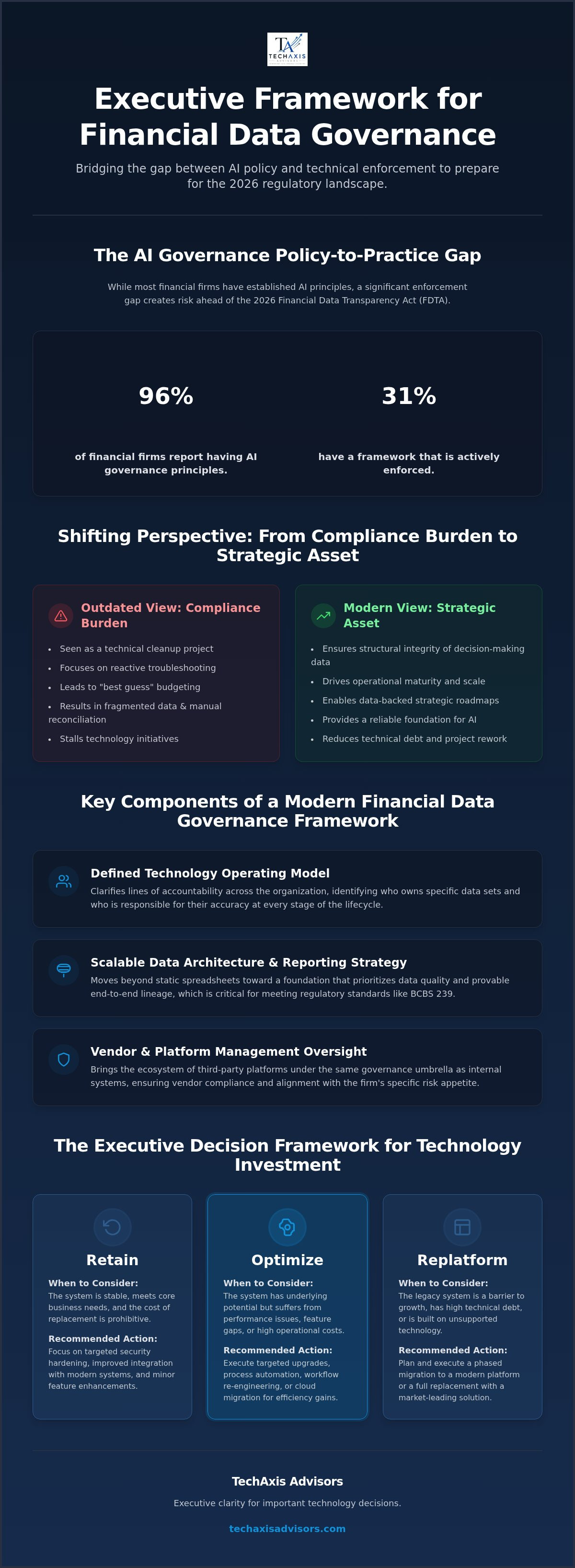
The Executive Decision Framework: Retain, Optimize, or Replatform
Replacement isn't always the answer. In fact, the assumption that legacy systems must be replaced often leads to unnecessary capital expenditure and high implementation risk. For many growth-stage firms, the most pragmatic path involves salvaging existing investments while addressing the data gaps that limit performance. Engaging specialized data governance consulting for financial firms helps leaders identify which systems can be salvaged and which are truly preventing operational scale. We evaluate the business case for six strategic options: retain, optimize, integrate, replatform, replace, or retire.
This disciplined framework ensures that technology spend is justified by evidence-based findings rather than vendor pressure. Boards don't care about tool features; they care about operational performance and the successful delivery of business transformations. By focusing on these six paths, you can preserve capital and reduce the organizational friction that typically accompanies a "rip and replace" strategy. Data governance consulting for financial firms provides the transparency needed to decide which path offers the highest return on investment.
Evaluating Technical Debt and Execution Risk
Technical debt isn't just a collection of old code; it's a structural barrier to scaling. When manual workarounds become the standard operating procedure, execution risk rises. We use structured diagnostics to identify where these bottlenecks exist and build a prioritized action register for modernization. This process mirrors the rigor of a Technology Due Diligence assessment. It highlights the specific areas where legacy infrastructure fails to support current regulatory requirements or reporting needs. Identifying these risks early allows you to address them before they compromise a major business initiative or an investor audit.
Developing a Prioritized Strategic Roadmap
A successful roadmap aligns technology investments with long-term business outcomes. It's not about implementing every available feature. It's about balancing quick wins with foundational infrastructure improvements. You must have executive clarity on the tradeoffs of each modernization path. For example, optimizing an existing reporting engine might provide the immediate clarity needed for a board meeting while you plan a longer-term replatforming project. This methodical flow ensures that your technology operating model remains agile. It allows you to pivot as market conditions or regulatory priorities shift without losing the structural integrity of your data.
Strategic Execution: Leveraging Fractional Technology Leadership
Data governance isn't a project with a fixed end date; it's a permanent operational requirement. For many growth-stage firms, the challenge isn't just defining the rules, but finding the senior-level authority to enforce them. Data governance consulting for financial firms often fails when there's no internal leader to bridge the gap between technical teams and the board. Fractional technology leadership solves this by embedding executive-grade oversight directly into your firm's operating model. This approach provides the structural integrity you need without the capital commitment of a full-time C-suite hire.
A fractional executive serves as a trusted advisor who understands the unique pressures of wealth management and private equity. They move beyond the "policy-practice gap" by ensuring that every technology decision aligns with the firm's broader strategic goals. This transition from a diagnostic assessment to ongoing execution leadership ensures that your data roadmap remains a living, functional asset. It replaces organizational confusion with a disciplined, results-oriented commitment to progress.
The Role of the Fractional CTO in Growth Companies
Growth-stage firms often face a leadership gap during periods of rapid transformation. You might have capable technical staff, but they likely lack the experience to manage complex vendor oversight or large-scale platform migrations. A fractional leader provides this missing execution support, acting as an independent advocate for your business interests. They ensure that third-party platforms meet your internal standards for data lineage and transparency. If you're wondering when a growth company needs a Fractional CTO, the answer usually lies in the complexity of your current technology debt. Unlike global strategy firms that often deploy junior consultants, a fractional partner provides direct access to veteran wisdom and hands-on delivery oversight.
TechAxis Executive Intelligence Assessments
Strategic progress begins with clarity. Our structured Executive Intelligence Assessments deliver board-ready briefs that replace technical jargon with evidence-based findings. These assessments provide CEOs and investors with an independent view of their technology maturity and a prioritized roadmap for improvement. We don't just identify problems; we provide the mechanical bridge needed to solve them. By utilizing our proprietary platform, you gain a clear understanding of the trade-offs involved in every technology investment. This methodical flow ensures that your firm is not just compliant, but operationally prepared for the demands of 2026. Your path toward disciplined, scalable growth can start with a confidential executive conversation to explore whether your priority requires an assessment or fractional leadership.
Establishing a Foundation for Scalable Financial Operations
Data governance is no longer a peripheral compliance task. It's the structural foundation for your firm's AI readiness and operational scale. By moving beyond tactical IT cleanup and adopting a disciplined "Retain, Optimize, or Replatform" framework, you ensure that technology investments align with long-term business strategy. Specialized data governance consulting for financial firms provides the independent oversight needed to bridge the gap between policy and practice. This transition ensures that your data architecture supports the transparency and accuracy required by the 2026 regulatory landscape.
Our advisors are veteran CIOs, CTOs, and CISOs with more than 25 years of leadership experience. We utilize the proprietary TechAxis Executive Intelligence Platform to deliver board-ready briefs and evidence-based findings. This methodical approach replaces organizational anxiety with a sense of controlled, disciplined progress. You can transform your data from a compliance burden into a strategic asset that drives measurable value and supports your firm's growth objectives.
Your path toward a more resilient technology operating model starts with executive clarity.
Frequently Asked Questions
What is the primary difference between data management and data governance?
Data management focuses on the technical mechanics of moving and storing data. Data governance ensures that data is trustworthy, compliant, and aligned with business strategy. It establishes the structural integrity of decision-making data through clear accountability. While management keeps the systems running, governance provides the executive oversight required to satisfy boards and regulators. It's the difference between having a database and having a reliable source of truth.
How much should a financial firm invest in data governance consulting?
Investment levels vary based on organizational complexity and regulatory risk profile rather than a flat fee. Firms should evaluate the cost of fragmented data and the risk of failed technology implementations when setting budgets. Strategic data governance consulting for financial firms scales with your operational needs. The goal is to provide a high return on investment by reducing technical debt and enabling AI-driven growth without the expense of a full-time executive hire.
Can a fractional CTO manage data governance for a wealth management firm?
A fractional CTO is an ideal solution for wealth management firms needing senior-level oversight without full-time costs. They provide the leadership bridge between technical staff and the board; ensuring that governance policies are actually enforced. This model embeds executive wisdom into your technology operating model. It allows growth-stage firms to navigate complex digital transformations with the steady hand of a seasoned professional who understands the specific pressures of the financial sector.
How long does a typical Executive Data Assessment take?
Our assessments follow a structured workflow designed for executive efficiency. We begin with a diagnostic phase to identify specific organizational pain points. This leads to an intelligence synthesis that produces board-ready findings and a prioritized strategic roadmap. While the timeline depends on the scope of your data ecosystem, the focus is always on delivering actionable insights quickly. This process ensures leadership has the clarity needed to make confident technology investment decisions.
Why is data governance critical for AI implementation in finance?
AI models are only as reliable as the data used to train them. In regulated finance, "black box" models pose significant legal and operational risks. Robust data governance consulting for financial firms ensures that your data has provable lineage and integrity. This transparency is essential for complying with 2026 standards like the EU AI Act and updated GLBA requirements. Without governed data, AI implementation often leads to inaccurate financial models that fail regulatory scrutiny.
What are the risks of ignoring data governance in private equity acquisitions?
Ignoring data governance during an acquisition often leads to overvaluing a target company. Undiscovered technical debt and fragmented data sets can stall post-merger integration and inflate operational costs. Investors face the risk of inaccurate real-time reporting, which compromises their ability to track performance. Failed governance can also hide significant regulatory liabilities. Structured technology due diligence identifies these risks early, protecting the investment thesis and ensuring a scalable operating foundation.
How does TechAxis Advisors differ from the Big Four consulting firms?
TechAxis Advisors provides direct access to veteran executives rather than the junior consultant model often found at larger firms. Our advisors are former CIOs, CTOs, and CISOs with more than 25 years of experience. We use a proprietary Executive Intelligence Platform to ensure all findings are evidence-based and repeatable. This provides a level of senior perspective and pragmatic execution that larger global strategy firms may struggle to match at a mid-market scale.
What are the core deliverables of a technology governance engagement?
Every engagement focuses on providing executive clarity and actionable next steps. We provide artifacts designed for C-suite review, moving beyond generic reports to provide the intelligence needed for confident decision-making. Core deliverables include:
Concise board-ready briefs and findings summaries.
Prioritized strategic roadmaps and action registers.
Full methodology documentation for traceability.
Each deliverable serves as a mechanical bridge from diagnostic to execution.



Comments