

Creating a Pragmatic AI Roadmap for Executive Leadership in 2026
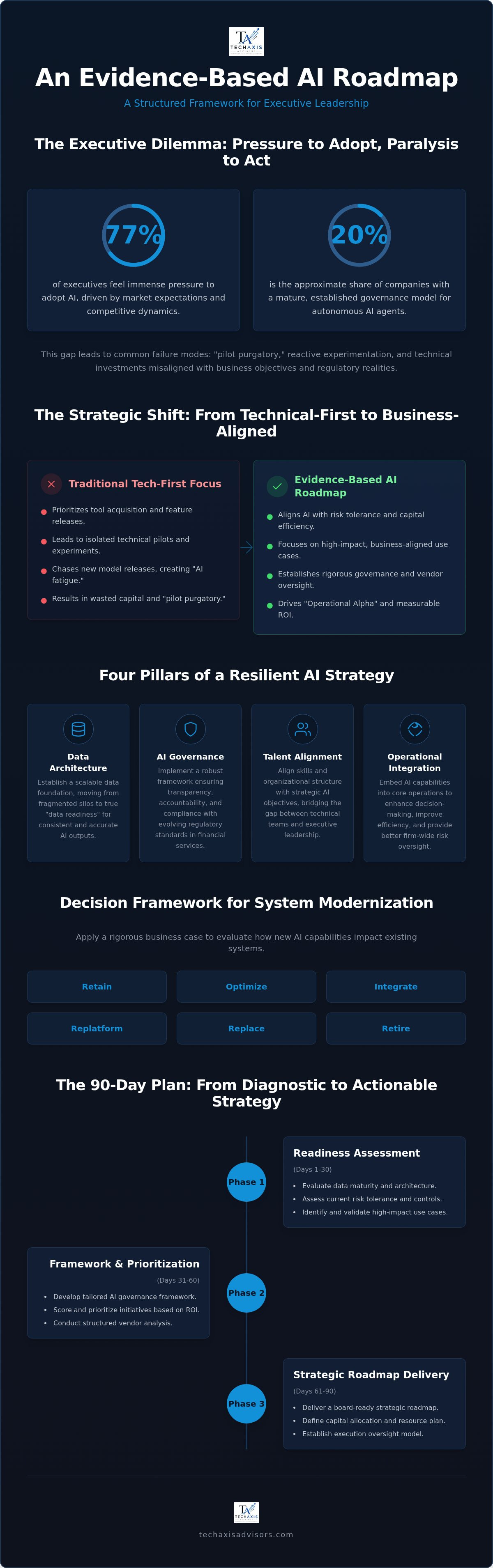
According to Deloitte’s 2026 State of AI in the Enterprise report, only about 20% of companies possess a mature governance model for autonomous AI agents. While Gartner forecasts worldwide AI spending to reach $2.59 trillion this year, many C-suite leaders remain caught in a cycle of reactive experimentation rather than strategic execution. Developing a pragmatic AI roadmap for executive leadership is now a requirement to protect margins and satisfy board level oversight. You've likely felt the weight of AI fatigue as model releases from OpenAI and Anthropic now arrive on a monthly cycle. It's difficult to justify technical investments when the regulatory environment, from the EU AI Act to new California transparency mandates, feels like a moving target.
We understand that your primary goal isn't to adopt technology for its own sake but to drive measurable business outcomes. This article provides a structured framework to move your organization beyond the hype and toward an evidence based strategy aligned with your core objectives. We'll examine how to identify the specific use cases that drive operational alpha and establish a rigorous governance structure for vendor oversight. You'll gain the clarity needed to transform technical potential into a board ready strategic roadmap that prioritizes security, compliance, and tangible ROI.
Table of Contents
Why Executive Clarity is the Foundation of AI Transformation
Executive leadership often views AI adoption as a technical hurdle. It's actually a strategy challenge. A traditional technology roadmap focuses on feature releases and software updates. In contrast, a pragmatic AI roadmap for executive leadership is a strategic document that aligns architectural choices with an organization's specific risk tolerance and capital allocation goals. Technical-first approaches often fail because they prioritize tool acquisition over business logic. This leads to "pilot purgatory," where organizations spend significant capital on experimental features that never reach production or deliver a measurable return.
Executive clarity prevents this waste. In financial services, the objective isn't just to adopt AI; it's to generate "Operational Alpha." This means achieving structural improvements in how the firm processes data, manages risk, and serves clients. The CEO's role is to move the conversation from hype-driven speculation to evidence-based objectives. By setting clear parameters for what AI should solve, leadership ensures that technical teams focus on high-impact use cases rather than chasing every new model release.
The Gap Between Interest and Implementation
Recent industry data indicates that 77% of executives feel immense pressure to adopt AI, yet few have successfully integrated it into core operations. This gap is largely driven by decision paralysis. Leaders are bombarded with monthly updates, such as the GPT-5.6 family or Claude Opus 5, and conflicting vendor claims. Information overload makes it difficult to distinguish between sustainable technology and passing trends. A structured diagnostic is necessary before committing to specific vendors or long-term contracts. This assessment ensures the firm understands its data readiness and regulatory obligations before investing capital in unproven systems.
Defining Success Beyond Productivity Gains
Productivity gains are often the first metric cited, but they're rarely enough to justify a complete transformation. True success is defined by structural operational maturity. AI should enhance data-driven decision-making and provide the board with better oversight of firm-wide risks. We call this "executive intelligence" in technology strategy. It's about building a foundation that allows for qualified delivery partners to execute on a clear, prioritized vision. When strategy is led by advisory leadership, the focus remains on business value rather than technical novelty. This approach ensures that every AI initiative contributes to the firm's long-term scalability and governance standards.
The Core Components of an Evidence-Based AI Strategy
An effective strategy replaces speculative technology adoption with structural integrity. It requires four distinct pillars: data architecture, governance, talent, and operational integration. Without these components, an AI roadmap for executive leadership remains a list of unfulfilled technical promises. Leaders must ensure that every investment serves a specific business objective while maintaining the firm's regulatory standing. This approach moves the organization from reactive experimentation to disciplined execution.
Building Scalable Data Foundations
AI is only as effective as the underlying data strategy. In wealth management and financial services, data is often trapped in legacy silos or fragmented across disparate platforms. For firms to scale, they must move beyond simple data collection to true data readiness. Establishing a comprehensive Data Strategy for Asset Managers is a prerequisite for any meaningful AI deployment. Without this foundation, models will produce inconsistent or inaccurate outputs that undermine executive confidence. High-quality, governed data ensures that "agentic" AI systems, which are increasingly common in 2026, can perform multi-step tasks with precision.
AI Governance for Financial Services
Regulated environments demand more than just technical security; they require transparency and accountability. A robust Governance Framework for Finance addresses privacy, algorithmic bias, and security. As of 2026, firms must navigate a complex patchwork of state-level regulations, such as the Illinois Artificial Intelligence Safety Measures Act and California’s transparency mandates. Compliance is no longer a check-the-box exercise. It's a core component of risk management. Structured assessments provide board-ready risk mitigation briefs that translate these technical requirements into clear business terms, ensuring that the firm remains ahead of SEC scrutiny.
Talent and operational integration complete the framework. Leadership must decide between building extensive internal teams or leveraging a fractional leadership model. For many growth-stage firms, fractional oversight provides senior expertise without the overhead of a full-time hire. Finally, AI tools must align with existing business workflows. Implementation should focus on augmenting human expertise rather than creating isolated technical islands. This ensures that the technology actually drives operational alpha. To determine where your firm stands in this transition, you may wish to start with a confidential executive conversation regarding your current infrastructure.
Decision Frameworks: Navigating Trade-offs in AI Adoption
A functional AI roadmap for executive leadership must move beyond simple "buy versus build" binaries. Instead, we apply a rigorous logic to existing technology assets: Retain, Optimize, Integrate, Replatform, Replace, or Retire. This framework ensures that capital isn't wasted on replacing systems that merely need better integration. Every decision carries a trade-off between speed and long-term technical debt. While rapid adoption of third-party tools might provide immediate functionality, it often creates fragmented data environments that are difficult to govern later.
Leadership must also evaluate the business case for custom development. While off-the-shelf solutions are faster to deploy, they rarely provide a competitive advantage. Custom builds, often supported through qualified delivery partners, allow for proprietary workflows that drive true differentiation. When selecting advisory partners, firms should be wary of the "prestige tax" associated with global strategy firms. These organizations often provide high-level theory delivered by junior staff. A boutique approach prioritizes senior-level access and evidence-based findings that translate directly into operational execution.
Evaluating AI Use Cases for Private Equity
In the context of Private Equity Technology Value Creation, the roadmap must prioritize initiatives based on EBITDA impact and exit readiness. We focus on "Operational Alpha", the measurable improvement in portfolio company performance through structural technology shifts. Using an Action Register allows leadership to track implementation progress with transparency. This disciplined approach ensures that AI initiatives aren't just technical experiments but are instead levers for increasing enterprise value before a liquidity event.
The Build vs. Buy Dilemma for Wealth Managers
Wealth managers face unique challenges regarding vendor lock-in and data sovereignty. When evaluating AI platforms, the cost-benefit analysis must include the long-term implications of white-label software development. A white-label approach allows firms to maintain a consistent client experience while leveraging external technical expertise. Vendor management strategies should prioritize platforms that offer robust APIs and data portability. This prevents the firm from being held hostage by a single provider's roadmap. Successful adoption requires a balance between external innovation and internal control over the client relationship.
The 90-Day Roadmap: Moving from Diagnostic to Operational Alpha
Executive transformation requires a disciplined timeline. Moving from ambiguity to "Operational Alpha" shouldn't take years. A structured 90-day AI roadmap for executive leadership provides a clear path for growth-stage firms. It begins with a deep diagnostic and ends with a governed pilot. This phased approach ensures that every step is backed by evidence-based findings rather than technical optimism. By breaking the process into three distinct 30-day blocks, leadership maintains control over capital allocation and risk management.
The Executive AI Readiness Assessment
The first thirty days focus on discovery. We conduct an Executive AI Readiness Assessment to evaluate the firm’s current data maturity, technical debt, and regulatory posture. This isn't a generic technical audit. It's a decision-support engagement designed to surface structural gaps before they become costly failures. By using the AI Readiness Assessment Checklist, leadership can identify "quick wins." These are low-complexity, high-impact automation opportunities that build organizational confidence without requiring massive architectural changes. These early successes prove the business case and secure buy-in for more complex initiatives later in the roadmap.
Synthesizing Intelligence into a Board-Ready Roadmap
Once the diagnostic is complete, the focus shifts to synthesis. We translate raw technical data into actionable executive briefs. These documents are designed for non-technical board members who need to understand technology risk and capital requirements without getting lost in jargon. A prioritized strategic roadmap emerges here. It includes a clear action register that assigns accountability for every milestone. This ensures that the AI roadmap for executive leadership remains a living document that guides the firm’s investment decisions. We categorize initiatives based on their potential for EBITDA impact and their alignment with long-term scalability goals.
The final phase, spanning days 61 through 90, involves launching a high-impact pilot. This is not a "black box" experiment. It is a controlled deployment with rigorous governance oversight and vendor accountability. We monitor performance against the initial business case to ensure the pilot drives measurable operational alpha. This 90-day cycle establishes a repeatable process for future AI initiatives, allowing the firm to scale with discipline. It bridges the gap between high-level strategy and tangible execution.
Ensuring Execution Continuity through Advisory Leadership
A well-defined AI roadmap for executive leadership provides the essential blueprint, but execution requires consistent senior-level oversight. Many growth-stage firms stumble because they delegate implementation to technical staff who lack the necessary business context. This disconnect often results in technical debt or tools that don't align with core organizational objectives. Advisory leadership bridges this gap by providing a steady hand during the transition from strategy to delivery. It ensures that vendors remain accountable and that technical decisions support long-term operational maturity. Independent oversight is particularly critical in financial services, where regulatory compliance and data security cannot be left to chance.
The Case for Fractional Technology Leadership
Growth-stage firms in wealth management and private equity often face a leadership vacuum. They need executive-level guidance to navigate complex technology shifts but don't yet require the overhead of a permanent, full-time CTO. This is where Fractional CTO Services become essential. These professionals act as "Strategic Architects," providing the wisdom of a veteran executive with the agility of a modern partner. They offer objective oversight for vendor implementations, ensuring that the firm isn't trapped by proprietary technical debt. By leveraging our Advisory Leadership model, organizations maintain the mechanics of scaling while focusing on their primary business goals. This approach provides the structural integrity needed to evolve as AI technologies advance.
Next Steps for Executive Leadership
The journey toward AI maturity is a continuous process. It begins with a structured diagnostic and moves toward strategic alignment through a prioritized action register. Leaders must maintain a business-first perspective on all technical investments. Every project should be evaluated on its ability to drive operational alpha and satisfy board-level oversight requirements. If your organization is facing information overload or unclear ROI on technical spend, it's time to shift the approach from reactive to proactive. We invite you to start a confidential executive conversation about your AI roadmap. This engagement provides the executive clarity needed to make informed decisions that protect your firm's future and drive sustainable growth.
From Strategic Intent to Operational Mastery
Transitioning from interest to implementation requires more than technical optimism. It demands a disciplined framework that aligns data architecture with business risk. By establishing a pragmatic AI roadmap for executive leadership, your firm can move beyond pilot purgatory and toward measurable operational alpha. This journey is built on evidence-based findings delivered via the TechAxis Intelligence Platform. It ensures that every investment is backed by board-ready deliverables and a prioritized roadmap tailored for the complexities of wealth management and financial services.
The pace of AI model releases won't slow down. Your strategy shouldn't either. Independent oversight and fractional leadership provide the bridge between high-level intent and tangible execution. You have the opportunity to replace organizational anxiety with a sense of controlled, disciplined progress.
We're ready to help you navigate these trade-offs with clarity and senior-level expertise.
Frequently Asked Questions
What is an AI roadmap for executive leadership?
An AI roadmap for executive leadership is a strategic document that aligns architectural choices with an organization's specific risk tolerance and capital allocation goals. It moves beyond technical feature lists to prioritize use cases based on EBITDA impact and structural operational maturity. This roadmap provides a clear sequence of diagnostic, synthesis, and pilot phases. It serves as a bridge between high-level board objectives and the technical mechanics of execution.
How much does an AI readiness assessment cost for a mid-market firm?
Costs for these executive decision-support engagements vary based on the scope of your data architecture and the complexity of your regulatory environment. We don't provide standardized price lists because each diagnostic is tailored to the specific infrastructure and scale of the firm. Leaders should evaluate this investment relative to the risk of failed technical pilots. A structured assessment prevents capital waste by identifying structural gaps before implementation begins.
Why do most AI projects fail at the executive level?
Failures typically stem from a technical-first approach that ignores business logic and operational integration. Projects often stall in the pilot phase because they lack clear governance or measurable ROI targets. When leadership follows hype rather than evidence-based findings, they often invest in tools that don't solve core organizational pain points. Success requires aligning every technical initiative with structural operational maturity and long-term scalability goals.
What is the difference between an AI audit and an executive assessment?
An AI audit is a retroactive technical check focused on existing system performance. An executive assessment is a forward-looking strategic exercise designed to build a pragmatic AI roadmap for executive leadership. It evaluates data readiness, talent gaps, and regulatory posture to provide board-ready clarity on capital allocation. The goal is to move from raw data to actionable intelligence that supports high-level decision-making.
How can wealth management firms ensure AI compliance?
Compliance requires a robust governance framework that addresses privacy, algorithmic bias, and security. Firms must navigate a patchwork of regulations, such as the Illinois AI Safety Measures Act and California’s transparency mandates effective in 2026. Implementing automated observability tools and maintaining an independent oversight model ensures that agentic systems remain within defined risk parameters. Regular reporting to the board on algorithmic transparency is now a standard requirement.
Does a growth-stage company need a full-time CTO for AI implementation?
Not necessarily. Many growth-stage firms benefit more from a fractional leadership model that provides senior expertise without the full-time executive salary. A fractional CTO acts as a strategic architect, overseeing vendor implementations and ensuring technical decisions align with business goals. This approach allows the firm to scale with discipline while maintaining professional distance from the granular mechanics of software builds or cloud migrations.
How long does it take to see ROI from an AI roadmap?
Initial quick wins can often be identified and piloted within the first 90 days of a structured roadmap. These early successes, such as automating reporting or data synthesis, build organizational confidence and prove the business case. However, structural operational alpha, which drives significant EBITDA impact, typically matures over six to eighteen months. Long-term ROI depends on the firm’s ability to integrate these tools into core business workflows effectively.
What are the risks of ignoring AI in private equity portfolio management?
The primary risk is the loss of competitive advantage during the exit phase. Portfolio companies that lack a modern data strategy or AI-driven operational efficiencies often face lower valuations during due diligence. Buyers in 2026 prioritize firms with mature technology governance and scalable infrastructure. Ignoring these shifts can lead to structural obsolescence and reduced enterprise value before a liquidity event or sale.


Comments