

Communicating Tech Strategy to Non-Technical Stakeholders
A sound technology plan can still stall when leaders cannot see the business decision behind it. That is a common challenge in communicating technology strategy to non-technical stakeholders. Technical detail can explain how a solution works, but executives and board members need to understand what it enables, what it requires in time and resources, which risks it changes, and what tradeoffs they are being asked to accept.
Technology leaders know that investment must support business priorities. The challenge is making that connection clear enough for stakeholders to compare options, align on acceptable risk, and commit to a decision. Without a shared understanding, discussions can circle around competing priorities instead of resolving them.
A practical communication framework can bring focus to those conversations. It helps leaders frame technology choices around business objectives, explain risks and tradeoffs in plain language, and make decision ownership and next steps explicit. The goal is not to remove technical substance. It is to ensure that technical detail supports a clear, accountable business decision.
Table of Contents
Why communicating technology strategy to non-technical stakeholders is a business priority
A five-part framework for explaining technology strategy to executives
Choose the right communication format for each technology decision
Address skepticism, competing priorities, and technology-versus-business misunderstandings
Turn executive understanding into accountable technology decisions and action
Why communicating technology strategy to non-technical stakeholders is a business priority
Technology strategy connects an organization’s priorities to the technology choices intended to support them. Technology strategy is more than a list of systems or projects. Communicating it means translating priorities, choices, implications, and requested decisions for the people responsible for approving, funding, overseeing, or delivering the work.
Technical accuracy is essential, but it does not guarantee shared understanding. A precise presentation can still leave executives unsure why an investment matters, which business outcome it supports, or what they are being asked to approve. When those points are unclear, investment rationale, risk ownership, and dependencies may go unresolved. Teams can then move forward with different assumptions about priority, timing, or acceptable disruption.
Before preparing materials, clarify each audience’s decision role. Are leaders being asked to set direction, approve funding, accept a risk, resolve a priority conflict, or receive an update? The answer determines what belongs in the main discussion and what can remain in supporting detail.
What non-technical stakeholders need to understand
Lead with the business objective and the organizational condition the strategy addresses. For example, a proposed platform integration might aim to reduce manual handoffs between teams. Explain the implications for customers, operations, resilience, growth, or governance, then state the decision required. Keep technical evidence available, but distinguish it from the information leaders need to make the decision.
Why technology presentations lose executive attention
Unexplained acronyms, detailed architecture diagrams, and long activity lists make it harder to see the business case. A progress report that says a team completed system configuration describes activity. It does not explain what capability that work supports, what impact is expected, or what uncertainty remains.
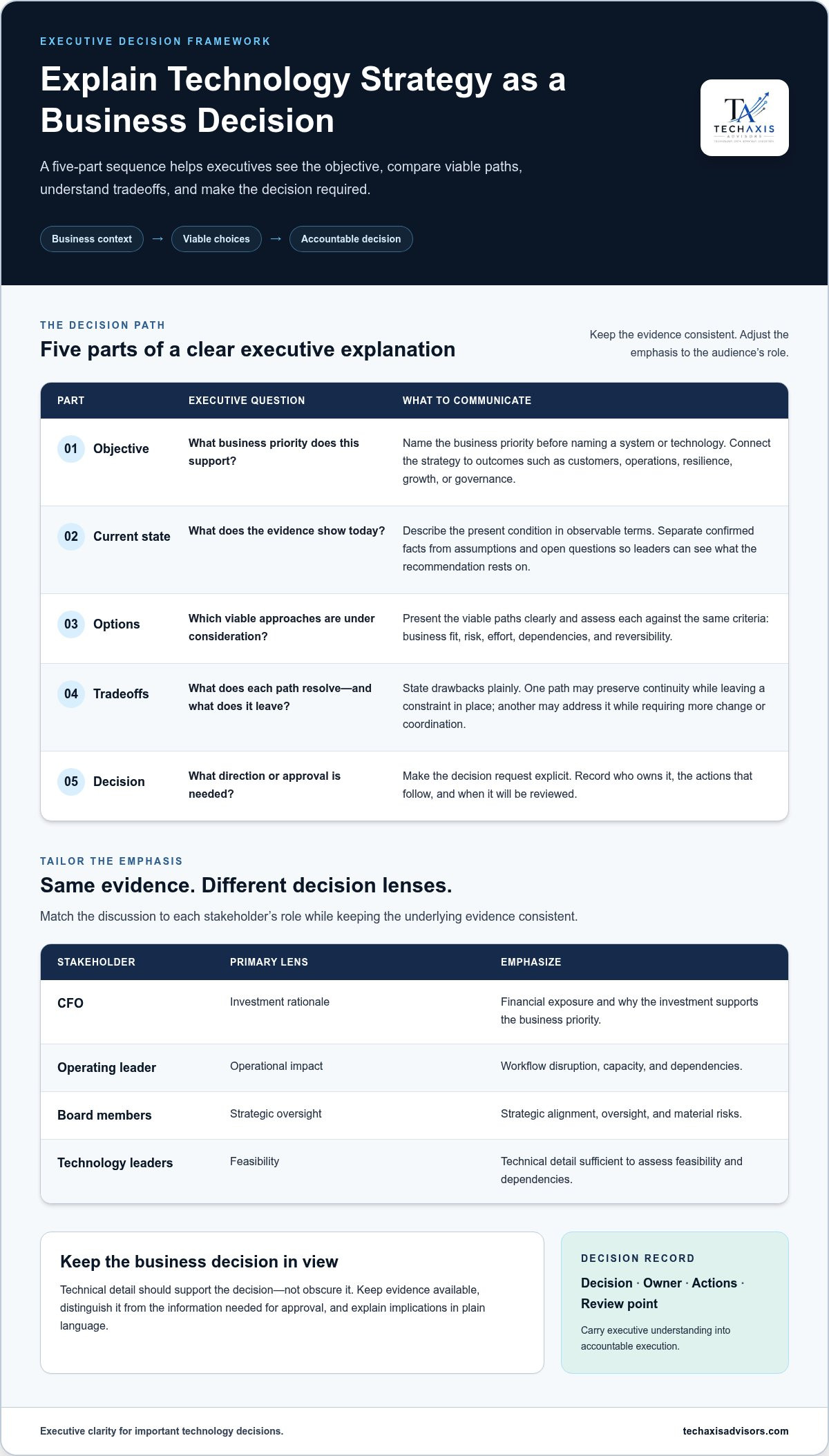
Emphasis should reflect the audience’s role. A CFO may focus on investment rationale and financial exposure. An operating leader may need to understand workflow disruption and capacity. Board members may require strategic alignment, oversight, and material risks. Technology leaders need enough detail to assess feasibility and dependencies. Effective communicating technology strategy to non-technical stakeholders keeps the evidence consistent while adjusting the emphasis for each group.
A five-part framework for explaining technology strategy to executives
Use a consistent sequence to move from business context to an actionable choice: objective, current state, options, tradeoffs, and decision. This structure gives executives and board members a clear path through the issue without requiring every audience to review the same level of technical detail. Adapt the emphasis, not the underlying evidence.
Start with the business objective and current state
State the business priority before naming a system or technology. If the objective is to make client onboarding more consistent, for example, describe the current constraint in observable terms, such as repeated manual handoffs or fragmented information. Distinguish confirmed facts from assumptions and unresolved questions. That separation helps leaders understand what the recommendation rests on and where further validation may be needed.
Present options, tradeoffs, and the decision request
Compare viable paths against the same criteria: business fit, risk, effort, dependencies, and reversibility. One option may preserve continuity but leave a known constraint in place. Another may address it while requiring more change or coordination. State the drawbacks plainly. A recommendation is more credible when leaders can see what it resolves and what it does not.
Use a decision-focused visual, such as a simple dependency map showing which work must happen first and which choices remain open. Avoid decorative graphics that do not clarify sequence, impact, or choice.
A concise executive summary can follow this pattern:
Objective: What business priority the strategy supports.
Current state: What the evidence shows about the present condition, plus assumptions and open questions.
Options: The viable approaches under consideration.
Tradeoffs: The implications for risk, effort, dependencies, and flexibility.
Decision: What approval or direction is needed, who owns it, and when it will be reviewed.
Keep the evidence consistent as you tailor the presentation. A CFO may need more emphasis on investment rationale. An operator may need to understand workflow dependencies. A board may need a concise view of strategic alignment and oversight. This approach makes communicating technology strategy to non-technical stakeholders a decision process rather than a technical briefing.
Leaders shaping a decision process around technology priorities can learn more through a confidential executive conversation.
Choose the right communication format for each technology decision
The format should fit the decision’s complexity and governance needs, not simply repeat the organization’s usual presentation template. A request for approval needs a clear recommendation. A decision with meaningful alternatives may call for an options discussion. A recurring progress update should report status, changes, and issues requiring attention, not reopen settled choices without cause.
Match the format to the decision and its risks
A decision memo works when leaders need a durable record of why an option was selected and what approval they gave. A board brief should foreground oversight: what the strategy means for the organization, where material exposure or dependencies remain, and which matters are still open. Use a live presentation when discussion is necessary, such as when operations and technology leaders must reconcile sequencing or resource priorities.
Keep recurring updates distinct from approval requests. If leaders are being asked to choose between viable paths, identify the choice directly rather than burying it in a status report. If no decision is required, say so and focus the update on what has changed.
Describe each risk in business terms: potential impact, evidence about likelihood, accountable owner, and mitigation approach. Separate known constraints from forecasts and assumptions that still need validation. Concise executive materials can carry the main narrative, with technical appendices available for leaders who need supporting detail. This makes communicating technology strategy to non-technical stakeholders clearer without obscuring uncertainty or technical accountability.
Address skepticism, competing priorities, and technology-versus-business misunderstandings
Clear communication does not mean removing technical complexity, minimizing risk, or shifting accountability away from technology leaders. It means explaining implications in business terms while preserving the evidence and uncertainty behind the recommendation. A question about cost may signal budget pressure. A concern about timing may reflect a critical operating period or a competing initiative. Listen for the business issue beneath the objection before responding.
Use follow-up questions to make the concern specific. Is the main issue the investment, timing, disruption to customers or staff, security exposure, or capacity required from another team? Naming the concern helps distinguish a disagreement about priorities from a gap in evidence or an unresolved dependency. It keeps communicating technology strategy to non-technical stakeholders grounded in the decision at hand.
Respond to objections with evidence and tradeoffs
Acknowledge the concern first, then answer with what the organization knows. If leaders question a proposed timeline, explain the dependencies that shape it, which assumptions still need validation, and what could change the estimate. If cost or disruption is the concern, compare viable alternatives and describe the consequences of delaying or changing course. Avoid presenting forecasts as guarantees. Be direct about unknowns and identify how they will be tested or monitored.
For example, if an initiative depends on data from another system, state that dependency plainly. Explain what happens if it is delayed and who can resolve the issue. This gives executives a basis for action without overstating certainty or reducing the discussion to technical detail. When priorities overlap, make the competing needs visible rather than assuming everyone weighs them the same way.
Build alignment without forcing consensus
Agreement on every point is not always necessary. Clarity about decision rights is. Identify who recommends a course, who makes the decision, whose expertise informs it, and who owns execution. If disagreement remains, record the issue and the decision-maker’s rationale rather than presenting dissent as consensus.
After the discussion, send a concise follow-up confirming the decision, accountable owners, open actions, and review points. That record gives teams a common reference and makes it easier to revisit the choice if assumptions change. It also preserves a clear line between advice, approval, and delivery responsibility.
For support with a technology decision, TechAxis Advisors offers a confidential executive conversation.
Turn executive understanding into accountable technology decisions and action
A strategy conversation is only complete when leaders can see what was decided and who is responsible for carrying it forward. Close the loop with a decision record and action register. The record should capture the approved direction, rationale, decision owner, and open risks. The action register should translate that direction into prioritized work, accountable owners, dependencies, and review points.
Create a clear record of decisions and accountability
Keep progress reporting tied to the outcomes the organization expects, the decisions still needed, and any material changes to timing, scope, dependencies, or risk. A regular review cadence gives executives a defined point to assess whether assumptions remain valid and whether action is on track. It makes ownership visible without requiring leaders to follow every technical activity.
For example, if a strategic priority depends on coordinating work across technology and operations, name the accountable leads and the dependency between their actions. If circumstances change, record what changed and whether it affects the approved direction. This creates a reliable link between executive intent and execution.
When executive decision support can help
Sometimes the next step is not another presentation. Leaders may need stronger evidence about the current environment, clearer options, or help maintaining oversight as work proceeds. A structured Executive Intelligence Assessment is an executive decision-support engagement that synthesizes evidence into findings and a prioritized roadmap, with an action register and executive-ready presentation to support decisions and ownership.
After an assessment, retained advisory or fractional leadership can provide continuity in governance, decision-making, and execution oversight. These roles address different needs: an assessment helps clarify the decision, while ongoing advisory or fractional leadership can help maintain alignment and accountability as priorities move forward. Learn more about how advisory engagements work.
Communicating technology strategy to non-technical stakeholders is most effective when the discussion leads to a clear choice, a named owner, and a way to review progress. The right support depends on whether the immediate need is evidence for a decision or leadership continuity after it.
Make the Next Technology Decision Clear and Accountable
Strong technology communication gives executives more than a clear explanation. It connects a business objective to the current situation, helps leaders compare options and tradeoffs, and makes the decision and ownership required explicit. The format should fit the decision, while follow-through should capture the rationale, actions, accountable owners, and review points.
That is the practical value of communicating technology strategy to non-technical stakeholders: leaders can make choices with a shared view of the evidence, risks, and responsibilities. When additional decision support is useful, an executive assessment can provide board-ready findings, a prioritized roadmap, an action register, and an executive presentation. TechAxis Advisors founder Aarati Dikshit brings more than 25 years of CIO, CTO, and CISO experience to technology leadership and advisory work.
To explore whether your priority calls for an assessment, strategic advisory, or fractional leadership, start with a confidential executive conversation.
Clear decisions create a stronger basis for coordinated action. With the right context, ownership, and review cadence, technology strategy can remain connected to the business priorities it is meant to serve.
Frequently Asked Questions
How do you explain a technology strategy to non-technical stakeholders?
Start with the business objective, then explain the current constraint, available options, tradeoffs, and decision required. Use evidence leaders can assess, and separate confirmed facts from assumptions or open questions. For example, explain how a proposed system integration relates to a business priority before describing its technical design. Adapt the level of detail for each audience, but keep the underlying evidence and key implications consistent.
How should technology leaders present a strategy to a board?
Present the strategy as a governance and business decision, not a technical inventory. Explain how it supports organizational priorities, what material risks or dependencies need oversight, and which decisions remain open. State whether the board is being asked to provide direction, approve a choice, or receive an update. Keep supporting technical detail available, but focus the main brief on implications, accountability, and the response required from board members.
What should an executive technology strategy presentation include?
An executive presentation should identify the business objective, current state, viable options, important tradeoffs, and decision request. Include the evidence behind the recommendation, distinguish known constraints from assumptions, and make dependencies and accountable owners visible. A useful closing summary states what leaders need to decide, who will act, and when progress or assumptions will be reviewed. Keep technical appendices available for questions without crowding the executive narrative.
How do you communicate technology risk to non-technical executives?
Describe each risk through its potential business impact, the evidence informing its likelihood, its accountable owner, and the mitigation approach. Explain effects executives can evaluate, such as possible disruption to operations or customers, rather than relying on technical labels alone. Be transparent about what is known and what remains uncertain. If a forecast depends on assumptions or external work, name those dependencies and explain how they will be monitored.
How can technology leaders respond when stakeholders are skeptical?
First acknowledge the concern, then clarify what is driving it. A question about timing may reflect operational capacity, while a cost objection may signal a competing investment priority. Respond with available evidence, relevant alternatives, and the tradeoffs of delaying or changing course. Avoid overstating certainty. If an assumption needs validation, say what remains unknown and how the organization can resolve it before making or revisiting the decision.
How often should technology strategy progress be communicated?
Set a cadence that reflects the initiative’s governance needs, decision points, and pace of change. Agree with sponsors on when they need routine updates, what information each update should contain, and which issues require prompt escalation. Report progress against expected outcomes, decisions needed, material changes, and emerging dependencies. Even when there is no major change, a concise update can maintain shared visibility and confirm whether the agreed direction still holds.
What is the difference between a technology update and a technology strategy presentation?
A technology update reports what has changed during execution, what remains on track, and where leaders may need to intervene. A strategy presentation focuses on direction: the business objective, current conditions, options, tradeoffs, and decisions required. An update should not become a strategy discussion unless new information changes the direction or requires approval. Keeping the purposes distinct helps executives understand whether they are being asked to monitor, resolve, or decide.
Can an executive technology assessment help leaders communicate strategy?
Yes. An executive assessment can organize evidence into decision-ready findings, helping leaders explain the current state, priorities, options, and areas requiring ownership. TechAxis Advisors’ structured Executive Intelligence Assessments provide board-ready findings, a strategic roadmap, an action register, and an executive presentation. These deliverables support executive decision-making and follow-through. Leaders still need to evaluate tradeoffs, assign accountability, and review progress as conditions change.



Comments