

Common Technology Mistakes Startups Make, and How Leaders Can Prevent Them
The technology choices that help a startup move quickly can also constrain its next stage of growth. The common technology mistakes startups make rarely begin with a bad tool. They begin when systems, vendors, data, and security decisions outpace business priorities and clear ownership. Which decisions could limit your company’s ability to scale?
Speed matters, but moving quickly without a decision framework can leave the business with disconnected investments, growing complexity, and risks no one clearly owns. The answer isn’t to replace every system or build for every possible future. It’s to identify what matters now, understand the tradeoffs, and act in proportion to business impact and risk.
This article examines recurring technology decision patterns that can hold startups back, from overbuilding and premature scaling to weak governance and unclear accountability. It also offers a practical way to assess priorities, weigh options, and assign ownership. The goal is a realistic path to stronger technology foundations without adding complexity the business doesn’t need.
Table of Contents
Why common technology mistakes startups make become harder to reverse as they grow
Seven common technology mistakes startups make across systems, data, and risk
How to distinguish a technology symptom from the decision causing it
A practical framework for preventing startup technology mistakes
How executive technology advisory can turn findings into a startup action plan
Why common technology mistakes startups make become harder to reverse as they grow
Startups need to move quickly. A small team may reasonably choose a simple tool, handle a process manually, or test a product before committing to a larger build. The tension is not speed versus discipline. It’s whether a decision is a deliberate experiment, with an owner and a review point, or an unexamined workaround that becomes part of how the business operates.
Technology choices shape operating capacity, customer experience, and risk. A process that depends on one person copying information between systems may be manageable at first. As activity grows, it can slow service and make errors harder to spot. A product built without a clear customer need may use scarce development capacity without improving the experience customers value. The right foundation is proportional to the business, not designed for hypothetical scale.
Technology decisions should reflect the company’s business objectives, operating needs, and tolerance for risk. Evaluate a shortcut by the consequences it creates, not simply by whether it looks technically imperfect.
When a practical shortcut becomes a structural constraint
Intentional experimentation has a purpose, a decision owner, and a point at which the team will reassess it. A workaround made without ownership or review can persist after requirements change. Hypothetical example: a startup manually transfers customer details between sales and service tools to validate a new workflow. If that process becomes routine without review, staff may spend more time reconciling records, and customers may receive inconsistent follow-up. The issue isn’t that the team started manually. It’s that nobody revisited the choice.
Early product decisions need the same discipline. An Minimum Viable Product (MVP) can help a team test a focused set of assumptions before building a broader product. The test should inform what to retain, change, or stop. A limited first version becomes a constraint when the business treats it as permanent despite new evidence about customer needs or operating requirements.
Why growth changes the consequences of early decisions
Growth adds users, workflows, and dependencies. A tool that once served one team may become part of several critical processes. If systems don’t share reliable information, employees must reconcile records, coordinate handoffs, or wait for reports assembled from different sources. That adds friction to decisions and can affect the consistency of customer interactions.
Fragmentation can also obscure accountability. Teams may disagree about which data is current, who maintains an integration, or who can approve a change. Those gaps can increase operational and control risk, especially when sensitive information or important workflows are involved. Not every startup needs enterprise-scale systems from day one. Review whether the current setup supports actual business demands, then address dependencies that create material delays, risk, or customer impact.
Seven common technology mistakes startups make across systems, data, and risk
Technology problems often start as separate decisions: a tool purchased to solve an immediate need, a workaround left in place, or a vendor relationship without a clear owner. Over time, these choices can compound across operations, reporting, and risk management.
Tool accumulation is not a technology strategy. Each investment needs a defined business purpose, an accountable owner, and a place in the operating model.
Technology choices that create avoidable complexity
Early choices should fit current needs while leaving room to reassess. Watch for recurring friction: teams compensating for missing requirements, integrations, or decision ownership with manual effort.
Buying tools before defining requirements. A platform may solve one team’s immediate problem but fit the wider workflow poorly. Look for repeated customization or separate processes that teams maintain just to make the tool work.
Overbuilding or scaling platforms too early. Designing for unproven demand can divert capacity from customer needs. Check whether features, infrastructure, or operating complexity exceed what the current product and workflows require.
Allowing point solutions to become disconnected systems. Separate tools can create duplicate records and inconsistent reporting. A practical warning sign is staff exporting, re-entering, or reconciling information to complete routine work.
Leaving technical debt without an owner. Some technical debt is a purposeful tradeoff, provided leaders understand and revisit it. Unmanaged dependencies and undocumented workarounds increase the effort involved in change. Teams may also struggle to explain how a critical process works.
Oversight gaps that expose the business
Leadership should oversee decisions about data, access, vendors, and automation because they affect business continuity and risk. Clear accountability helps teams address issues before they become embedded in daily operations.
Building on weak data foundations. Inconsistent definitions or incomplete records can undermine decisions and customer workflows. A recognizable signal is two teams producing different answers to the same business question.
Leaving vendor and security oversight undefined. Unclear ownership of renewals, integrations, data access, exit planning, or access reviews can limit flexibility and weaken accountability. Watch for critical knowledge held only by a vendor, teams unsure who manages the relationship, or permissions that remain after roles or needs change.
Adopting AI without a defined use case or governance. Automation may produce unreliable outputs or introduce data-handling concerns when inputs, review responsibilities, and acceptable uses aren’t established. A warning sign is a pilot with no clear business measure or accountable owner.
For leaders weighing these issues, an executive conversation about technology priorities can help clarify which decisions warrant attention first.
How to distinguish a technology symptom from the decision causing it
A visible technology problem is a clue, not a diagnosis. Repeated manual work may point to a process gap, an integration issue, or unclear ownership. Replacing a system before understanding which factor drives the friction can add disruption without addressing the cause. Use symptoms to guide investigation, then test the decisions and dependencies behind them.
These patterns don’t prove a single root cause. Inconsistent reports, for example, might reflect different business definitions rather than a failing reporting platform. Ask who relies on the affected process, where information originates, what decisions the process supports, and who is accountable for its performance. The answers help distinguish a technical limitation from an operating-model problem.
Signals executives can investigate without assuming the answer
Trace a recurring workaround from the task back to its trigger. If employees re-enter data, determine whether the systems can be integrated, the process simplified, or ownership clarified. If reports conflict, compare definitions, sources, and update responsibilities before concluding that the reporting tool needs replacement. Establish what is failing and why before selecting a solution.
Once the underlying need is clear, consider the least disruptive viable response. Retain a system that still meets requirements. Optimize its configuration or process. Integrate it where information must flow between platforms. Replatform when the current environment limits necessary operations. Replace it when it no longer supports business needs, or retire it when the capability is unnecessary. Each option has different effort, dependency, and transition considerations.
A business-first test for technology decisions
Evaluate the options against four questions: Does the change support strategic objectives? Is the risk of keeping the current state within the company’s tolerance? How will each option affect customers and day-to-day operations? What people, data, vendor, and system dependencies must be addressed to execute it? Include the cost of inaction, such as ongoing manual effort or constrained decisions, alongside the disruption and delivery capacity required for change.
This approach is useful for the common technology mistakes startups make because it shifts attention from visible symptoms to accountable decisions. In a transaction or investment context, the same discipline can inform a broader review of technology due diligence for growth-stage companies, where capabilities, dependencies, and risks need to be understood before commitments are made.
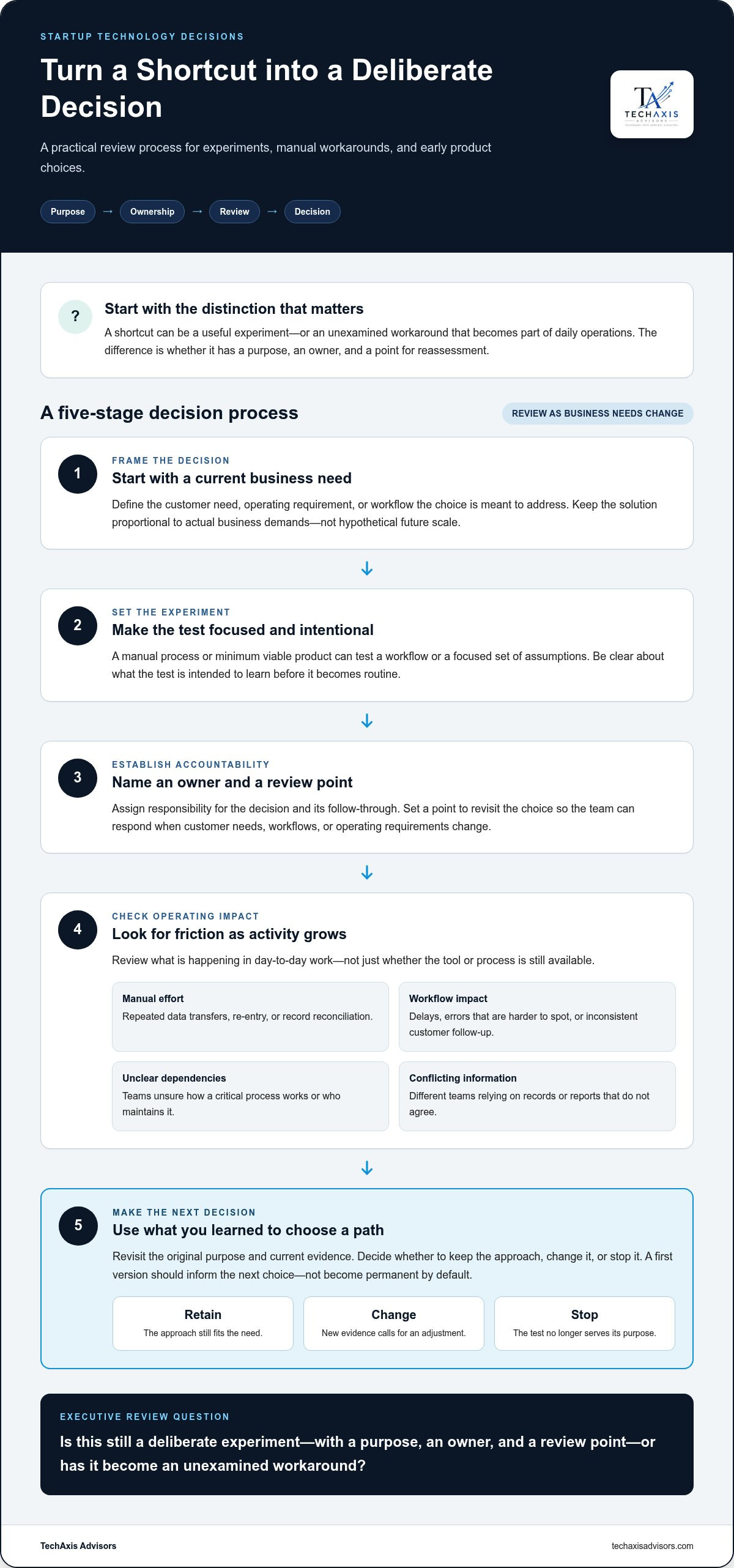
A practical framework for preventing startup technology mistakes
A small leadership team doesn’t need a large governance process to make better technology decisions. It needs a repeatable sequence that connects business priorities to evidence, tradeoffs, and accountable action. This framework helps address the common technology mistakes startups make without turning every choice into a major project.
Define the outcome. State the business result the decision should support, such as reducing delays in a customer workflow, improving reporting consistency, or supporting a planned operating change. Describe how leaders will recognize progress. Avoid defining success only as implementing a platform or completing a technical task.
Map dependencies. Identify the teams, processes, data, vendors, and systems affected by the decision. Note what depends on the current setup and what would need to change if it’s retained, optimized, integrated, replatformed, replaced, or retired. This exposes constraints before a solution is selected.
Assess risks and assumptions. Record what’s known, what remains uncertain, and what could happen if the current state continues. Consider customer and operational impact, access to reliable data, vendor reliance, and the consequences of disruption. Distinguish confirmed issues from assumptions that need validation.
Prioritize the work. Compare business impact, risk exposure, and strategic relevance with readiness to act. An urgent control gap may need attention before a longer-term architecture improvement. Account for dependencies, available evidence, internal ownership, and delivery capacity. A high-priority issue may still need a defined next step before a broader change is feasible.
Assign ownership. Name an executive decision owner who can set direction and resolve tradeoffs, alongside an operational owner responsible for coordination and follow-through. Document the decision, rationale, assumptions, dependencies, and review trigger in a concise action register.
Prioritize by business impact, risk, and readiness
Use a focused leadership discussion rather than a complicated scoring model. Ask which issue most affects customers or core operations, which creates material exposure, and which matters to the company’s direction. Then test whether the team has enough information, capacity, and ownership to proceed. If a critical dependency is unclear, make resolving it the next action rather than launching a broad replacement effort.
Create accountability without adding process for its own sake
Keep the record brief enough to maintain. A decision entry can capture the intended outcome, selected approach, alternatives considered, accountable owners, key assumptions, and the event that should prompt review. Set review points around meaningful changes, such as a new business requirement, an incident, or a material system decision, rather than adding standing meetings without a clear purpose.
When leadership capacity is limited, structured technology decision support can clarify priorities, owners, and execution steps while keeping decisions tied to business needs.
How executive technology advisory can turn findings into a startup action plan
When leaders have evidence but lack a shared view of its significance, an objective executive decision-support engagement can bring the business implications into focus. It is useful when technology choices affect strategic plans, risk tolerance, or operating priorities, and internal teams are too close to the issues to provide an independent perspective. The purpose is not to prescribe a predetermined solution, but to support informed executive judgment.
From assessment findings to prioritized decisions
A structured Executive Intelligence Assessment examines a defined area of technology in its business context. The findings are synthesized into an executive-ready view of what matters, why it matters, and where leadership attention may be warranted. Deliverables include board-ready findings, a strategic roadmap, and an action register. These materials give leaders a clear basis for discussion and connect technology considerations to business objectives without requiring the board to work through technical detail.
Advisory support can continue after an assessment, helping leadership interpret new information, maintain governance, and oversee vendors or qualified delivery partners involved in execution. This is executive guidance, not a guarantee of results or an assumption that every implementation is delivered directly by the advisor. TechAxis Advisors structures its technology advisory services around focused assessments, ongoing counsel, and fractional executive leadership.
Choosing the right level of leadership support
A focused assessment suits a defined question or area of uncertainty. Ongoing advisory provides strategic counsel as decisions arise over time. Fractional executive leadership offers a more sustained senior presence for organizations that need technology direction and governance but do not require a full-time executive. The right model depends on the scope of the decisions and the leadership capacity already in place.
Founder Aarati Dikshit brings more than 25 years of CIO, CTO, and CISO experience to this work. Leaders considering an independent perspective can start with a confidential conversation about whether an assessment, strategic advisory, or fractional leadership fits the decision at hand.
Make technology decisions part of the growth plan
Growth changes what the business needs from its systems, data, and vendors. Revisit key technology decisions when customer needs, operating processes, or strategic priorities shift. This keeps earlier choices visible and gives the team a chance to adjust before workarounds become harder to unwind.
The common technology mistakes startups make aren’t inevitable. Leaders can reduce the chance of repeating them by treating technology as an ongoing business responsibility, with decisions grounded in current objectives and clear accountability. Progress doesn’t require solving every issue at once. It starts with a well-defined priority and a realistic next step.
With a disciplined approach, your startup can keep moving quickly while making technology decisions that support the business as it evolves.
Frequently Asked Questions
Is technical debt always a problem for a startup?
No. The practical question is whether existing compromises are consuming capacity needed for planned work. Ask engineering to identify recurring delays or rework tied to earlier decisions, then compare the effort to address them with the value of upcoming product priorities. This makes technical debt a planning consideration rather than an abstract measure. Include agreed work in delivery discussions so it stays visible alongside customer-facing commitments.
Can an early-stage startup rely on spreadsheets before investing in data systems?
Yes, if a spreadsheet fits its purpose and the team can maintain it reliably. Define which file is authoritative, limit editing to people who need it, and use clear validation rules for important entries. For example, a forecast used in leadership decisions should identify its data source and update date. If mistakes become difficult to detect or correct, reassess whether the process still fits the decision it supports.
When should a startup consider fractional technology leadership?
Consider it when technology choices repeatedly require executive judgment that no current leader has the time or experience to provide. Examples include evaluating a major platform proposal, translating an operating plan into technology priorities, or preparing a clear view of technology needs for the board. The signal is not company size alone. It’s whether consequential decisions are stalled, made without sufficient context, or competing for a founder’s attention.
How often should startup leaders review their technology vendors and platforms?
Use contract renewal dates as a planning cue, but don’t rely on them as the only review point. Revisit a vendor relationship when the company changes its operating model, the service no longer meets user needs, or a product’s roadmap affects a planned business initiative. Before renewal, compare actual use with the original purpose and note any changes in service requirements. This keeps the discussion tied to business fit rather than habit.
What should a startup include in a technology risk review?
Include a short scenario exercise, not just a list of possible weaknesses. Ask what the company would do if a critical service became unavailable, a key employee could not perform their role, or an important vendor stopped supporting a needed capability. Clarify which business activities would be affected, what work could continue, and what decisions leaders would need to make. Record unresolved assumptions and use them to guide follow-up planning.
How can investors assess technology risks before investing in a startup?
Connect the review to the investment thesis and planned growth. Examine whether the product roadmap is supported by the company’s current delivery capacity, and whether critical technical knowledge is concentrated in one person or vendor. Investors can also review how product changes are planned, tested, and released, along with the rationale for major technology commitments. These questions help distinguish manageable constraints from issues that could affect execution after investment.



Comments