

Business Intelligence Strategy Consulting: A Framework for Executive Clarity
Most growth-stage organizations don't have a data problem; they have a clarity problem. You've likely invested in various platforms. Yet, your executive team still faces fragmented reports and a persistent lack of trust in reporting accuracy. This is why business intelligence strategy consulting has shifted from a technical exercise to a vital governance framework. It's about building a decision engine that aligns with your specific growth targets and risk tolerance. We agree that at the board level, a dashboard is only as valuable as the evidence-based findings it supports.
This guide provides a structured framework to transform disconnected legacy systems into a prioritized data roadmap. You'll learn how to improve the operational maturity of your reporting while managing increasing compliance risks. We also address critical governance needs, especially as evolving data privacy regulations nationwide demand more rigorous data handling. This approach replaces organizational anxiety with a sense of controlled, disciplined progress. By focusing on executive-level decision support, you can finally align your technology spend with tangible business outcomes.
Table of Contents
Beyond Dashboards: Why Business Intelligence Strategy Often Fails to Deliver Executive Clarity
The Architecture of Executive Intelligence: Defining a Strategic BI Framework
Evaluating the Business Case: Tradeoffs in BI Modernization and Advisory Models
A Step-by-Step Roadmap to Implementing a Governance-Led BI Strategy
Bridging the Execution Gap: Integrating Strategic Advisory into Data Operations
Beyond Dashboards: Why Business Intelligence Strategy Often Fails to Deliver Executive Clarity
Many organizations mistake a suite of visualizations for a comprehensive strategy. True Business intelligence (BI) isn't about the software you buy; it's a structured approach to acquiring and applying knowledge for executive decision-making. Without this strategic foundation, the technology becomes a cost center rather than a value driver. Effective business intelligence strategy consulting focuses on bridging the gap between raw data collection and board-ready insights.
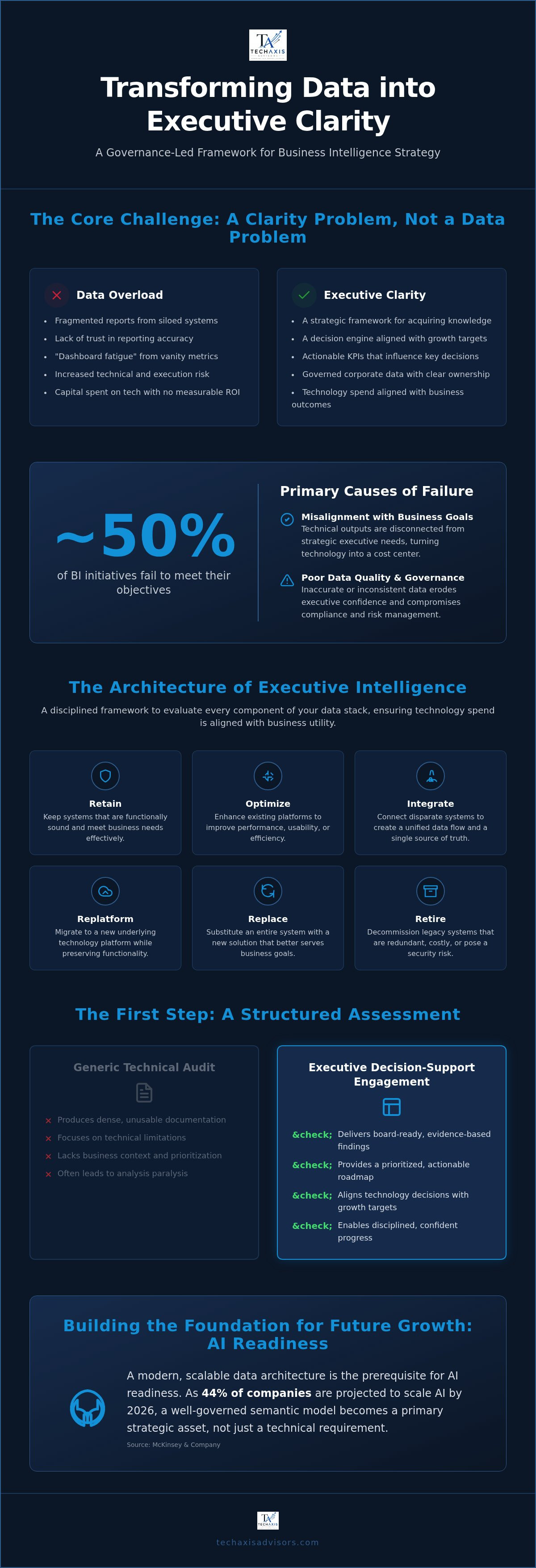
The stakes for getting this right are high. Industry data suggests that nearly 50% of BI initiatives fail to meet their objectives. These failures rarely stem from technical limitations. Instead, they result from a misalignment between data outputs and business goals, coupled with poor data quality. When reports don't reflect operational reality, executive confidence erodes. This disconnect creates a business issue where capital is deployed into tech stacks that provide no measurable return on investment.
Distinguishing between technical reporting and Executive Intelligence is critical for growth-stage firms. Reporting tells you what happened; Executive Intelligence explains why it happened and what the trade-offs are for the next move. The cost of inaction is significant. Beyond the wasted setup costs, organizations without a roadmap face lost market opportunities and increased technical debt. They find themselves reacting to the market rather than leading it.
The Disconnect Between Data and Decision-Making
C-suite leaders often find that more data actually leads to less clarity. This phenomenon, known as dashboard fatigue, occurs when teams prioritize vanity metrics over actionable KPIs. If a metric doesn't influence a specific business decision, it shouldn't be on the executive summary. Fragmented data foundations also increase technical execution risk. When data lives in silos, the probability of conflicting reports increases, making it impossible for the board to reach a consensus on the path forward.
The Role of Governance in BI Success
Successful business intelligence strategy consulting moves beyond simple technical audits. It treats data as a governed corporate asset through executive decision-support engagements. In highly regulated sectors, such as wealth management or private equity, data lineage and accuracy aren't optional. They're foundational to compliance and risk management. Establishing a clear framework ensures that every data point has a verified source and a clear owner. Proper governance provides the structural integrity needed to scale operations without compromising reporting reliability.
The Architecture of Executive Intelligence: Defining a Strategic BI Framework
A disciplined architecture is the difference between a high-performing data asset and a collection of expensive silos. Effective business intelligence strategy consulting begins with a structured diagnostic. At TechAxis Advisors, we utilize our proprietary Executive Intelligence Platform to provide this clarity. We don't assume your current stack needs total replacement. Instead, we evaluate every component through a rigorous framework: retain, optimize, integrate, replatform, replace, or retire. This ensures your technology spend remains aligned with actual business utility.
Modern data architecture is now the prerequisite for AI readiness. As organizations look to scale AI across the enterprise, as 44% of companies are projected to do by 2026 according to McKinsey, the underlying semantic model becomes a strategic asset. You can review our strategic advisory services to see how we bridge these technical requirements with business goals. Building a scalable operating foundation ensures your reporting capability evolves alongside your organizational maturity.
Evidence-Based Assessments vs. Generic Audits
Technical audits often produce dense, unusable documentation. In contrast, an executive decision-support engagement delivers board-ready findings. These include concise briefs, prioritized roadmaps, and clear action registers. By using a structured platform for these assessments, we ensure traceability. Every recommendation is backed by evidence rather than consultant intuition. This methodology mirrors the rigor found in the EDUCAUSE library on BI strategy, which emphasizes the need for a verified process to drive institutional success.
Aligning Technology with Risk Tolerance
Your data architecture must reflect your organization's risk profile. In wealth management and financial services, this means integrating compliance requirements directly into the BI roadmap. Strategy dictates whether you need real-time data streams or if batch processing suffices. It also determines how you handle cybersecurity risks and technology governance. A scalable foundation must evolve with your maturity, ensuring that as you grow, your reporting remains accurate and your data remains secure. If you're ready to define your roadmap, you can start with a confidential executive conversation.
Evaluating the Business Case: Tradeoffs in BI Modernization and Advisory Models
Selecting the right partner for business intelligence strategy consulting is a financial decision as much as a technical one. Executives often weigh the brand recognition of global strategy firms against the senior-level access provided by boutique advisory models. While large firms offer significant scale, they frequently deploy junior resources for the actual execution. This can lead to a gap between high-level theory and the practical realities of your data environment. In contrast, boutique firms prioritize direct engagement with veteran executives who bring decades of operational experience to the table.
The choice between a full-time hire and fractional leadership is another critical tradeoff for growth-stage organizations. A full-time CTO is a significant capital commitment that may exceed the current needs of the business. You can explore this further in our Fractional CTO vs Full Time CTO: An ROI Analysis. Fractional leadership allows you to access high-level strategy and governance without the overhead of a permanent executive salary. This model is particularly effective when navigating the complex transition from legacy reporting to a modernized data architecture.
Modernization doesn't always require a complete system replacement. The business case for optimization is often stronger than the case for a total overhaul. Replacing core systems involves high costs and significant operational risk. By evaluating whether to retain, optimize, or integrate existing tools, you can achieve the necessary reporting clarity while preserving capital. This pragmatic approach ensures that every technology dollar is tied to a specific, measurable business outcome.
Choosing the Right Strategic Partner
Effective advisory requires a deep understanding of the executive perspective. You should evaluate firms based on the actual experience of their leadership; look for advisors who have served as CIOs or CTOs in your specific industry. Objective guidance is paramount. An independent partner avoids the bias of vendor-driven solutions and focuses solely on what aligns with your growth targets. This level of specialized expertise is essential for the firms we serve, particularly those in financial services and private equity.
The ROI of Strategic BI Advisory
The return on investment for strategic advisory is found in the reduction of execution risk. Expert oversight prevents common pitfalls, such as misaligned data taxonomies or failed platform migrations. Beyond risk mitigation, a structured strategy drives operational efficiency through automated reporting frameworks. This reduces the manual labor required for data preparation and allows your team to focus on analysis. To justify the investment to the board, focus on clear performance metrics: reduction in reporting cycles, improved data accuracy rates, and the speed of evidence-based decision-making.
A Step-by-Step Roadmap to Implementing a Governance-Led BI Strategy
Execution requires a methodical progression from discovery to mastery. Effective business intelligence strategy consulting avoids the common mistake of attempting to solve every data issue at once. Instead, it focuses on a sequence that builds structural integrity while delivering immediate executive clarity. This roadmap serves as your leadership bridge from technical confusion to evidence-based confidence.
Step 1: Conduct an Executive Data & Analytics Assessment. This is the necessary starting point for any BI strategy. It identifies critical gaps in your current reporting stack and evaluates the trustworthiness of your data.
Step 2: Define business-aligned KPIs. Move beyond vanity metrics. Focus exclusively on the data points that drive board-level decisions and align with your organization’s specific growth targets.
Step 3: Establish a data governance framework. Codify the rules for data handling to ensure long-term accuracy. This step is vital for meeting increasing regulatory demands in the financial sector.
Step 4: Design a prioritized strategic roadmap. Create a clear action register that categorizes initiatives by business value and technical complexity. This ensures resources are deployed where they provide the highest return.
Step 5: Execute via fractional leadership. Utilize advisory leadership or qualified delivery partners to oversee implementation. This provides the necessary governance to keep technical teams aligned with business outcomes.
Establishing the Data Foundation
A reliable reporting framework cannot be built on a crumbling foundation. You must address technical debt before layering on AI or advanced analytics. Modernizing your data architecture is about more than just moving to the cloud; it's about ensuring real-time reporting capability that supports operational scalability. If you're evaluating a potential acquisition or preparing for a major shift, use our Technology Due Diligence Checklist to evaluate your current infrastructure's readiness for transformation.
Governance and Risk Mitigation
In wealth management and financial services, data privacy is a primary operational risk. New 2026 state laws, such as the Indiana Consumer Data Protection Act, require rigorous opt-in consents and clear privacy notices for sensitive data. Building accountability into the data lifecycle protects the firm from reputational and financial damage. Proper governance ensures that your BI engine remains compliant while providing the evidence-based findings the board requires. You can explore Our Services to see how we integrate these compliance layers into your broader data strategy.
Bridging the Execution Gap: Integrating Strategic Advisory into Data Operations
Strategic plans often falter because the transition from diagnostic findings to operational execution is poorly managed. Many practitioners cite a lack of organizational buy-in as the primary reason for BI project failure. However, this is often a leadership gap rather than a cultural one. Effective business intelligence strategy consulting provides the necessary bridge by integrating advisory leadership directly into your data operations. This ensures that the prioritized roadmap developed during the assessment phase is actually implemented with precision. It moves the organization from passive insight to active, evidence-based action.
Fractional Leadership as an Execution Catalyst
Fractional CTOs serve as the 'Strategic Architect' for your digital transformation. They provide the senior oversight required to manage complex vendor relationships and internal technical teams without the overhead of a full-time executive hire. This role is critical for managing the shift from a diagnostic state to an active execution state. By maintaining a focus on governance and accountability, fractional leaders ensure that technical delivery remains aligned with the board's growth targets. They provide the steady, experienced hand needed to navigate high-stakes technology decisions during growth phases. You can learn more about this model through our Advisory Leadership services.
Maintaining Strategic Alignment During Growth
As your business matures, your reporting requirements will naturally become more complex. A static strategy cannot support a scaling organization. You must adapt your framework to handle new data streams and evolving compliance risks. When specific technical implementations are required, we support execution through qualified delivery partners and custom software development services. This vendor oversight ensures that any new builds adhere to the architectural standards established in your strategic roadmap. It prevents the accumulation of new technical debt that often occurs during rapid expansion.
The executive path to data-driven clarity is a continuous cycle of assessment, optimization, and mastery. By relying on evidence-based insights rather than anecdotal reports, you maintain the trust of the board and the confidence of your investors. This disciplined approach transforms fragmented data into a governed decision engine that protects the firm's interests while driving sustainable growth. Ultimately, the goal is to replace organizational confusion with a sense of controlled, disciplined progress.
Moving Toward Evidence-Based Executive Governance
Transforming fragmented data into a governed decision engine requires more than technical implementation. It demands a strategic shift toward executive clarity. We've explored how a structured framework moves your organization beyond dashboard fatigue and into a state of disciplined progress. By prioritizing governance and aligning technology with risk tolerance, you protect the firm's interests while driving sustainable growth. Effective business intelligence strategy consulting replaces organizational uncertainty with a structured path to operational maturity.
TechAxis Advisors supports this transition through evidence-based findings delivered via our proprietary Executive Intelligence Platform. Our team of former CIOs, CTOs, and CISOs provides the senior oversight necessary to bridge the execution gap. As a certified WOSB, MWBE, and SBE, we're committed to delivering the independent advisory your board requires. You don't have to navigate the complexities of digital transformation alone. This disciplined approach ensures your technology spend finally correlates with tangible business outcomes.
Start with a confidential executive conversation
Your organization's data holds the answers to your most pressing growth challenges. We look forward to helping you find them with the steady hand of a seasoned professional.
Frequently Asked Questions
What is the difference between BI strategy and a technical data audit?
A technical audit focuses on the current state of tools and code. A BI strategy is a governance-led framework that aligns data acquisition with executive decision-making. Strategy involves identifying growth targets and risk tolerance rather than just checking server logs. It provides a prioritized roadmap that treats data as a strategic corporate asset. This approach ensures that technical outputs directly support board-level confidence and operational goals.
How do we know if our firm needs an Executive Data & Analytics Assessment?
Your firm likely needs an assessment if the C-suite lacks trust in reporting accuracy or faces fragmented data across legacy systems. If you can't align technology spend with business outcomes, a structured diagnostic is required. This engagement identifies critical gaps and provides board-ready findings. It's the essential first step for any organization looking to scale its reporting maturity and reduce technical execution risk during periods of rapid growth.
Can a Fractional CTO help implement a business intelligence strategy?
Yes, a Fractional CTO serves as the strategic architect during the implementation phase. They provide senior-level oversight and execution governance without the overhead of a full-time hire. This model is particularly effective for managing the transition from strategic advisory to operational data operations. They ensure that vendor oversight and technical delivery remain strictly aligned with the board's growth objectives while building a scalable technology operating model.
What are the common reasons BI initiatives fail in financial services?
Initiatives often fail due to a lack of executive governance and a misalignment between technology tools and business goals. In financial services, poor data quality and failure to meet regulatory compliance risks are primary drivers of project collapse. Without a clear business intelligence strategy consulting partner, firms often fall into dashboard fatigue. This happens when teams collect vanity metrics that don't drive board-level confidence or actionable insights.
How long does it typically take to see results from a new BI strategy?
Initial results, such as improved reporting clarity and identified technical gaps, often emerge within the first 90 days following a diagnostic assessment. Achieving full operational maturity is a multi-phase process. The timeline depends on the complexity of your current data architecture and the prioritized roadmap developed during the strategy phase. Continuous advisory ensures that progress remains disciplined and measurable while the organization adapts to its new data-driven framework.
Do we need to replace our entire legacy tech stack for better reporting?
No, replacement isn't always the most pragmatic solution. We evaluate legacy systems through a framework of retain, optimize, integrate, replatform, replace, or retire. Often, optimizing existing systems or integrating siloed data is more cost-effective and carries less operational risk than a total overhaul. The goal is to build a scalable foundation that supports evidence-based findings without unnecessary capital expenditure or disruption to your current business operations.
How does AI readiness factor into a modern business intelligence strategy?
AI readiness is a foundational element of modern data architecture. As of 2026, a McKinsey survey indicates that 44% of organizations are scaling AI, making the underlying semantic model a critical strategic asset. A modern business intelligence strategy consulting engagement ensures your data is clean, governed, and structured for AI agents. This preparation allows for conversational analytics and real-time decision support, transforming static reporting into a proactive decision engine that scales with the business.


Comments