

Business Case for AI Implementation: An Executive Decision Framework
An AI pilot can work exactly as designed and still fail the investment test. A business case for AI implementation must show more than technical performance. It needs to connect measurable value to a business baseline and account for the full costs, risks, and operational ownership required to deliver it.
That standard can be difficult to meet. Expected benefits are hard to quantify before deployment, pilot results may not hold across everyday workflows, and dependencies such as data readiness, integration, governance, and staff adoption can remain unclear. Executives need a disciplined way to distinguish a promising demonstration from repeatable business value.
This article outlines how to build an evidence-based investment case, from defining outcomes and assessing total costs to evaluating risk, dependencies, and alternatives. It also explains how decision gates can guide leaders to scale, revise, or stop an initiative based on the evidence.
Table of Contents
Why an AI Implementation Business Case Must Start With a Business Problem
How to Build a Business Case for AI Implementation: Estimate Value, Costs, and Return
Compare AI Use Cases by Feasibility, Value, and Alternatives
Address AI Implementation Risks With Decision Gates and Measures
Turn the AI Business Case Into an Executive Decision and Action Plan
Why an AI Implementation Business Case Must Start With a Business Problem
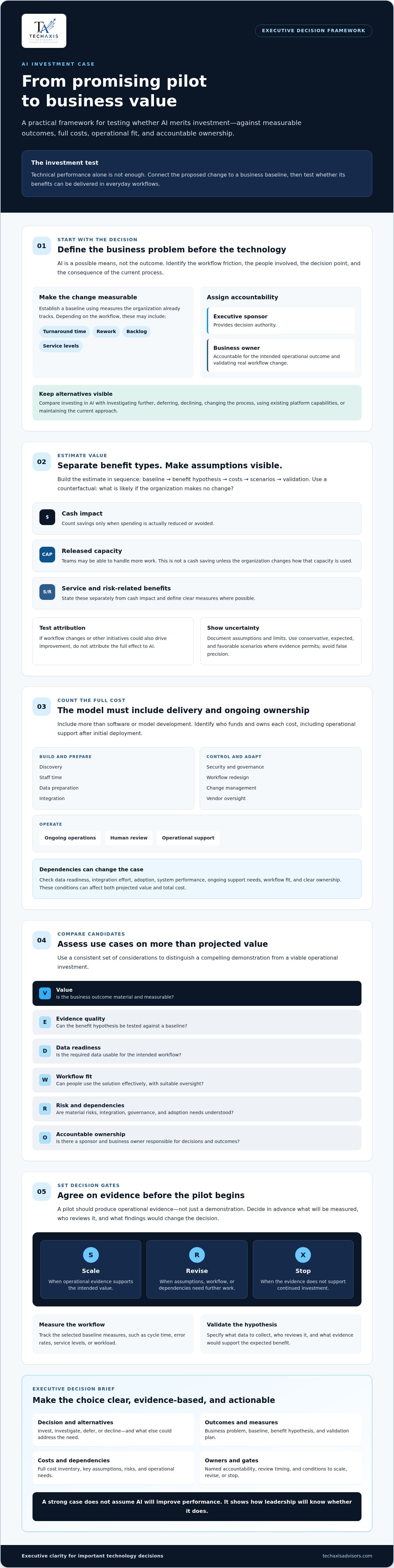
A business case for AI implementation is an evidence-based decision document that connects an investment to expected outcomes, full costs, material risks, organizational fit, and accountable ownership. It should explain what business problem needs to change and how leadership will determine whether the investment is working.
AI is a possible means, not the outcome. A firm may want faster research, more consistent service, or better-informed decisions. Start with that business need, then evaluate whether AI is suitable. Workflow redesign, existing software, or no change may be more appropriate.
Which business problem is important enough to evaluate?
Identify where friction occurs: the workflow, the users involved, the decision point, and the consequence of the current process. For example, a financial services team could examine delays in preparing client reports and establish a baseline using measures it already tracks, such as turnaround time, rework, backlog, or service levels. Do not assume AI will improve those measures.
Name an executive sponsor and a business owner. The sponsor provides decision authority. The business owner is accountable for the intended operational outcome and can validate whether the workflow changes in practice.
What decision should the business case support?
Frame the decision as whether to invest, investigate further, defer, or decline. Compare AI with practical alternatives, such as changing the process, using an existing platform capability, or maintaining the current approach. This makes tradeoffs visible and avoids treating adoption as the goal.
Consider organizational fit as well as technical feasibility. Assess whether employees can use the solution effectively, how responsibilities may change, and what oversight the workflow requires. A useful overview of potential risks of AI in the workplace can help leaders consider effects such as changes in work organization and deskilling.
The resulting decision should identify what evidence is still needed, who is responsible for obtaining it, and when it will be reviewed. For broader sector context, see this overview of the leadership teams TechAxis Advisors serves.
How to Build a Business Case for AI Implementation: Estimate Value, Costs, and Return
A credible estimate makes assumptions visible rather than presenting a single forecast as fact. Build the model in sequence: establish the baseline, state the benefit hypothesis, inventory costs, test scenarios, and define how results will be validated. This lets executives assess both potential return and confidence in the estimates.
How should leaders quantify expected benefits?
Start with a counterfactual: what is likely to happen if the organization makes no change? Then select measures tied to the workflow, such as cycle time, error rates, service levels, or workload. If AI is proposed to assist with report preparation, for example, estimate its potential effect on staff time and rework, then validate those measures against current process data.
Separate benefit types. Cash savings count only when spending is actually reduced or avoided. Released capacity may let teams handle more work, but it is not a cash saving unless the organization changes how that capacity is used. State service improvements and risk-related benefits separately, with clear measures where possible.
Document assumptions, attribution limits, and a range of outcomes. If an improvement could also result from workflow changes or other initiatives, do not attribute the full effect to AI. A validation plan should specify which data to collect, who will review it, and what evidence would support the benefit hypothesis.
Which costs and dependencies belong in the model?
Include more than software or model development. The full cost inventory should cover discovery, staff time, data preparation, integration, security, governance, workflow redesign, change management, vendor oversight, ongoing operations, and human review. Identify who funds and owns each element, including operational support after initial deployment.
Test assumptions that could change the result. Model how adoption, system performance, work volume, integration effort, or ongoing support needs could affect value and cost. Use conservative, expected, and favorable scenarios where the evidence permits. Avoid false precision when inputs remain uncertain.
Dependencies matter as much as estimates. Usable data, a suitable workflow, clear ownership, and user adoption may determine whether projected benefits are achievable. If these conditions are not in place, show the cost and work required to address them, or treat them as reasons to investigate before committing to implementation.
To structure assumptions and next steps, leaders can review TechAxis Advisors’ approach to advisory work as a reference for disciplined decision support.
Compare AI Use Cases by Feasibility, Value, and Alternatives
Once leaders have defined the business problem and how to assess value, they can compare a small set of candidate use cases. Apply common criteria rather than ranking ideas by enthusiasm or technical novelty. A business case for AI implementation is stronger when it explains why one opportunity is more actionable than another and what evidence is still missing.
How can executives prioritize candidate use cases?
Assess each candidate against strategic relevance, a measurable baseline, evidence quality, data readiness, workflow fit, risk, accountable ownership, and the organization’s capacity to deliver. Separate potential value from confidence. A high-value idea with weak evidence or no business owner may warrant investigation, not immediate investment.
A bounded test can resolve a specific uncertainty, such as whether a tool can handle the organization’s actual documents or fit a review workflow without adding unacceptable oversight. Define the question and success measures before testing.
These examples are prompts for organization-specific evaluation, not recommendations or proof of likely results. A comparison table should record evidence quality, dependencies, ownership, and risk alongside potential value. Avoid a numerical score unless the criteria and supporting evidence are clear. A composite score can conceal weak assumptions.
When might an alternative to AI be the better investment?
Compare AI with workflow simplification, conventional automation, existing platform capabilities, and process controls. If inconsistent data or unclear process ownership is the main constraint, address that first. Applying AI to a poorly defined process may reproduce its friction rather than resolve it.
When leadership needs structured readiness decision support before choosing among these paths, the Executive AI Readiness Assessment can help frame the decision.
Address AI Implementation Risks With Decision Gates and Measures
A positive pilot result is useful evidence, not proof of scalable business value. Reassess pilot evidence against the costs, oversight demands, integration needs, and operating conditions expected at scale. A business case for AI implementation should define those conditions before testing begins, so favorable results do not substitute for an investment decision.
Assign owners to distinct responsibilities: the business owner tracks intended benefits, data owners address data quality and access, designated leaders oversee model performance, workflow leaders support adoption, and operational teams plan ongoing support. One executive should have authority to resolve tradeoffs and make gate decisions.
What risks can change the investment decision?
Assess risks relevant to the use case, including data quality, privacy, security, reliability, vendor dependency, and effects on employees and workflow. Identify applicable organizational policies and regulatory obligations, and verify specific legal or regulatory interpretations with qualified counsel. Document each material risk, its mitigation, residual exposure, accountable owner, and escalation route. A risk without an owner is not actively managed.
Which decision gates should govern a pilot and scale-up?
Before testing, record the baseline, target measures, evidence requirements, review cadence, and person or group authorized to decide. Measures should cover business outcomes and operating indicators, such as human review or support effort, where relevant. Set explicit criteria to continue, revise, pause, or stop, and clarify who can act when a threshold is missed.
At each gate, compare observed results with the original assumptions. Reassess the economics if usage, performance, integration, oversight, or support requirements differ from the pilot conditions. A limited test may show that a system can perform a task, but it may not reflect the resources or controls needed for routine operation.
Continue when evidence supports the outcome and required controls are workable.
Revise when a correctable gap remains in performance, workflow fit, or adoption.
Pause or stop when material risks, costs, or unmet measures undermine the case.
For broader governance context, compare these controls with an appropriate financial services framework and tailor them to the organization’s policies, use case, and obligations.
Turn the AI Business Case Into an Executive Decision and Action Plan
An executive brief should make the decision clear before explaining the technology. State the business objective, the problem to address, and the specific approval requested. That might be permission to investigate a use case, fund a bounded test, or proceed to a defined implementation stage. The business case for AI implementation should present an evidence-based recommendation, not a promise of results.
What should an executive AI investment brief include?
Summarize the current baseline, expected value scenarios, full costs, alternatives, key assumptions, risks, dependencies, and accountable owners. Keep the language direct and non-technical. Distinguish verified evidence from estimates, and identify who owns benefits, data, oversight, workflow adoption, and operational support.
Make uncertainty useful to the decision. Specify which assumptions remain untested, what evidence would change the recommendation, and what conditions would trigger a pause or stop. If a projected benefit depends on staff adoption or reliable data, name the measure that will demonstrate readiness and the owner who will confirm it. Leadership can then authorize a bounded next step without treating uncertain benefits as guaranteed.
How can leaders move from assessment to accountable execution?
Match support to the decision ahead. Structured executive decision support can clarify readiness and options before commitment. Ongoing advisory or fractional executive leadership may help establish accountability, governance, and oversight as the organization moves from decision to execution. The appropriate next step depends on the evidence gap and leadership capacity.
TechAxis Advisors’ Executive Intelligence Assessments provide evidence-based findings, a prioritized roadmap, an action register, and an executive presentation. These deliverables can help leadership translate analysis into assigned actions and decision points. Learn more about how TechAxis works and consider whether an assessment, advisory, or fractional leadership engagement fits the decision at hand.
Make the Next AI Decision With Evidence
A sound business case for AI implementation starts with a business outcome, not a technology choice. Establish a baseline, compare AI with practical alternatives, and make benefits, total costs, risks, dependencies, and ownership visible. Then use defined decision gates to determine whether the evidence supports scaling, revision, or stopping.
This discipline lets executives act without overstating certainty. A focused assessment can clarify what is known, what still needs validation, and what decision is appropriate now. TechAxis Advisors’ structured assessments provide evidence-based findings, executive-ready roadmaps, action registers, and presentations. Founder Aarati Dikshit brings more than 25 years of executive CIO, CTO, and CISO experience to leadership technology decisions.
With clear measures and accountable owners, your organization can move forward at a pace the evidence supports. Contact TechAxis Advisors to discuss an executive assessment, advisory, or fractional leadership engagement.
Frequently Asked Questions
How do you build a business case for AI implementation?
Build a business case for AI implementation by connecting a defined business problem to measurable outcomes, investment requirements, risks, and accountable ownership. Document the current process and baseline, compare AI with practical alternatives, and state the assumptions behind expected benefits. Include a plan to validate those assumptions and decision points for continuing, revising, or stopping. Distinguish verified evidence from estimates so leaders can see what remains uncertain.
What costs should an AI business case include?
Include costs across the initiative’s lifecycle, not just software or initial development. Consider discovery, staff time, data preparation, integration, security, governance, vendor oversight, workflow changes, training, ongoing operations, support, and human review. Account for prerequisites that may require additional work, such as improving data quality or clarifying process ownership. Assign cost assumptions to responsible owners, and revisit them if scope, usage, or operating requirements change.
How do you calculate ROI for an AI project?
Compare the initiative’s expected net benefits with its full costs over a clearly stated period. Monetize only benefits that can be credibly measured, such as reduced spending or avoided expense. Report released capacity, service improvements, and risk-related benefits separately when they are not direct cash effects. Define the no-change scenario, document assumptions and attribution limits, and test conservative, expected, and favorable cases. Validate actual results against the same baseline and measures.
Can a small AI pilot prove the business case for full implementation?
No. A pilot can test a specific assumption, such as whether a tool can handle representative inputs or fit a workflow under controlled conditions. It does not automatically establish the cost, reliability, adoption, integration, oversight, or support requirements of scaled use. Before testing, define the evidence it must produce and the decision that follows. Treat pilot findings as inputs to a fresh scale assessment, not automatic approval to expand.
What should executives measure before scaling an AI solution?
Measure business outcomes against the original baseline, along with the operating conditions needed to sustain them. Depending on the workflow, track cycle time, error rates, service levels, workload, user adoption, human review effort, and support needs. Confirm data quality and reliability using evidence from representative operations. Executives should also review whether total costs, residual risks, and ownership remain acceptable at the proposed scale, and document who has authority to approve expansion.
When should a company decide not to implement AI?
Decline or defer AI when the business problem is not material or measurable, a simpler alternative addresses it, or evidence is too weak to justify investment. A lack of usable data, unclear workflow ownership, unmanageable risk, or insufficient operational capacity can also make implementation premature. Leaders can first improve the process, use existing platform capabilities, or gather evidence through a bounded investigation. A no-go decision is reasonable when expected value does not justify full costs and residual risk.
Who should own an AI business case and its expected benefits?
A business executive close to the affected workflow should own the intended outcome and validate whether benefits appear in practice. An executive sponsor should provide decision authority and resolve cross-functional tradeoffs. Assign supporting owners for data, model oversight, workflow adoption, and operational support, with finance or other relevant leaders reviewing assumptions. Keep accountability explicit after approval: technology delivery alone does not make one team responsible for realizing every expected benefit.



Comments