

Building a Single Source of Truth for Data: An Executive Strategic Framework
If your leadership team is struggling with conflicting reports, you aren't just facing an administrative headache; you're likely absorbing a significant financial hit. Gartner research from 2026 indicates that poor data quality costs the average organization $12.9 million annually. This internal friction often surfaces at the worst possible moments, such as when the CFO and COO present different versions of the same metric during a board meeting. You've likely felt the frustration of manual reconciliation and the growing realization that your current data foundation cannot support reliable AI outputs.
Building a single source of truth for data is no longer a technical project for the IT department; it's a strategic necessity for executive clarity and regulatory compliance under standards like the SECURE Data Act of 2026. This article provides a pragmatic framework to transition from fragmented reporting to a unified data architecture that drives disciplined growth. We'll explore the trade-offs of various governance models and outline a scalable roadmap for AI readiness, ensuring your data serves as a reliable asset rather than a source of organizational risk.
Table of Contents
The Strategic Cost of Fragmented Data in Growth-Stage Firms
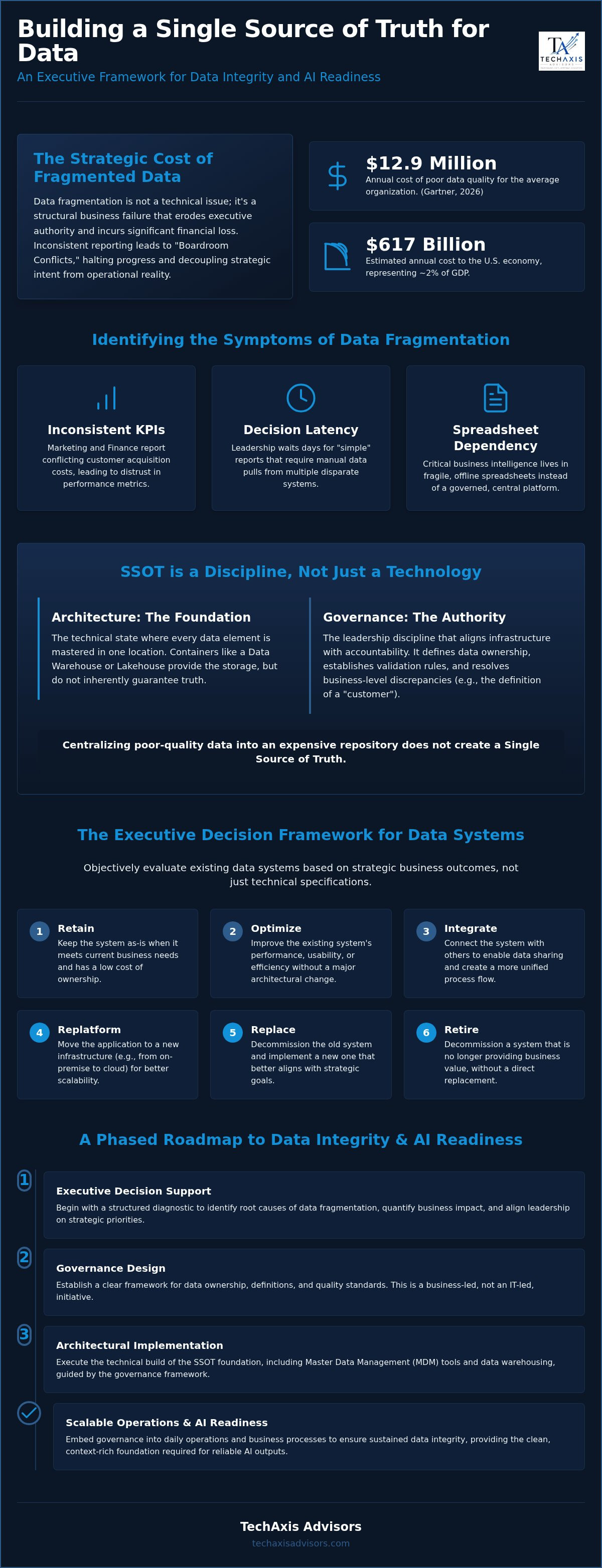
Data fragmentation isn't just a technical glitch; it's a structural failure that erodes executive authority. When different departments present conflicting versions of the same reality, the result is a "Boardroom Conflict" that halts progress. Across the U.S. economy, poor data quality costs an estimated $617 billion annually, representing roughly 2% of GDP. For growth-stage firms, these operational bottlenecks manifest as wasted hours spent on manual reconciliation rather than strategic execution. Successfully building a single source of truth for data is the only way to ensure that decisions are based on evidence rather than departmental bias.
Establishing a Single Source of Truth (SSOT) provides the necessary foundation for objective oversight. Without it, leadership teams operate in a fog of "shadow IT" and inconsistent reporting cycles. This lack of transparency is particularly dangerous for wealth management and financial services firms, where data integrity is a prerequisite for both client trust and regulatory standing.
Identifying the Symptoms of Data Fragmentation
Fragmentation is often masked by high-performing teams who use manual workarounds to compensate for poor systems. You can identify these gaps through specific operational red flags:
Inconsistent KPIs: Marketing reports a customer acquisition cost that doesn't align with the figures on the finance ledger.
Decision Latency: Leadership waits days for a "simple" report because data must be pulled from three disparate systems and cleaned in Excel.
Spreadsheet Dependency: Critical business intelligence lives in fragile, offline spreadsheets rather than a governed, central platform.
Building a single source of truth for data
eliminates these manual reporting cycles, allowing leaders to act on real-time intelligence instead of stale, reconciled exports.
The Impact on Organizational Scalability
Rapid growth exposes the fragility of siloed data. As you add new vendors and platforms, technical debt compounds. This platform sprawl makes it nearly impossible to maintain the data integrity required for modern compliance. Under the SECURE Data Act of 2026, firms face expanded oversight regarding data minimization and consumer access rights. If you don't know where your data is mastered, you can't comply with deletion requests through platforms like the California DROP system. Beyond compliance, fragmented data creates an AI bottleneck. Advanced models require a context-rich, governed foundation; without it, AI outputs are untrustworthy and potentially harmful. Data fragmentation fundamentally increases execution risk for CEOs by decoupling strategic intent from operational reality.
Defining the Single Source of Truth: Architecture vs. Governance
A common executive misconception is that a Single Source of Truth (SSOT) is a specific piece of software you can purchase. In reality, an SSOT is an architectural state where every data element is mastered in one location for enterprise-wide use. While technical containers like a Data Warehouse or a Data Lakehouse provide the storage, they don't inherently guarantee truth. Building a single source of truth for data is a leadership discipline that aligns technical infrastructure with organizational accountability. Without this alignment, you're simply centralizing poor-quality data into a more expensive repository.
Master Data Management (MDM) serves as the technical anchor in this process. It provides the tools to link all critical data to one master file. However, technology alone cannot resolve the discrepancies between how a sales leader defines a "qualified lead" and how a finance leader defines a "customer." These are governance decisions. Achieving data integrity requires a structured approach to how information is captured, validated, and shared across the firm.
The Components of a Modern Data Foundation
A reliable data foundation rests on three pillars that bridge the gap between raw information and executive intelligence:
Master Data: This involves identifying the core business entities, such as clients, products, and assets, that must remain consistent across all platforms.
Data Governance: This is the framework of accountability. It defines who owns specific data sets and establishes the quality standards they must meet.
Integration Frameworks: These are the mechanics of the flow. They ensure data moves reliably from source systems to the SSOT without losing context or accuracy.
Focusing on these components ensures that your technology stack supports your business objectives rather than creating new silos.
Governance as a Strategic Asset
The most successful transformations occur when organizations move from "IT owning the data" to "the business owning the data." When business units take stewardship of their data, alignment improves naturally. A formal Data Stewardship program empowers subject matter experts to define the rules for their own domains. This shift reduces the burden on technical teams and ensures that data reflects the actual mechanics of your operations.
Effective governance turns data from a liability into a strategic asset. It provides the clarity needed for rapid scaling and ensures your organization is prepared for advanced automation. You can explore how these elements fit into a broader data and reporting strategy to see where your current gaps lie. If you're unsure where your governance currently stands, it may be time to start with a confidential executive conversation to evaluate your roadmap.
The Executive Decision Framework: Retain, Optimize, or Replace
Deciding how to modernize your data environment shouldn't be a matter of intuition. It requires a structured, evidence-based assessment to determine your current maturity levels and identify where technical debt is stalling your growth. For wealth management firms managing complex legacy systems, the path forward isn't always a total overhaul. Instead, leadership must evaluate the business case for each asset using a disciplined 6R Framework: Retain, Optimize, Integrate, Replatform, Replace, or Retire. This approach ensures that building a single source of truth for data remains a value-driven exercise rather than an expensive technical migration for its own sake.
A pragmatic framework for these decisions includes:
Retain and Optimize: Maintaining existing systems while refining data quality at the source to extend the asset's life.
Integrate: Linking disparate silos through a unified governance layer to create a shared view of the truth.
Replatform or Replace: Moving to new infrastructure when legacy debt prevents scaling or fails to meet modern security standards.
Retire: Systematically eliminating redundant platforms that no longer serve a strategic purpose.
Analyzing Options and Tradeoffs
The most common mistake is assuming that technical debt always requires replacement. Incremental improvements to existing workflows often provide a higher ROI than high-risk migrations. However, when legacy tech hinders real-time intelligence or fails to meet the stringent data privacy standards effective in 2026, you've reached a critical tipping point. Identifying this threshold requires a leadership bridge that can translate technical constraints into business risks. A senior-led Executive Intelligence Assessment provides the clarity needed to navigate these trade-offs without the inherent bias of a software vendor.
Calculating the Real ROI of Data Modernization
Modernization ROI is often hidden in the significant reduction of manual labor across your finance and operations teams. When your staff no longer spends 15% to 25% of their time reconciling disparate reports, that capacity is redirected toward high-value analysis and strategy. Beyond labor, the primary driver for building a single source of truth for data is accelerated AI readiness. Reliable automation is impossible without a context-rich data foundation that models can trust and interpret accurately. Organizations often face inflated project costs when they pay for the administrative overhead of massive global strategy firms rather than the direct expertise of senior practitioners who understand the mechanics of scaling a business.
A Roadmap for Building Data Integrity and AI Readiness
Execution is where many strategic visions fail. Transforming your data environment requires a methodical sequence that moves from discovery to mastery. Building a single source of truth for data is achieved through a disciplined progression that ensures every technical decision supports a specific business outcome. This roadmap replaces organizational anxiety with a predictable path toward data integrity and AI readiness.
Phase 1: The Executive Data Assessment. This phase identifies critical gaps in your current strategy and architecture.
Phase 2: Establishing the Governance Framework. Here, you define ownership and the quality metrics that ensure data remains trustworthy.
Phase 3: Architectural Design. This involves selecting a model that balances security with the scalability needed for growth.
Phase 4: Execution and Vendor Oversight. Managing technical partners is crucial to ensure delivery stays aligned with your strategic intent.
Step 1: Diagnostic and Strategy Alignment
A structured diagnostic is the prerequisite for any technology investment. It uncovers hidden risks and highlights opportunities for consolidation. Your data roadmap must align with your 3-5 year business strategy to remain relevant as your firm scales. This process is a core part of how we work to ensure technology never outpaces your operational capacity. By identifying technology risks early, you avoid the common trap of building features that your organization isn't yet ready to utilize.
Step 2: Building the Operational Foundation
Success depends on human accountability as much as technical protocols. You need data champions within your leadership team to drive adoption and model data-driven decision-making across departments. High-quality data isn't fixed after the fact; it's maintained at the point of entry through automated quality controls. This foundation is essential for AI readiness. Machine learning models only perform when they're fed structured, context-rich information that reflects your actual business mechanics. Without this ground-level integrity, automation will simply accelerate the distribution of errors.
Strategic Advisory: Aligning Data Foundations with Business Outcomes
Growth-stage firms often reach a threshold where technical complexity outpaces internal leadership capacity. While a permanent CTO may be a future milestone, the immediate requirement is strategic oversight during critical transitions. Building a single source of truth for data requires more than just an architect; it requires an executive partner who can align technical roadmaps with the board's fiduciary expectations. Fractional technology leadership provides this bridge. It offers the wisdom of a veteran executive with the agility required for rapid scaling.
The TechAxis Executive Intelligence Platform
Structured diagnostics are the foundation of executive clarity. We utilize a proprietary Executive Intelligence Platform to conduct evidence-based assessments that move beyond standard technical audits. These engagements provide board-ready findings, translating complex tech ecosystems into prioritized roadmaps that leadership can act upon immediately. For firms in specialized sectors, such as wealth management, this clarity is vital for maintaining compliance and competitive advantage. You can explore how these principles apply specifically to your sector in our guide on Data Strategy for Asset Managers.
These assessments ensure that every data initiative is rooted in verifiable facts. They provide a clear audit trail and traceability throughout the data journey, which is essential for meeting the transparency requirements of 2026 regulations. By identifying specific technology risks and opportunities, we help leadership teams avoid the common pitfalls of over-engineered solutions. Strategy requires leadership.
Fractional CTO Leadership for Data Execution
Execution defines success. Many organizations falter when they hand a high-level roadmap to junior staff or external vendors without senior oversight. An Executive Technology Advisor ensures that the process of building a single source of truth for data remains focused on business outcomes rather than technical vanity. This role involves rigorous vendor oversight and the establishment of governance protocols that prevent future data silos from forming.
By leveraging advisory leadership, firms gain access to senior-level expertise without the overhead of a full-time hire. This model provides the necessary governance to manage delivery partners and ensure that every technology investment is traceable to a specific strategic goal. This disciplined approach ensures that your data foundation is not just accurate today, but remains scalable as you pursue market expansion or AI automation. If you're ready to move from fragmented reporting to a unified data foundation, start with a confidential executive conversation to explore your data priorities.
Transitioning to a Unified Data Foundation
The transition from fragmented reporting to executive clarity requires a disciplined commitment to governance and architectural alignment. By building a single source of truth for data, you eliminate the operational friction of manual reconciliation and create a scalable foundation for AI readiness. This strategic shift ensures that your leadership team makes decisions based on evidence rather than departmental silos or stale spreadsheets.
Achieving this level of integrity demands senior oversight that understands the mechanics of growth. TechAxis Advisors provides this through structured Executive Intelligence Assessments and the wisdom of a founder with over 25 years of experience as a CIO, CTO, and CISO. As a certified MWBE and WOSB, we focus on providing the pragmatic leadership bridge your organization needs to navigate complex technology transformations without unnecessary overhead.
Your data should be your most reliable strategic asset. With the right framework and advisory leadership, you can replace organizational anxiety with a sense of controlled, disciplined progress.
Frequently Asked Questions
What is the difference between a single source of truth and a data warehouse?
An SSOT is a strategic state of data integrity; a warehouse is a technical repository. Building a single source of truth for data creates a mastered record the entire firm trusts. The warehouse is the container; the SSOT is the outcome.
How long does it typically take to build a single source of truth?
Transformations span three to nine months depending on complexity. We recommend a phased roadmap delivering reporting wins within ninety days. This pace respects leadership's cognitive load while ensuring steady progress without "big bang" risks.
Do we need to replace all our legacy systems to achieve data integrity?
Replacement is rarely mandatory. We evaluate the business case to retain, optimize, integrate, replatform, replace, or retire assets. Integrating legacy systems through governance minimizes execution risk and preserves investments while creating a shared view of truth.
How does a single source of truth impact our AI readiness?
AI depends on a governed data foundation. Building a single source of truth for data ensures automation is fueled by traceable information meeting 2026 standards. Without it, models produce inaccurate outputs, creating significant organizational and compliance risk.
What is the role of an executive in a data strategy project?
Executives serve as primary sponsors. Their role is to define business outcomes and empower data champions. Leadership must resolve conflicts over metric definitions, ensuring data stewardship is a strategic responsibility rather than a purely technical task.
How much should a growth-stage company invest in data architecture?
Investment should focus on the cost of inaction. Research shows poor data quality costs organizations $12.9 million annually. A value-driven model prioritizes foundational governance over software, preventing excessive administrative overhead while ensuring scalability.
How do we measure the success of an SSOT initiative?
Success is measured by reduced manual reconciliation and increased decision speed. Track KPIs like report turnaround times and the elimination of fragile spreadsheets. Success occurs when leadership no longer disputes the validity of numbers during meetings.
Can a fractional CTO lead a data modernization program?
A fractional CTO provides senior oversight without full-time overhead. They bridge strategy and execution, providing governance to manage delivery partners. Using structured diagnostics, they ensure data modernization remains aligned with business goals and translates insights into results.


Comments