

Benefits of a Part-Time CIO: Executive Leadership Without a Full-Time Role
What if the value of a part-time CIO isn’t fewer leadership hours, but clearer ownership of the technology decisions that shape your business? When growth, modernization, or AI initiatives lack executive direction, teams can invest time and resources without a clear connection to business priorities. The benefits of a part-time CIO come from bringing senior judgment, accountability, and continuity to those decisions without assuming a full-time executive role is the right fit.
It’s reasonable to weigh this model against the cost and commitment of a permanent hire. But the decision is about more than budget. A part-time CIO can help leadership improve visibility into technology risks, vendor performance, governance, and execution while aligning priorities with organizational needs. The tradeoff is that part-time capacity requires clear priorities, decision rights, and access to the right people.
This article explains where fractional CIO leadership can create business value, where its limits matter, and which organizational conditions make it a practical option. It also distinguishes an executive assessment from strategic advisory and embedded leadership, helping you identify the level of support your organization needs now.
Table of Contents
Why a Part-Time CIO Can Improve Executive Technology Decisions
How Part-Time CIO Leadership Turns Priorities Into Governed Execution
Part-Time CIO vs. Full-Time CIO, Interim Leadership, and Advisory
How to Assess Whether a Part-Time CIO Fits Your Organization
How TechAxis Approaches Part-Time CIO Leadership and Next Steps
Why a Part-Time CIO Can Improve Executive Technology Decisions
Technology decisions need an accountable owner, not simply more technical activity. Without executive direction, business leaders may approve separate initiatives based on local needs, while no one is responsible for resolving conflicts, setting priorities, or explaining tradeoffs. The result can be a busy technology function with limited clarity about which decisions matter most to the organization.
The business value of part-time CIO leadership is experienced executive judgment applied to technology priorities, governance, and follow-through at a level of involvement suited to the organization’s needs. This can improve decision clarity and risk visibility. It does not guarantee savings, revenue growth, or successful delivery. Those depend on the business case, execution, and broader organizational conditions.
Where technology leadership gaps affect the business
Technology ownership is often distributed. A finance leader weighs investment, operations focuses on process, technical teams assess feasibility, and vendors recommend solutions within their scope. Each perspective may be reasonable, but fragmented accountability makes it harder to compare initiatives against shared business priorities.
Consider an organization planning an AI pilot, a core platform modernization, and improvements to management reporting. Each initiative may have a sound rationale, but the same internal leaders and subject-matter experts may be needed across all three. A CIO can help executives clarify dependencies, assess readiness, and sequence decisions instead of treating every initiative as equally urgent.
That coordination matters to wealth management and financial services organizations, where technology choices may affect operations, data, client experience, and oversight. The aim is not to centralize every decision. It is to establish who decides, what evidence informs the decision, and how progress will be reviewed.
What a part-time CIO contributes beyond technical advice
Technical advice explains what a system can do. Executive leadership connects that choice to why the organization should act, what it must prioritize, and who is accountable for the next step. A part-time CIO translates between technical teams, vendors, and business leaders so decisions can be assessed in terms of objectives, dependencies, risk, and operating impact.
The role may include setting decision criteria, establishing governance, reviewing vendor proposals, clarifying ownership, and communicating material issues to executives. It can also help leadership distinguish between a problem that needs a technology change and one better addressed through process, integration, or clearer accountability.
A fractional executive works with an organization on an ongoing, part-time basis, rather than joining only to deliver a recommendation or cover a temporary vacancy. The distinction matters: useful leadership requires enough context and continuity to revisit decisions as circumstances change. The role also needs agreed authority and access to decision-makers. Part-time availability alone cannot resolve unclear sponsorship or execution ownership.
In practice, a CIO can help leadership turn competing proposals into explicit choices: proceed, defer, revise, or stop. That creates a stronger basis for accountability and more transparent discussion of risk. These are decision-quality benefits, not promised financial outcomes.
How Part-Time CIO Leadership Turns Priorities Into Governed Execution
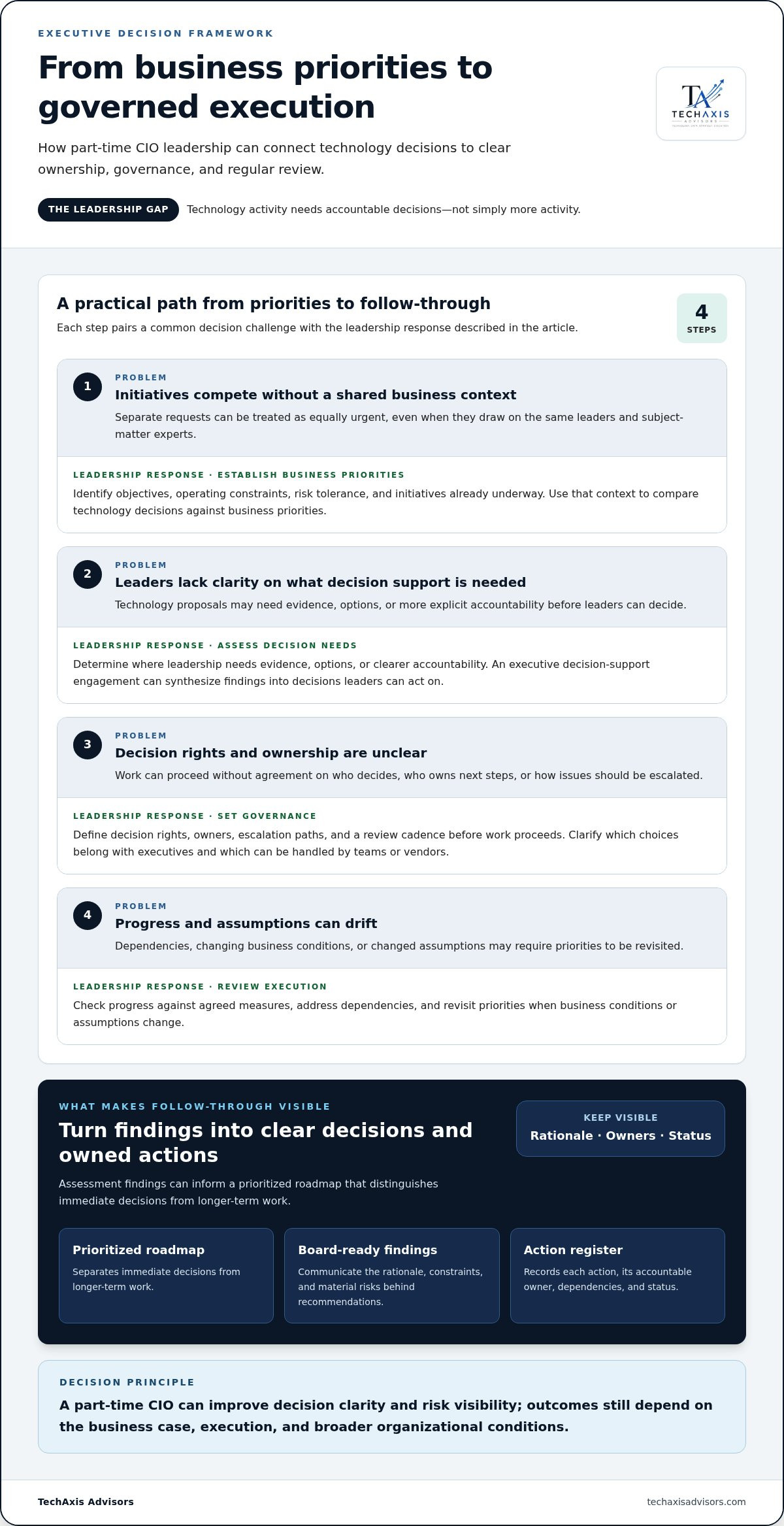
A strategy becomes useful when leaders can see what happens next, who owns it, and how progress will be judged. Part-time CIO leadership can provide a disciplined path from business priorities to governed execution, while keeping accountability with the executives, internal teams, and vendors responsible for delivery.
Establish business priorities. Identify objectives, operating constraints, risk tolerance, and initiatives already underway. This gives technology decisions a business context instead of treating each request as a separate priority.
Assess decision needs. Determine where leadership needs evidence, options, or clearer accountability. An executive decision-support engagement can synthesize findings into decisions leaders can act on.
Set governance. Define decision rights, owners, escalation paths, and a review cadence before work proceeds. Make clear which choices belong with executives and which can be handled by teams or vendors.
Review execution. Check progress against agreed measures, address dependencies, and revisit priorities when business conditions or assumptions change.
Assessment findings can inform a prioritized roadmap that distinguishes immediate decisions from longer-term work. Board-ready findings help communicate the rationale, constraints, and material risks behind recommendations. An action register makes follow-through visible by recording each action, its accountable owner, dependencies, and status. Together, these deliverables help executives move from observations to a manageable set of decisions and actions.
The roadmap should reflect choices, not presume that every system needs replacement or every initiative should proceed. Depending on the business case, leaders may choose to retain, optimize, integrate, replatform, replace, or retire a capability. Sequencing matters too. A data initiative, for example, may depend on resolving ownership or process questions before a team can deliver useful reporting.
Governance provides the operating rhythm for this work. A decision forum gives executives a place to resolve tradeoffs; named owners clarify responsibility; escalation paths surface issues that exceed a team’s authority. Regular progress reviews compare actual status with agreed measures, such as decision completion, dependency resolution, or milestone progress. These measures show execution status, not guaranteed financial or operational results.
A CIO-level advisor can coordinate across leaders, employees, and vendors by clarifying requirements, reviewing commitments, and surfacing delays or decisions that need executive attention. This is oversight and leadership, not a replacement for internal owners or implementation teams. TechAxis’s advisory leadership connects executive guidance with governance and follow-through while keeping delivery responsibilities explicit.
Agree on scope, decision rights, meeting cadence, and progress measures at the outset. Those boundaries make the role workable on a part-time basis and help leaders identify when priorities or involvement need to change. The engagement structure can be discussed in a confidential executive conversation.
Part-Time CIO vs. Full-Time CIO, Interim Leadership, and Advisory
The right leadership model depends on the work that must be owned, the authority required, and how long that need is likely to continue. Part-time support isn’t automatically a lighter or sufficient option. A fractional CIO may need to make consequential decisions and coordinate substantial work, even with a defined level of availability. The benefits of a part-time CIO are most relevant when the organization needs sustained executive direction but not a permanent CIO seat.
When a part-time CIO may fit better than a full-time role
A fractional model may fit when senior technology direction is needed across a defined transformation, a period of growth, or an ongoing governance requirement, but the organization doesn’t need a permanent executive dedicated to technology. Required authority and workload matter more than headcount alone. A smaller organization with complex decisions may need substantial leadership; a larger one with established executives and clear ownership may need narrower support.
Before choosing the model, clarify whether the leader must set direction, participate in executive decisions, oversee delivery, or hold day-to-day responsibility for a broad function. If sustained availability and accountability exceed the agreed fractional scope, a full-time role may be more appropriate. A fractional CTO guide for growth companies offers a related perspective on leadership models.
When interim or project-based support may be more appropriate
Interim leadership addresses a temporary coverage need, such as a vacancy or transition, and is usually organized around that defined period. Project-based advisory is different: an executive decision-support engagement can assess a bounded question or domain, then present findings and options without taking on continuing leadership accountability.
If decisions, governance, and follow-through remain ongoing after an assessment or transition, a continuing fractional or full-time relationship may be needed. Align the model with the duration of the need, the authority required, and the level of involvement executives expect. A conversation about leadership needs and fit can help frame those choices.
How to Assess Whether a Part-Time CIO Fits Your Organization
A part-time CIO is a practical fit when the organization needs sustained executive technology leadership, but the work can be governed within a clearly defined scope and cadence. Use this diagnostic to assess the need:
Decision bottlenecks: Are technology choices stalled because no executive owns the tradeoffs or can align teams around a decision?
Executive sponsorship: Is a senior leader prepared to sponsor the role, resolve competing priorities, and support its authority?
Risk visibility: Can leadership see material technology risks, vendor dependencies, and delivery concerns in time to make informed decisions?
Follow-through: Is there a need for ongoing oversight of priorities and decisions, rather than a one-time recommendation?
If several answers are yes, fractional leadership may address a real gap. This can be particularly relevant in growth-stage or regulated environments, where technology decisions intersect with operating priorities and oversight. Organizations TechAxis supports include wealth management, financial services, and other complex businesses managing these demands.
Questions executives should resolve before engaging
Start by identifying the specific decisions that lack an owner. Then agree on what the role is accountable for: setting priorities, shaping governance, advising executives, overseeing vendors, or coordinating execution. Name the executive sponsor and identify which internal leaders and vendors must participate in reviews. Without that participation, even sound recommendations can remain disconnected from delivery.
Part-time availability works only when scope, authority, and cadence are explicit. Define which decisions the CIO can make, which require executive approval, how often leaders will meet, and how urgent issues will be escalated. If executives expect daily operational ownership or immediate involvement across a broad technology function, the need may exceed a part-time model. A full-time leader or a different operating structure may be more appropriate.
How to define scope, authority, and progress
Set engagement boundaries before work begins. Specify the business priorities in scope, the sponsor responsible for resolving conflicts, and the teams expected to provide information or act on decisions. Choose progress indicators tied to those priorities, such as milestone status, decisions awaiting approval, or unresolved dependencies. These indicators support oversight; they don’t promise a particular financial or operational result.
A structured assessment can help executives establish a baseline, clarify decision needs, and determine whether ongoing leadership is warranted. TechAxis’s executive assessments provide evidence-based findings and a prioritized roadmap, giving leadership a clearer basis for defining scope and follow-through.
Review the arrangement as business needs evolve. If decision volume, operational demands, or required availability outgrow the agreed scope, revisit the leadership model rather than relying on an informal expansion of responsibilities. A confidential executive conversation can help clarify the next step.
How TechAxis Approaches Part-Time CIO Leadership and Next Steps
TechAxis Advisors provides executive technology advisory, aligning guidance with the organization’s business context rather than prescribing technology for its own sake. The engagement starts by clarifying the leadership question and the decisions at stake. Structured assessment and intelligence synthesis then help executives determine whether they need a focused recommendation, continued counsel, or an embedded leader with an ongoing role.
This approach connects the level of support to the organization’s actual need. A defined question may call for an executive decision-support engagement. A recurring need for senior input may warrant retained advisory. Where leadership must stay involved in governance and transformation over time, fractional executive support can provide continuity. The scope and authority are shaped around the work, not assumed in advance.
Evidence-based support for executive decisions
TechAxis Advisors uses its Executive Intelligence Platform to structure assessments and synthesize relevant information for leadership consideration. The purpose is to help executives evaluate options, assumptions, and tradeoffs in context, then decide what action is warranted. This supports informed judgment without treating every observation as a mandate to invest or change systems.
Advisory leadership can guide governance, coordinate with internal teams, and provide oversight of vendors and qualified delivery partners. It does not mean TechAxis Advisors automatically performs implementation work or guarantees that a particular initiative will succeed. Execution depends on the agreed scope, organizational decisions, and delivery responsibilities.
A practical next step for leadership teams
Before discussing support, identify the decision or organizational challenge that needs attention. Note who currently owns it, what makes it difficult to resolve, and whether you need a discrete assessment, ongoing advisory, or an embedded fractional leader. This gives the conversation a practical starting point and helps distinguish an immediate decision need from a continuing leadership requirement.
TechAxis Advisors can discuss these options in light of your organization’s priorities and the level of executive ownership required. The objective is to clarify a suitable next step, not to presume that every technology challenge calls for the same engagement.
Make the Leadership Model Fit the Decisions Ahead
Technology leadership is not a fixed organizational design. As priorities shift, the right level of executive involvement may change too. Treat the role as part of leadership planning: revisit whether the current arrangement still matches the decisions your organization needs to make and the attention those decisions require.
A clear conversation about the next phase can help leadership move from uncertainty to a deliberate choice, without committing to a model before the need is understood.
With the right leadership structure, technology decisions can remain connected to the organization’s direction as it grows and changes.
Frequently Asked Questions
What are the main benefits of a part-time CIO?
A part-time CIO can give executives a portfolio-level view of technology choices, helping them see how one decision affects other investments, operating dependencies, and future options. This is useful when separate proposals each appear reasonable but compete for the same resources or rely on shared systems. The benefit is clearer evaluation of tradeoffs and assumptions, not a promise of lower costs or improved financial performance.
Is a part-time CIO enough for a growing company?
It can be, particularly if internal managers can handle routine operations while company leadership needs help evaluating how growth changes its technology requirements. For example, entering a new market or combining business units may expose gaps in data access, system integration, or decision ownership. Executives can assess whether the role is sufficient by examining the complexity of upcoming changes and the operational responsibilities that remain with internal leaders.
How does a part-time CIO differ from a fractional CTO?
The titles aren’t applied consistently across organizations, so compare the mandate rather than relying on the label. A CIO role often emphasizes enterprise-wide technology, information, and operating alignment. A CTO role may focus more on product technology, architecture, or engineering direction. A company building a technology-led product may prioritize CTO expertise, while a firm coordinating systems across business functions may need broader CIO leadership.
Can a part-time CIO oversee vendors and internal technology teams?
Yes, within agreed responsibilities. For a vendor renewal, for instance, a CIO may help executives compare current commitments with business needs, identify dependencies that affect a transition, and frame the decision to renew, change, or reconsider the arrangement. Internal managers still direct their teams, and vendors remain accountable for their contracted work. The CIO’s contribution is executive-level oversight of the decision and its organizational implications.
When should a company consider a full-time CIO instead?
A full-time CIO may be appropriate when the organization needs a leader to manage a broad technology function as a regular, day-to-day responsibility. One practical test is to review recurring executive escalations and operational decisions: if they require frequent attention that cannot be handled through an agreed part-time cadence, the role may need greater availability. Consider the sustained workload and accountability, not only the number of current initiatives.
What should executives define before engaging a part-time CIO?
Alongside the role’s priorities, clarify what falls outside its mandate. Identify an internal counterpart for operational matters, specify who approves decisions with financial or organizational impact, and agree how sensitive information will be accessed and shared. These boundaries reduce ambiguity when a new issue arises. Executives should also establish how disagreements over priorities will be resolved, rather than leaving the CIO to reconcile competing expectations without sponsorship.
Can a part-time CIO help a financial services or wealth management firm with technology governance?
Yes. A CIO can help leadership clarify who owns technology decisions, how exceptions are documented, and which issues should be escalated to risk, compliance, or legal teams. For example, executives may establish a consistent record of why a platform decision was made, who approved it, and what assumptions informed it. This can strengthen governance processes, but it doesn’t replace the firm’s compliance or legal responsibilities.



Comments