

Assessing Technical Debt in Acquisitions: An Executive Framework for 2026
What if the most significant liability on your target's balance sheet isn't recorded in the financial statements? In 2026, technical debt consumes up to 40% of IT budgets, yet it remains largely invisible during traditional due diligence. Assessing technical debt in acquisitions is no longer a niche IT task; it's a fundamental requirement for protecting your investment's terminal value. You recognize that a successful deal depends on more than just historical EBITDA. It requires a technology platform that can actually support the growth you've projected without collapsing under the weight of legacy code or expired software support.
We'll provide a clear framework for identifying these unrecorded liabilities to ensure your valuation reflects reality. You'll learn how to move beyond simple audits toward a strategic modernization roadmap that addresses looming risks like the 2027 SAP ECC end-of-support deadline and new SEC cybersecurity reporting mandates. With the federal funds rate at 3.63%, the cost of post-deal remediation is too high to leave to chance. This guide outlines how to adjust valuations based on technical risk and build a post-deal infrastructure that scales. We'll examine the trade-offs between optimization and replacement to ensure your integration stays on track and within budget.
Table of Contents
Technical Debt as an Unrecorded Liability in M&A
Technical debt is often the most significant unrecorded liability in a transaction. While a balance sheet accounts for physical assets and accounts payable, it rarely quantifies the remediation tax required to maintain legacy systems. In 2026, research from Deloitte indicates that technical debt consumes between 21% and 40% of total IT spending in large organizations. For an acquirer, this represents a direct drag on EBITDA and a potential hurdle to achieving projected synergies. It's a financial burden that compounds over time, making it harder to realize the investment's full potential.
Traditional financial audits focus on historical performance and visible assets. They often overlook the structural integrity of the underlying technology. Assessing technical debt in acquisitions requires distinguishing between intentional debt, such as strategic shortcuts taken for speed to market, and unintentional debt, which stems from poor architecture or obsolete infrastructure. Debt compounds. It slows down everything. When developers spend 33% of their time on maintenance instead of creating value, the terminal value of the investment is at risk. You don't want to inherit a system that's too brittle to scale.
The Business Impact of Unmanaged Debt
Unmanaged debt manifests in three primary areas that directly affect the bottom line:
Direct Costs: Increased spending on patching, maintenance, and high-cost legacy support contracts.
Opportunity Costs: Slower feature release cycles prevent the organization from responding to competitive threats or entering new markets.
Risk Factors: Elevated probability of security breaches and non-compliance with evolving regulations, such as the SEC mandate to report material cybersecurity incidents within four business days.
Executive Clarity vs. Technical Jargon
High-stakes decisions require board-ready findings rather than granular code reviews. Executive clarity involves translating technical concepts into business risks and capital expenditure requirements. A structured Executive Technology Assessment provides this bridge. It moves beyond a simple technical audit to offer evidence-based findings and a prioritized roadmap. This approach ensures leadership understands the trade-offs between retaining, optimizing, or replacing systems. By assessing technical debt in acquisitions through this lens, you gain the confidence to adjust valuations based on real-world technical risk and operational requirements.
The Four Pillars of Technical Debt Assessment
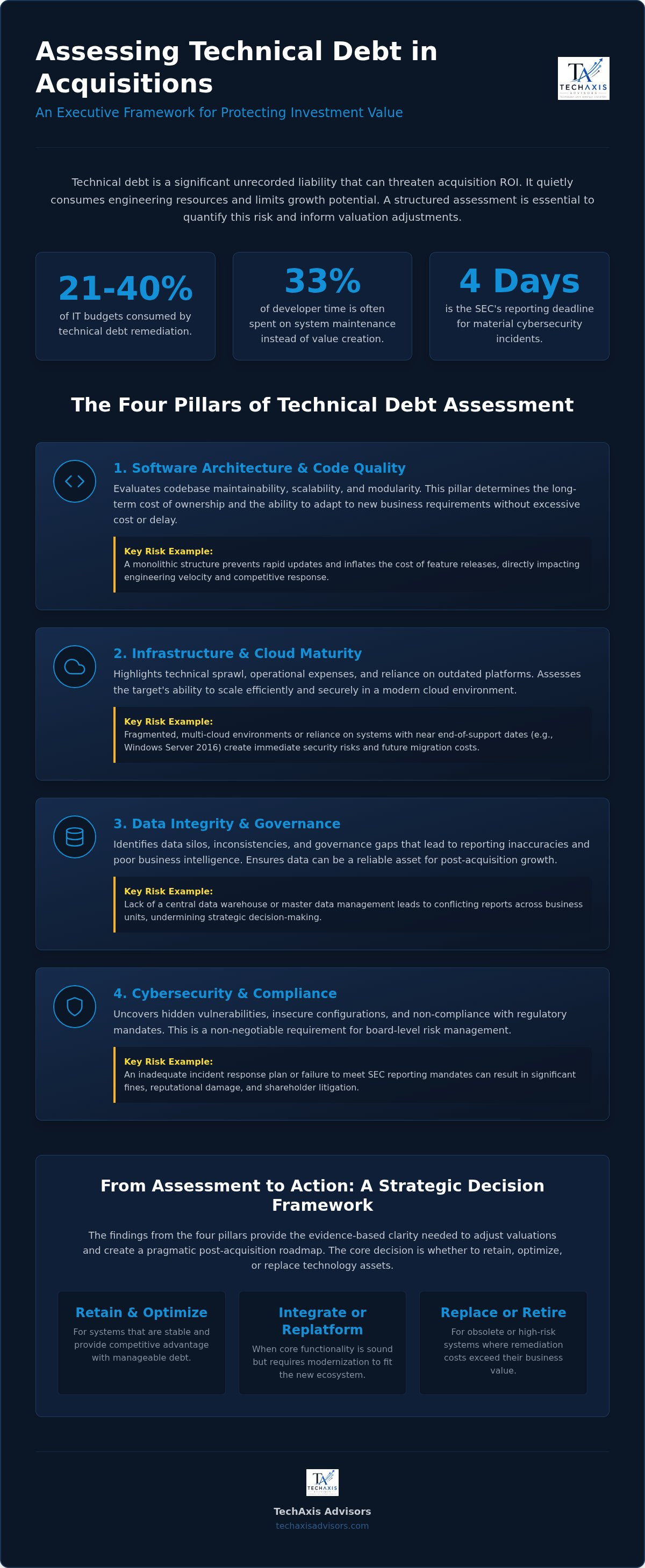
Effective technology due diligence requires a methodology that extends beyond simple source code analysis. While code quality is important, it represents only a fraction of the total risk profile. A structured framework for assessing technical debt in acquisitions focuses on four distinct pillars. These pillars provide the evidence-based findings necessary for a confident investment decision. We replace technical uncertainty with executive clarity.
First, software architecture and code quality determine long-term maintainability. We evaluate if the codebase is modular or a monolithic structure that prevents rapid updates. Second, infrastructure and cloud maturity highlight technical sprawl. Many targets suffer from fragmented cloud environments that inflate operational expenses. Third, data integrity and governance identify silos that lead to reporting inaccuracies. Finally, cybersecurity and compliance uncover hidden vulnerabilities. With the SEC's 2026 mandate requiring material incident reporting within four business days, understanding the target's security posture is a non-negotiable requirement for the board.
Evaluating Software and Infrastructure Scalability
A target's ability to handle 10x growth without a full rebuild is a key driver of terminal value. When assessing technical debt in acquisitions, we prioritize the identification of "locked-in" proprietary systems that hinder future flexibility. If a target relies on Windows Server 2016, they face an end-of-support deadline on January 12, 2027. This creates immediate security and compliance risks. Our Executive Intelligence Assessments quantify these risks as specific capital expenditure requirements. We evaluate whether to retain, optimize, or replace these systems based on their alignment with your post-deal growth objectives.
Data and Cybersecurity Risk Analysis
Data debt is often the most expensive category to remediate post-acquisition. Poorly structured data models prevent the effective use of AI and automation. In financial services, the ISO 20022 mandate for payment systems adds a hard deadline of November 2026. Companies that haven't modernized their messaging standards face significant operational hurdles. We also assess "security debt" in legacy applications. This includes unpatched vulnerabilities and outdated third-party integrations that could void cyber insurance policies. Identifying these liabilities early allows for an accurate valuation adjustment. To understand how these risks impact your specific deal, start with a confidential executive conversation.
Measuring the Financial and Operational Impact on Acquisition ROI
Technical debt isn't just a technical concern. It's a financial liability that directly impacts the terminal value of an acquisition. When assessing technical debt in acquisitions, we quantify the "Remediation Tax." This is the capital required to bring a target's technology stack to a state of operational maturity. Without this calculation, your projected ROI is based on incomplete data. High-debt organizations deliver features 25-50% slower than their peers. They also spend 40% more on maintenance. These inefficiencies act as a silent drag on your investment's performance from day one.
Synergy realization depends on the smooth integration of systems. If the target's infrastructure is brittle, integration timelines will slip. This delay postpones the cost savings and revenue growth promised to the board. There's also a significant human cost. Developers in high-debt environments spend 33% of their time fixing old issues rather than building new value. This leads to burnout and the loss of key technical talent during the critical post-acquisition phase. Evidence-based findings from an Executive Intelligence Assessment allow you to negotiate deal terms or valuation adjustments with confidence. You're no longer guessing; you're making decisions based on quantified risk.
EBITDA Impact and the Cost of Inaction
Inefficient legacy processes create a persistent drag on margins. We calculate this impact by analyzing operational expenses tied to manual workarounds and redundant systems. Failing to address these issues early leads to higher long-term costs. Modernization becomes more expensive as technical layers accumulate. A prioritized roadmap identifies the most critical remediation tasks first. This approach ensures that capital is deployed where it will have the greatest impact on EBITDA and operational scalability.
Speed to Market and Competitive Positioning
Innovation thrives on agility. Technical debt stifles this agility. It forces your team to focus on "keeping the lights on" instead of outmaneuvering competitors. We use AI Readiness Assessments to determine if the target's data structure can support modern automation. This is a critical factor in improving operational maturity through technology. If the foundation is weak, the cost to implement advanced analytics will be prohibitive. Accurate assessment ensures you understand the target's true competitive standing before the deal closes.
Strategic Decision Framework: Retain, Optimize, or Replace
Successful integration requires a disciplined approach to asset categorization. When assessing technical debt in acquisitions, leadership must move beyond the binary choice of keeping or discarding a system. We use a multi-option framework to evaluate the business value of each technology asset based on the mechanics of scaling and the total cost of ownership. This ensures capital is allocated to areas that drive the highest return on investment while maintaining structural integrity across the portfolio.
The first path is to Retain. This applies when legacy systems still provide a defensible competitive advantage or are stable enough to support current operations without significant risk. Optimize & Integrate is the middle ground. It involves bridging the gap between target and acquirer systems to ensure data flows smoothly across the new organization. When the cost of maintenance exceeds the cost of modernization, we move to Replatform & Replace. Finally, we Retire redundant technology. Phasing out overlapping platforms is one of the fastest ways to capture immediate cost synergies post-close.
The Business Case for Modernization
Modernization isn't a technical project; it's a financial strategy. We evaluate the ROI of replatforming by comparing the long-term maintenance tax against the cost of a new system. This analysis must align with your long-term business strategy. If you plan to scale rapidly, maintaining a brittle legacy system is a liability that will eventually stifle growth. Managing vendor and platform transitions during the integration phase requires a steady hand. It's about maintaining operational continuity while building the capacity needed for future market expansion. We focus on the business impact rather than abstract technical theory.
Governance-Driven Execution
Post-acquisition technology projects fail without executive oversight. Establishing clear governance ensures that modernization efforts stay on schedule and within budget. We use a strategic roadmap to track progress and enforce accountability across all workstreams. This structured approach provides the leadership bridge necessary for complex transformations. Clarity in oversight replaces organizational anxiety with disciplined progress. Effective advisory leadership is essential for maintaining compliance while pursuing aggressive growth goals in highly regulated sectors.
Leveraging Advisory Leadership to Mitigate Post-Acquisition Risk
Navigating the technology landscape of a modern merger requires more than a technical audit. It demands senior-level access to professionals who understand the intersection of software architecture and business valuation. Assessing technical debt in acquisitions is a strategic exercise that informs the entire post-deal integration plan. While technical teams focus on code, executive leadership must focus on the mechanics of scaling and the structural integrity of the investment. High-stakes decisions are best supported by evidence-based findings rather than generic consulting reports.
A Fractional CTO provides the necessary leadership bridge during these transitions. They offer the wisdom of a veteran executive with the agility required for growth-stage challenges. This role moves beyond diagnostic findings to provide active governance and vendor oversight. By utilizing a structured Executive Intelligence Platform, advisors provide action registers that translate technical risk into capital expenditure requirements. This replaces organizational anxiety with a sense of controlled, disciplined progress toward your desired business outcomes.
Independent Advice vs. Implementation Bias
Objectivity is a fundamental requirement for effective due diligence. Many global firms face an inherent conflict of interest because they also sell managed IT services or direct software implementations. This can lead to a bias toward replacing systems regardless of the business case. Independent advisors focus solely on executive decision-support engagements. This ensures that every technology investment is anchored to your specific risk tolerance and long-term goals. You receive a pragmatic evaluation of whether to retain, optimize, or retire assets based on their true contribution to competitive advantage.
From Diagnostic to Execution
The transition from a technology assessment to operational results is where many acquisitions lose momentum. Fractional leadership ensures that the findings from the due diligence phase are integrated into a board-ready strategic roadmap. This roadmap provides clear accountability and tracks progress against prioritized milestones. It addresses immediate risks, such as the upcoming ISO 20022 mandate or pending end-of-support deadlines for enterprise software. This structured approach provides the executive clarity needed to protect your acquisition ROI and ensure long-term scalability.
Securing Long-Term Value Through Technical Clarity
The success of a 2026 acquisition depends on your ability to identify what isn't on the balance sheet. By assessing technical debt in acquisitions with a structured framework, you replace uncertainty with evidence-based findings. You've seen how legacy infrastructure and unaddressed security debt can erode terminal value and delay critical synergies. Protecting your investment requires moving beyond technical jargon to achieve executive clarity.
Our methodology leverages the proprietary TechAxis Advisors Executive Intelligence Platform to provide a prioritized roadmap for modernization. You gain access to veteran expertise from former CIOs, CTOs, and CISOs who understand the high stakes of private equity and financial services. As an SBA WOSB and MWBE certified firm, we provide the independent oversight necessary to ensure your technology strategy aligns with your growth objectives.
Take control of your post-deal scalability and ensure your target is ready for the demands of a modern market.
Frequently Asked Questions
What is the most common form of technical debt found in acquisitions?
Obsolete infrastructure and software nearing end-of-support are the most frequent issues. In 2026, many targets still rely on Windows Server 2016 or SAP ECC 6.0. These systems face hard support deadlines in 2027. Relying on them creates immediate compliance risks and security vulnerabilities. Identifying these forced modernization events is a critical part of assessing technical debt in acquisitions. It ensures you aren't surprised by mandatory capital expenditures shortly after closing.
How do you quantify technical debt for a valuation adjustment?
Quantifying debt requires calculating the "Remediation Tax" needed to reach operational maturity. This includes direct costs for software licenses, cloud migration, and developer hours. We also factor in the drag on EBITDA. Since technical debt consumes up to 40% of IT spending in large organizations, failing to adjust the valuation can lead to overpayment. Evidence-based findings provide the necessary leverage to negotiate deal terms based on actual technical liabilities.
Can technical debt be managed without a complete system overhaul?
Complete overhauls are rarely the only solution. We evaluate assets through a framework of "retain, optimize, integrate, replatform, replace, or retire." Some legacy systems still provide a defensible advantage and should be retained. Others can be optimized by bridging gaps with modern APIs. This pragmatic approach focuses on managing technical risk while preserving terminal value. Strategic management is about balancing modernization costs against the projected ROI of the acquisition.
How long does a typical executive technology assessment take during due diligence?
A structured executive technology assessment typically takes two to four weeks. This timeline aligns with standard M&A due diligence cycles. The process focuses on high-impact areas like infrastructure scalability, data integrity, and cybersecurity posture. By utilizing a proprietary Executive Intelligence Platform, we provide board-ready findings quickly. This ensures that investors have a clear roadmap and quantified risk profile before the deal reaches the final negotiation stage.
What are the red flags for technical debt in a target company's infrastructure?
Primary red flags include a high ratio of maintenance spending compared to new feature development. If developers spend over 30% of their time fixing legacy issues, engineering velocity is compromised. Other indicators include frequent system outages, lack of automated testing, and reliance on end-of-support software like Windows Server 2016. These signs suggest a brittle infrastructure that will likely fail to support post-acquisition growth without significant and immediate investment.
How should technical debt be prioritized post-acquisition?
Prioritization should focus on security vulnerabilities and compliance mandates first. Systems that block planned synergies or prevent the ISO 20022 payment standard compliance by November 2026 take precedence. We then address debt that hinders operational scalability. Using a prioritized roadmap ensures that capital is deployed where it generates the most business value. This disciplined progression replaces organizational confusion with a clear path toward technical and operational mastery.
What is the role of the C-suite in managing technical debt?
The C-suite must provide governance and oversight rather than managing granular technical details. Leadership's role is to ensure that technology decisions are anchored to business goals and risk tolerance. This involves establishing accountability for modernization projects and monitoring the ROI of technical investments. By viewing technical debt as a financial liability, executives can make more informed decisions about capital allocation and long-term strategy during periods of rapid growth.
Why is an independent assessment better than an internal IT review?
Independent assessments offer objectivity that internal teams often lack due to "sunk cost" bias or implementation fatigue. External advisors also avoid the conflict of interest found in firms that sell managed IT services. Assessing technical debt in acquisitions requires a peer-to-peer dialogue between seasoned professionals and the C-suite. This objective perspective provides a more accurate view of technical risk, ensuring that the findings are board-ready and focused on business value.



Comments