

AI Strategy for Wealth Management Firms: A 2026 Executive Framework
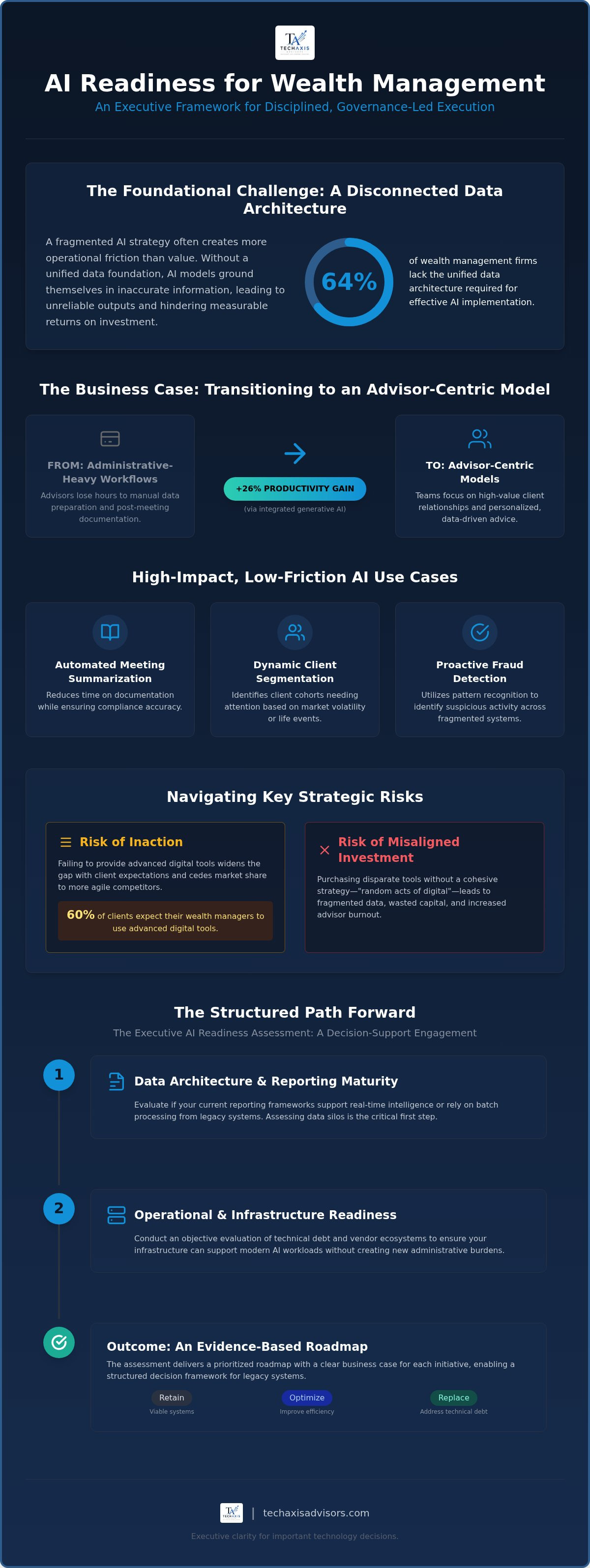
Sixty-four percent of wealth management firms currently lack the unified data architecture required to generate a measurable return on their AI investments. While the promise of automation is significant, many executives are finding that a fragmented AI strategy for wealth management firms often creates more operational friction than value. You've likely seen advisors continue to lose hours to manual prep work while your leadership team navigates the valid fear of AI hallucinations in a strictly regulated environment.
This guide provides a pragmatic, evidence-based framework to move your organization from tactical experimentation to disciplined, governance-led execution. We'll examine the critical June 2026 Regulation S-P compliance deadlines, the SEC's 2026 examination priorities for AI oversight, and the specific data requirements for achieving operational maturity. You'll gain a clear roadmap to align your technology spend with tangible business outcomes, replacing organizational anxiety with a structured path toward advisor efficiency and institutional growth.
Table of Contents
The Business Case for AI in Wealth Management
Wealth management is undergoing a structural shift. Firms are moving away from administrative-heavy workflows toward advisor-centric models that prioritize client-facing time. This transition is essential for achieving operational maturity. Evidence-based research indicates a 26% productivity increase in financial services when generative AI is integrated into core processes. This gain allows your team to focus on high-value relationships rather than the mechanics of data preparation. A disciplined AI strategy for wealth management firms ensures that technology spend translates into reduced execution risk and improved advisor retention.
Beyond the Hype: Pragmatic AI Use Cases
Execution begins with identifying high-impact, low-friction use cases. Early automation often centered on the Robo-advisor model for basic portfolio rebalancing. However, 2026 standards require a more integrated approach. Current applications focus on enhancing the advisor's ability to deliver personalized advice at scale. Success in this area requires moving beyond generic communication to offer tailored strategies that reflect each client's unique financial position.
Automated Meeting Summarization: Reducing the time spent on post-meeting documentation while ensuring compliance accuracy.
Dynamic Client Segmentation: Identifying specific client cohorts that require immediate attention based on market volatility or life events.
Fraud Detection: Utilizing pattern recognition to identify suspicious activity across fragmented legacy systems.
These applications improve client retention by providing the data-driven insights that high-net-worth individuals expect. They allow advisors to move beyond generic communication and offer tailored strategies that reflect the client's unique financial position.
The Cost of Inaction vs. Misaligned Investment
The primary risk for wealth management leaders isn't just missing out on technology. It's the risk of "random acts of digital." This occurs when a firm purchases disparate tools without a cohesive AI strategy for wealth management firms. The result is usually fragmented data and increased advisor burnout. If a new tool doesn't integrate with existing legacy systems, it becomes another administrative burden rather than a solution. You must replace organizational anxiety regarding technology with a sense of controlled, disciplined progress.
Misaligned investment wastes capital and creates organizational confusion. Conversely, inaction leads to a widening gap between firm capabilities and client expectations. Sixty percent of clients now expect their wealth managers to utilize advanced digital tools. Firms that fail to provide these capabilities risk losing market share to more agile competitors. Strategic alignment ensures that every dollar spent on AI contributes to the firm's long-term scalability. This requires an objective evaluation of your current operational maturity before committing to large-scale implementations.
Assessing Foundation: The Executive AI Readiness Assessment
Successful implementation of an AI strategy for wealth management firms doesn't begin with a vendor demo. It starts with a structured diagnostic. You need to identify the gap between your current operational state and your desired automation outcomes. Unlike a standard technical audit, an executive decision-support engagement focuses on evidence-based findings that link technology risks directly to your organizational objectives. This provides the clarity required to authorize significant capital expenditure. You can explore how these diagnostics fit into broader TechAxis services to ensure your roadmap is both practical and defensible.
Step 1: Data Architecture and Reporting Maturity
A 2026 study found that 64% of wealth management firms lack the unified data layer necessary for effective AI implementation. Without this foundation, your models will ground themselves in fragmented or inaccurate information. You must evaluate whether your current reporting frameworks support real-time intelligence or if they're still reliant on batch processing from legacy systems. Assessing data silos is a critical first step in establishing a comprehensive data strategy for asset managers.
Step 2: Operational and Infrastructure Readiness
Infrastructure evaluation requires a cold look at technical debt and vendor ecosystems. Many firms are still managing a complex web of integrations that hinder AI deployment. You need to assess your cloud transformation status to ensure your environment can handle the compute demands of modern models. AI readiness is defined by a firm's structural maturity and data integrity rather than its access to specific software tools. Identifying these bottlenecks early prevents the "random acts of digital" that often derail technology projects.
Step 3: Talent and Cultural Alignment
Your internal team's ability to manage AI-driven workflows is as critical as the technology itself. You must identify the gap between current skills and the requirements of an augmented advisory model. This isn't about reducing headcount. It's about reallocating human capital to higher-value activities. A thorough assessment determines if your staff has the capacity for oversight and governance. If you're unsure where your firm stands, you might start with a confidential executive conversation to prioritize your next steps.
Reviewing the internal team’s ability to manage AI-driven workflows.
Identifying the gap between current skills and future-state requirements.
Establishing a baseline for cultural readiness and change management.
Strategic Options: A Framework for AI Implementation
Execution requires a decision framework that accounts for existing legacy infrastructure. An effective AI strategy for wealth management firms evaluates every asset through the lens of six strategic choices: Retain, Optimize, Integrate, Replatform, Replace, or Retire. This objective approach prevents the common mistake of assuming that total replacement is the only path to modernization. By evaluating the business case for each system, you can prioritize investments that offer the highest impact on advisor productivity while maintaining operational stability.
Off-the-Shelf Platforms vs. Custom Co-Pilots
Many firms begin by looking at vendor-locked ecosystems like Salesforce or Microsoft. These platforms offer speed to market but often come with significant long-term constraints. You're effectively tethered to the vendor's roadmap; this may not align with your specific firm goals. Conversely, custom co-pilots or proprietary agentic AI can be built directly on your existing CRM data. This path offers greater control and differentiation. It allows you to create a unique advisor experience that isn't available to your competitors. However, this requires a higher level of internal structural maturity and data integrity as discussed in previous sections.
Managing the "Buy vs. Build" Trade-off
The decision to build proprietary tools involves a complex total cost of ownership (TCO) analysis. You must account for ongoing maintenance, security, and the need for qualified delivery partners. Large global strategy firms often charge a "prestige tax" that doesn't always correlate with senior-level access or practical execution. Boutique advisory firms often provide a more agile, hands-on approach that bridges the gap between high-level theory and tangible results. This model values tangible execution over abstract consulting frameworks.
Reducing execution risk is paramount when managing custom software developments. For firms without a full-time technology leader, navigating vendor selections and implementation phases is difficult. You can refer to this Fractional CTO Guide for Software Projects to understand how to maintain oversight during complex builds. The goal is to balance the immediate need for efficiency with a scalable architecture that supports your long-term vision. This disciplined approach ensures that your technology spend is an investment in growth rather than a recurring expense.
Governance and Risk Management in Regulated Environments
Security and compliance remain the primary obstacles to a successful AI strategy for wealth management firms. Fiduciary duty isn't negotiable. It requires more than just portfolio performance; it demands absolute explainability. You can't deploy black-box systems that obscure the logic behind client-facing advice or portfolio adjustments. A governance-driven approach ensures that technology supports your fiduciary responsibilities while meeting the rigorous standards set by state and federal regulators. This framework replaces organizational anxiety with a disciplined process for oversight and accountability.
The SEC's 2026 Examination Priorities specifically target AI governance as a primary focus area. Examiners are currently scrutinizing written policies under Rule 206(4)-7, focusing on human oversight procedures and the accuracy of AI-related marketing claims. Smaller RIAs face a June 3, 2026, deadline for updated Regulation S-P requirements. These mandates include implementing comprehensive incident response programs and adhering to a strict 30-day breach notification rule. An Executive Technology Advisor provides the board-level clarity needed to navigate these mandates without stalling your operational progress.
Mitigating AI Hallucinations and Data Privacy Risks
To maintain accuracy, firms are shifting toward Retrieval-Augmented Generation (RAG). This architecture grounds AI outputs in your firm's verified, internal data sets rather than broad public information. It's an essential step for reducing the risk of hallucinations in a regulated environment. You should establish clear protocols where a human advisor reviews and approves every AI-generated proposal before it reaches a client. This advisor-in-the-loop requirement is a cornerstone of the AI in Financial Services: 2026 Framework.
Cybersecurity and Technology Risk Integration
AI initiatives don't exist in a vacuum. They must align with your existing CISO frameworks to ensure structural integrity across the entire organization. Managing third-party vendor risk is particularly critical as your AI supply chain expands. Regulators now expect firms to conduct deep due diligence on the security practices of their software providers. Board-ready briefs should address technology risk by providing a prioritized roadmap of vulnerabilities and mitigation strategies. This ensures that your AI strategy for wealth management firms remains resilient against emerging threats.
Execution: Bridging the Leadership Gap with a Fractional CTO
Many growth-stage wealth management firms operate without a full-time Chief Technology Officer. This often creates a leadership gap where technical decisions are made by committee or delegated entirely to external vendors. This lack of centralized, independent oversight is a primary reason why many initiatives fail to scale. A fractional CTO provides embedded executive leadership to bridge the gap between high-level vision and tactical execution. This model is specifically designed for firms that require senior technology expertise without the overhead of a permanent C-suite hire.
The transition from assessment findings to a prioritized strategic roadmap requires a steady hand. You need a leader who can translate complex diagnostic data into clear, board-ready action items. This ensures that your AI strategy for wealth management firms isn't just a theoretical document but a living operational plan. By providing the necessary leadership bridge, a fractional partner helps replace organizational confusion with a sense of controlled, disciplined progress.
Turning Insights into Results
Execution involves more than just selecting tools. It requires rigorous vendor oversight and the management of qualified delivery partners. A fractional leader ensures that every technology investment remains anchored to your core business strategy. They hold implementation teams accountable, preventing the cost overruns and scope creep that often plague complex software projects. This level of oversight is essential for reducing execution risk and ensuring structural integrity.
They also manage the "buy vs. build" trade-offs discussed earlier, ensuring that your data architecture supports long-term scalability. By maintaining a professional distance from vendors, they provide the independent perspective required for objective decision-making. You can explore the specific indicators for this model in our guide on when a growth company needs a fractional CTO. The goal is to move from "random acts of digital" to a structured narrative of identification, improvement, and mastery.
The TechAxis Approach to AI Advisory
TechAxis Advisors utilizes a structured, evidence-based methodology powered by our proprietary Executive Intelligence Platform. This platform delivers board-ready deliverables, including prioritized roadmaps, action registers, and strategic briefs. We don't offer generic advice or technical audits. We provide executive decision-support engagements that empower your leadership team to move forward with confidence. Our approach is led by a founder with 25 years of experience as a CIO, CTO, and CISO in financial services, ensuring that every recommendation is grounded in the practicalities of wealth management.
Success in 2026 isn't found in the software you purchase. It's found in the leadership you deploy to manage your technical evolution. We provide the wisdom of a veteran executive combined with the agility of a modern innovator. You should start with a confidential executive conversation to determine your firm's readiness for scale and identify the specific leadership bridge your organization might be missing.
Building a Defensible Path to Operational Maturity
The shift toward an augmented advisory model is no longer a theoretical exercise; it's a structural requirement for firms aiming to maintain a competitive advantage. You've seen that a successful AI strategy for wealth management firms depends on data integrity, clear governance, and the ability to bridge the leadership gap. Moving from experimentation to scale requires replacing fragmented technical audits with structured diagnostics that provide board-ready roadmaps. This ensures every technology investment contributes directly to your firm's scalability and advisor productivity.
TechAxis Advisors supports this transition through evidence-based Executive Intelligence Assessments and our proprietary platform. Our founder brings 25 years of experience as a CIO, CTO, and CISO to every engagement, ensuring your technology spend remains anchored to business strategy. We provide the senior oversight needed to manage vendor ecosystems and mitigate execution risk. You don't have to navigate these complex decisions alone.
Your firm's operational maturity is within reach. By focusing on disciplined execution and structural integrity, you can empower your advisors and deliver the personalized experience your high-net-worth clients expect.
Frequently Asked Questions
What is the first step in creating an AI strategy for a wealth management firm?
The first step is a structured diagnostic focused on business alignment rather than technical features. An executive-led assessment identifies your firm's current operational maturity and data integrity. This process ensures your AI strategy for wealth management firms remains anchored to tangible outcomes. You must define specific use cases, such as automated meeting preparation, before committing to significant capital expenditure. Starting with a diagnostic prevents uncoordinated technology projects and ensures spend is defensible to the board.
How much does an AI Readiness Assessment typically cost for mid-market firms?
Investment for an executive decision-support engagement varies based on the firm's complexity and the volume of fragmented legacy systems. While global strategy firms often charge a prestige tax for junior consultant labor, boutique advisory models focus on providing senior-level access and practical roadmaps. Instead of a fixed technical audit fee, these engagements are positioned as strategic investments that reduce execution risk and prevent misaligned technology spend that can cost a firm millions in technical debt.
Can we implement AI without replacing our legacy CRM or core systems?
You can often implement AI by choosing to optimize or integrate existing legacy systems rather than replacing them. A disciplined framework evaluates whether to retain, replatform, or retire specific assets based on their ability to support a unified data layer. Since 64% of firms lack this infrastructure, focus on creating a middleware bridge or RAG model. This allows you to leverage your existing CRM data while gaining the benefits of modern automation without a total system overhaul.
What are the biggest compliance risks when using generative AI for client advice?
The most significant risks involve fiduciary duty and the lack of algorithmic explainability. Regulators are scrutinizing written policies under Rule 206(4)-7 and the accuracy of AI-related marketing claims. Smaller firms must also meet updated Regulation S-P requirements by June 3, 2026. These include strict 30-day breach notification rules and vendor due diligence. Failure to maintain human oversight of AI-generated advice can lead to enforcement actions and significant reputational damage that impacts client trust.
How does a Fractional CTO differ from a traditional IT consultant?
A fractional CTO provides embedded executive leadership and accountability, whereas a traditional consultant typically offers project-based advice from the sidelines. Fractional leaders act as a bridge between your business strategy and technical execution, managing vendor oversight and implementation teams. They aren't just delivering a report; they're invested in the mechanics of your success. This model is ideal for growth-stage firms that need veteran CIO-level wisdom without the overhead of a permanent full-time hire.
What is the expected ROI timeframe for AI investments in wealth management?
ROI timeframes depend on the specific use cases deployed, but firms often see productivity gains within the first six to twelve months. Research indicates that generative AI can increase productivity in financial services by 26%. Initial returns usually manifest in reduced administrative hours for advisors, such as automated meeting summaries. Long-term ROI is achieved through operational scalability and improved client retention, as 60% of clients now expect their wealth managers to utilize advanced digital tools.
How do we ensure our data is "AI-ready" for 2026?
Ensuring your data is ready requires moving beyond siloed storage to a unified data architecture. You must assess the accuracy and accessibility of your internal data sets to ground your AI models effectively. This involves identifying technical debt that hinders real-time reporting and intelligence. Since data readiness is the primary blocker for most firms, a structured diagnostic is essential. It provides a prioritized roadmap for cleaning and consolidating data before you invest in expensive automation tools.
Does TechAxis Advisors perform the actual software coding for AI tools?
TechAxis Advisors doesn't perform direct software builds or cloud migrations. Instead, we support execution through advisory leadership, governance, and vendor oversight. We maintain a white-label partnership to provide custom software development and implementation services through qualified delivery partners. This independent position allows us to provide objective, evidence-based findings without the bias of a specific software vendor. Our primary goal is to provide the executive clarity needed for important technology decisions.



Comments