

AI Strategy for Private Equity: 2026 Executive Framework
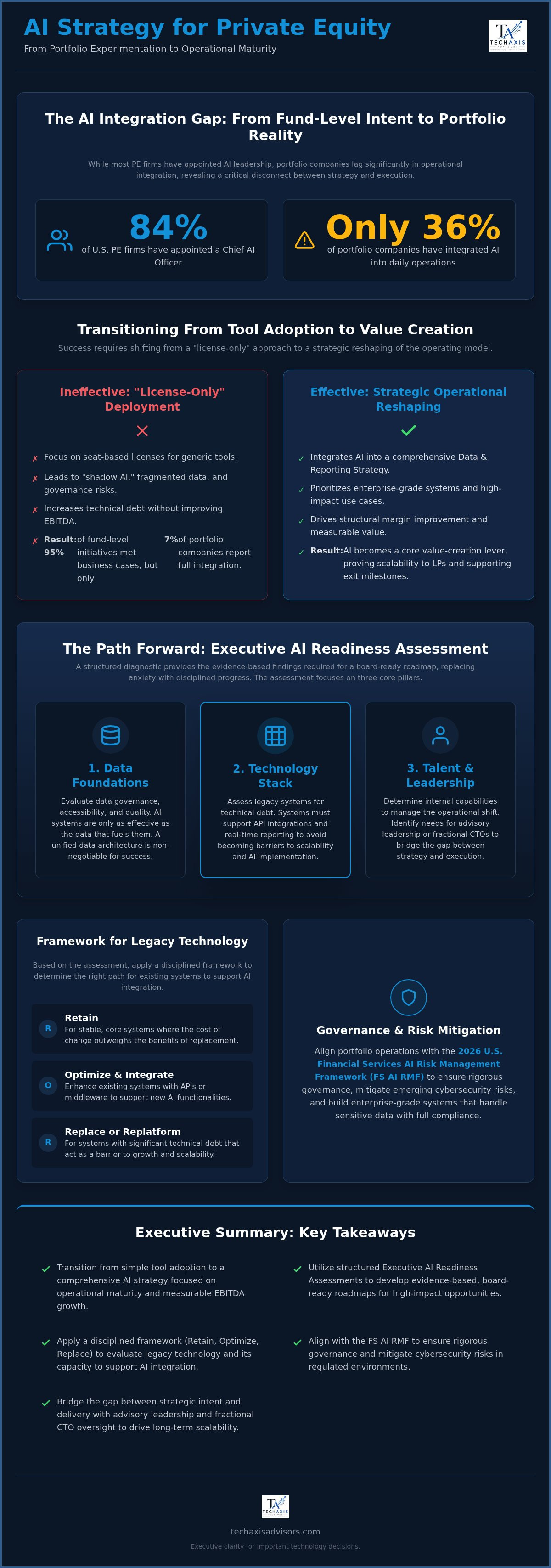
While 84% of U.S. private equity firms have appointed a Chief AI Officer as of 2026, only 36% of portfolio companies have successfully integrated AI into daily operations. This significant gap highlights a critical friction point for many leaders; the move from fund-level experimentation to portfolio-wide execution is often stalled by technical debt and fragmented governance. You've likely seen that the initial rush to deploy tools hasn't always translated into the expected EBITDA improvements. Developing a cohesive AI strategy for private equity requires moving past the pilot phase and addressing the structural realities of the middle market.
This guide provides an evidence-based framework designed for executive clarity and disciplined progress. You'll learn how to align AI initiatives with the U.S. Financial Services AI Risk Management Framework (FS AI RMF) while overcoming organizational resistance to new operating models. We'll examine the specific trade-offs between retaining legacy systems and replatforming for scale. Our objective is to provide a structured roadmap to transition your portfolio from modest AI experiments to a state of operational maturity that drives measurable value.
Table of Contents
The Shift from AI Deployment to Operational Reshaping
The initial phase of AI adoption in 2025 was characterized by a "license-only" approach. Many firms within the private equity sector invested heavily in seat-based licenses for general-purpose LLMs, expecting immediate productivity gains. However, data from August 2026 indicates that while 95% of AI initiatives at the fund level met original business cases, only 7% of portfolio companies report full integration. This disparity stems from a failure to reshape the operating model. A successful AI strategy for private equity must move beyond simple tool adoption to drive structural margin improvement. It's not enough to automate a single task; you must rethink how the business creates value.
The Limitations of Generic AI Tooling
Generic tools often create "shadow AI" problems where employees use unauthorized platforms to process sensitive deal data. This creates fragmented data silos and significant governance risks. Moving from experimentation to evidence-based implementation requires a disciplined approach. Seat licenses alone don't drive EBITDA growth. They often increase technical debt if they aren't integrated into a broader Data & Reporting Strategy. Firms that succeed focus on structural integrity. They prioritize enterprise-grade systems that handle sensitive data while meeting strict compliance requirements. This transition ensures that AI remains an asset rather than a liability during the holding period.
Focusing on High-Impact Use Cases
Identifying functional areas for automation is a matter of operational maturity. Finance, HR, and customer support offer clear opportunities for margin expansion through automated reporting and streamlined workflows. However, these initiatives must align with the investment thesis and specific exit milestones. If the goal is a three-year exit, the focus should be on rapid-deployment automation that provides immediate transparency. Evaluating use cases based on risk tolerance ensures that AI investments remain pragmatic and evidence-based. It's about building a bridge between strategic insight and operational delivery that Limited Partners can verify during their own due diligence processes. Leading firms use these outcomes to prove the company's scalability, turning AI from a technical experiment into a core value-creation lever.
Conducting an Executive AI Readiness Assessment
A successful AI strategy for private equity begins with a structured diagnostic rather than a technical audit. While many firms focus on the potential of new tools, they often overlook the underlying structural integrity of the portfolio company. An Executive AI Readiness Assessment provides the evidence-based findings necessary to build a board-ready roadmap. This process replaces organizational anxiety with disciplined progress, ensuring that every technology dollar is tied to an operational outcome.
The Diagnostic Framework: Data, Tech, and Talent
The first pillar of an assessment evaluates data foundations. AI systems are only as effective as the data that fuels them. If a portfolio company lacks a unified data architecture, any AI implementation will likely yield fragmented results. We examine whether data is governed, accessible, and clean enough for advanced modeling. This evaluation often uncovers significant technical debt. Legacy systems that cannot support API integrations or real-time reporting act as barriers to scalability. Understanding Generative AI's role in private equity requires a clear view of these technical constraints before deployment begins.
Talent is the final pillar. Assessing internal capability is vital for determining if the current team can manage the shift in the operating model. Often, growth-stage companies lack the senior expertise to oversee complex AI transitions. Identifying the need for advisory leadership or fractional CTO services ensures the business has the necessary oversight to avoid the "license-only" trap discussed previously. This bridge between strategic insight and execution is what differentiates successful portfolios from those stuck in the pilot phase.
Deliverables for the Board and C-Suite
An effective assessment must translate complex technical debt into executive clarity. Board members don't need granular code reviews; they need to understand risks, costs, and time-to-value. The primary deliverable is a prioritized strategic roadmap that categorizes initiatives into immediate improvements and long-term structural changes. It provides a clear action register that defines accountability and specific next steps:
Risk Mitigation: Addressing immediate security or compliance gaps in existing AI usage.
Operational Improvements: Identifying low-hanging fruit for automation that drives quick wins.
Structural Scaling: Long-term investments in data infrastructure and talent to support growth.
Using these evidence-based insights allows the C-suite to justify technology spend with confidence. It moves the conversation from abstract theory to tangible execution. If your portfolio requires this level of diagnostic depth, you may want to start with a confidential executive conversation to explore your specific readiness needs.
The Retain, Optimize, or Replace Framework for PE Portfolios
A common pitfall in developing an AI strategy for private equity is the assumption that legacy technology must always be replaced to support modern intelligence. This "rip and replace" mentality often introduces unnecessary execution risk and capital expenditure. A pragmatic executive framework instead evaluates systems through a business-first lens, categorizing assets into three distinct paths: retain, optimize, or replace. This disciplined approach ensures that technology investments align with the investment lifecycle and exit milestones of the portfolio company.
Retaining systems is often the most sensible choice when a legacy platform remains stable and holds high-quality historical data. In these cases, the focus shifts to optimization. By building robust API layers or using middleware to integrate AI capabilities into existing ERP and CRM ecosystems, firms can extract value without the disruption of a full-scale migration. Retiring obsolete systems that no longer serve a functional purpose is equally critical. This reduces the attack surface for cybersecurity threats and eliminates the maintenance burden of redundant infrastructure.
The Business Case for Legacy Modernization
The decision to replatform occurs when the cost of maintaining technical debt exceeds the projected ROI of a new system. Calculating this tipping point requires an objective analysis of operational efficiency and scalability. Modernization isn't just about new features. It's about reducing execution risk. When AI integration is hindered by closed architectures, the business case for replacement becomes clear. Effective Operational Scalability Consulting focuses on these transitions, ensuring that new platforms support the long-term data strategy without creating new silos.
Managing Vendor and Platform Transitions
Vendor management is a critical component of technology governance. As the AI market evolves rapidly, avoiding vendor lock-in is paramount. Contracts must be structured to allow for flexibility as more capable models and platforms emerge. A rigorous Vendor & Platform Management strategy ensures that third-party tools meet strict compliance standards, particularly in regulated financial environments. This oversight prevents the "shadow AI" issues mentioned in previous sections and ensures that the portfolio company maintains structural integrity throughout the holding period. Transitions should be methodical, prioritizing data transparency and accountability at every stage.
Governance and Risk Mitigation in Regulated AI Environments
The regulatory landscape for AI reached a turning point in February 2026 with the release of the U.S. Financial Services AI Risk Management Framework (FS AI RMF). This voluntary framework maps NIST principles to 230 specific operational control objectives. For leadership, this isn't just a technical checklist. It's a fundamental requirement for maintaining structural integrity across the portfolio. A robust AI strategy for private equity must prioritize these controls to satisfy both federal regulators and Limited Partners. Data from August 2026 shows that 47% of LPs now monitor how GPs adopt AI in investment and operational processes. Oversight is no longer optional; it's a core component of fiduciary duty.
AI Governance Frameworks for Finance
Building a governance structure that withstands scrutiny requires more than just policy documents. It demands clear accountability. With 84% of U.S. private equity firms now employing a Chief AI Officer, the standard for leadership has shifted toward disciplined oversight. These executives must ensure that AI-driven decisions are transparent and free from algorithmic bias. This is especially critical in wealth management where existing consumer protection laws are strictly applied to automated systems.
Firms shouldn't wait for a single federal AI law. They must navigate an emerging patchwork of state laws, such as California's Health Care Services AI Act. To see how these pieces fit together, review our guide on AI Governance Frameworks for Finance. Balancing innovation with risk tolerance means establishing a "human-in-the-loop" requirement for high-stakes financial modeling and ensuring that data privacy remains a non-negotiable priority.
Cybersecurity and Technology Risk Management
Protecting proprietary data is a primary concern as AI systems become more integrated into the operational fabric. Many portfolio companies still rely on generic tools that lack enterprise-grade security. This creates a significant leak risk for sensitive deal information and intellectual property. A disciplined approach involves assessing the security posture of every third-party AI vendor before integration. You must verify how they handle your data and whether they meet the standards of current Technology Governance & Compliance protocols.
Integrating these assessments into your broader Technology Due Diligence for Growth-Stage Companies ensures that technical debt doesn't hide future liabilities. This methodical flow suggests a well-defined process that replaces organizational anxiety with a sense of controlled progress. It ensures that the portfolio's attack surface remains minimal while the firm scales.
Strategic Execution: Integrating Advisory into the Investment Lifecycle
Execution is where most strategies fail. A comprehensive AI strategy for private equity requires continuous oversight to ensure that the prioritized roadmap stays on track through every phase of the investment lifecycle. Many mid-market companies struggle to bridge the gap between high-level strategic intent and daily operational delivery. This is where retained advisory becomes a critical lever for value creation. It provides the board with a steady, reassuring hand to navigate the complexities of AI integration without the friction of a massive consulting engagement. This model replaces organizational anxiety with controlled progress, ensuring that AI initiatives are not just started, but finished.
Fractional Leadership vs. Full-Time Hires
The need for senior technology leadership is undeniable, yet the overhead of a full-time Chief AI Officer for every portfolio company is often prohibitive. Fractional leadership offers a disciplined alternative. It allows firms to scale their technology operating models with the wisdom of a veteran executive while maintaining the agility of a modern innovator. This model ensures end-to-end continuity. The same partner who conducts the diagnostic oversees the result. By utilizing TechAxis Advisory Leadership, firms gain access to 25+ years of executive experience to drive execution across the holding period. This approach provides the necessary leadership bridge that a growing company might be missing.
The TechAxis Approach to AI Execution
Our methodology centers on structured Executive Intelligence Assessments that deliver evidence-based, board-ready findings. These assessments don't just identify technical gaps; they provide the prioritized roadmap discussed in previous sections. To move from insight to mastery, we support execution through advisory leadership, governance, and vendor oversight. TechAxis does not perform direct software builds or cloud migrations. Instead, we work with qualified delivery partners to manage custom implementation. This ensures that technical execution remains high-quality while the strategic architect maintains oversight of the business value. This disciplined approach values tangible execution over abstract theory, providing a reliable partner in business transformation.
Start with a confidential executive conversation to explore whether your priority requires an assessment, strategic advisory, or fractional leadership.
Mastering Operational Maturity in the AI Era
The transition from experimenting with tools to building a durable AI strategy for private equity requires a disciplined, evidence-based approach. We've explored how structured diagnostics and fractional leadership provide the necessary bridge between strategic intent and measurable EBITDA growth. By aligning with frameworks like the FS AI RMF and evaluating legacy systems through a "retain, optimize, or replace" lens, firms replace organizational anxiety with a clear roadmap for scalability. This process ensures that technology remains an asset rather than a liability during the holding period.
TechAxis Advisors supports this journey through our proprietary Executive Intelligence Platform and advisory leadership led by a founder with 25+ years of CIO, CTO, and CISO experience. As a certified SBA WOSB and NJ MWBE, we provide the executive clarity required for high-stakes technology decisions. Our focus remains on tangible execution and providing the leadership bridge your portfolio might be missing.
Bringing order to complex organizational challenges is the first step toward long-term mastery. We look forward to supporting your portfolio's transformation through methodical, results-oriented progress.
Frequently Asked Questions
What is an Executive AI Readiness Assessment for private equity?
An Executive AI Readiness Assessment is a structured diagnostic engagement that evaluates a portfolio company's data architecture, technical debt, and talent. Unlike a technical audit, this assessment focuses on business alignment and operational maturity. It results in a prioritized roadmap that identifies high-impact automation opportunities. By using an evidence-based approach, leadership can justify technology spend to the board while ensuring every initiative supports the investment thesis and exit milestones.
How can AI drive value creation in portcos without replacing existing systems?
AI drives value by optimizing existing infrastructure through API integrations and middleware layers. Instead of a costly replacement, firms can "wrap" legacy systems with intelligent automation to streamline reporting or customer support. This approach reduces execution risk and capital expenditure. By focusing on structural integrity and data transparency, portcos can achieve margin expansion and EBITDA growth without the disruption of a full-scale platform migration during the holding period.
What are the primary risks of implementing AI in regulated financial services?
The primary risks involve non-compliance with the 2026 U.S. Financial Services AI Risk Management Framework (FS AI RMF) and existing consumer protection laws. Algorithmic bias and data privacy leaks are significant concerns in wealth management. Implementing an AI strategy for private equity requires rigorous technology governance and vendor oversight. Failure to establish clear accountability can lead to regulatory scrutiny, intellectual property loss, and reputational damage that impacts the eventual exit valuation.
How do we measure the ROI of an AI strategy in a portfolio company?
ROI is measured by tracking specific operational outcomes against exit milestones, such as reduced cost-to-serve or improved data transparency. Leadership should evaluate structural margin improvements and the reduction of technical debt. Success isn't just about tool adoption; it's about measurable scalability. By linking AI outcomes to specific KPIs like EBITDA growth or faster reporting cycles, PE firms can provide Limited Partners with verifiable proof of value creation throughout the investment lifecycle.
When should a PE firm consider a Fractional CTO for AI oversight?
A firm should consider a Fractional CTO when a portfolio company lacks the senior executive expertise to oversee complex AI transitions but doesn't require a full-time hire. This role provides the necessary leadership bridge between strategic intent and operational delivery. It's particularly effective during the post-acquisition integration phase or when technical debt hinders scaling. Fractional leadership ensures end-to-end continuity from the initial diagnostic to the final result without unnecessary executive overhead.
How does AI impact technology due diligence during the acquisition phase?
AI shifts the focus of due diligence toward assessing a target company's data quality and automation readiness. Buyers now evaluate whether a company's architecture can support advanced modeling or if it's burdened by technical debt. As of August 2026, 47% of LPs monitor AI adoption in these processes. Due diligence must now include an analysis of existing AI usage, potential cybersecurity leaks, and compliance with emerging state-level regulations like California’s health care AI disclosure rules.
What is the difference between AI deployment and operating model reshaping?
AI deployment involves the simple installation of tools or seat licenses, which often fails to drive returns. In contrast, operating model reshaping involves rethinking how the business creates value through structural changes. This includes automating core functional areas like finance or customer support to drive margin improvement. While deployment is a technical task, reshaping is a disciplined exercise in operational maturity that aligns an AI strategy for private equity with the company's long-term investment strategy.
How do we ensure data privacy when using large language models in PE?
Ensuring data privacy requires moving away from generic consumer tools toward enterprise-grade AI platforms that offer strict data isolation. Firms must implement rigorous technology governance and vendor management protocols. It's essential to verify that proprietary deal data isn't used to train public models. Clear accountability and the use of private cloud environments help protect sensitive intellectual property, ensuring that the portfolio company remains compliant with both federal and state-level privacy regulations.



Comments