

AI Strategy for Asset Management: A 2026 Executive Framework
The global AI in asset management market is projected to reach $7.1 billion in 2026, yet the gap between capital investment and operational impact is widening. Most C-suite leaders recognize that a coherent AI strategy for asset management is no longer optional. You likely feel the pressure to move faster while grappling with fragmented data foundations that hinder performance. It's a common frustration. Experimentation has its place, but it shouldn't be a permanent state of being.
This guide provides an evidence-based framework to help you transition from isolated pilots to scalable operational maturity. We'll examine how to build a prioritized roadmap that addresses the shift toward agentic AI systems while maintaining strict compliance with the latest regulatory standards. You'll learn to navigate the governance requirements of the EU AI Act and the SEC's updated Regulation S-P. We'll also outline a path to structural integrity that provides executive clarity without the high overhead of a full-time technology team.
Table of Contents
Beyond Pilots: The Shift to Strategic AI in Asset Management
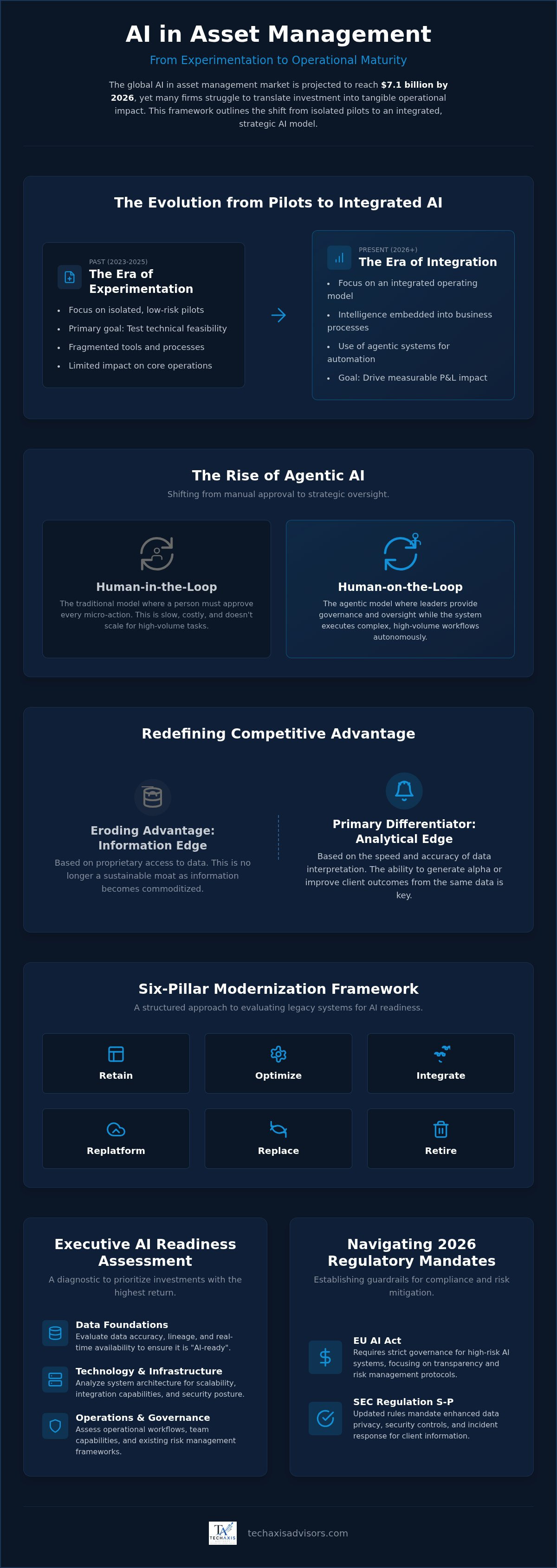
The era of isolated AI experimentation has concluded. Between 2023 and 2025, firms focused on low-risk pilots to test feasibility. In 2026, the focus has shifted to the integration phase. A successful AI strategy for asset management now requires moving beyond standalone tools toward a core operating model that embeds intelligence directly into business processes. Strategic AI is defined by this shift. It replaces fragmented experimentation with agentic systems that function as autonomous extensions of your team.
Asset managers are uniquely positioned to benefit from this transition. Your business is fundamentally built on information processing and decision-making. AI scales these core functions without the need for a proportional increase in headcount. This creates a compelling business case: achieving hyper-personalization for clients while maintaining constrained operational costs. It's about building a structure that supports growth through increased analytical capacity.
The Evolution of Agentic Systems in Finance
Agentic systems represent the next phase of automation. Unlike early generative models that simply summarized data, these agents execute complex workflows. They can update records, trigger rebalancing events, or generate tailored client reports based on real-time market shifts. This evolution builds upon the technical foundations of Algorithmic Trading, where pre-programmed instructions governed execution. Today, the scope is broader. The role of the executive is also changing. We are moving from "human-in-the-loop," where a person must approve every micro-action, to "human-on-the-loop" oversight. In this model, leaders provide governance and "kill switches" while the system manages the high-volume mechanics of the firm.
Identifying the Basis of Competition
Traditional advantages are eroding. Access to data is no longer a proprietary moat. When every firm has access to the same information, "information edge" disappears. Analytical differentiation is the new gold standard. Your advantage now stems from how quickly and accurately your firm can interpret data to drive alpha or improve client outcomes. Operational maturity is the primary differentiator. Firms that successfully integrate AI can deliver institutional-grade insights to mid-market clients while automating middle-office functions that previously required manual intervention. Success requires a disciplined approach to execution. It isn't about chasing the latest model. It's about building a structure that delivers a measurable impact on the P&L.
The Executive AI Readiness Assessment: Evaluating Maturity
Execution risk is the primary barrier to scaling intelligent systems in high-stakes financial environments. Many firms rush into implementation without a clear understanding of their current capabilities. A structured Executive AI Readiness Assessment serves as a diagnostic tool to identify these risks before they impact the P&L. The primary output is executive clarity. This engagement provides a transparent view of how your technical assets align with your business goals. It ensures that any AI strategy for asset management is built on a foundation of verifiable evidence rather than speculative potential.
This assessment moves beyond a simple technical audit. It functions as an executive decision-support engagement that categorizes your firm's maturity across data, technology, and operations. By identifying specific bottlenecks, you can prioritize investments that offer the highest return on complexity. The focus remains on replacing organizational confusion with a disciplined, methodical roadmap for progress. It's about establishing a baseline that supports accountable growth.
Data Foundations and Reporting Strategy
Modernizing your data architecture is an absolute prerequisite for any AI initiative. Fragmented data silos lead to inconsistent AI performance and regulatory vulnerabilities. You must evaluate the accuracy, lineage, and real-time availability of your business intelligence. This involves analyzing both structured portfolio data and unstructured client communications to ensure they are "AI-ready." A robust reporting strategy ensures that your leadership team has access to high-fidelity insights that drive alpha. For a comprehensive breakdown of these requirements, review our Data Strategy for Asset Managers. While resources like an AI Asset Management Guide provide general technical definitions, your strategy must reflect the specific reporting needs of your investor base.
Evaluating the Technology Operating Model
A firm's technology operating model determines its ability to support a sustainable AI strategy for asset management while maintaining oversight. You must assess whether your current team has the capacity for management or if technical debt will stall automation. This evaluation applies a business case lens to your existing stack: should you retain, optimize, integrate, replatform, replace, or retire specific systems? Infrastructure must align with long-term scalability rather than just solving immediate tactical pains. Identifying these trade-offs early prevents the accumulation of "hidden" costs that often plague growth-stage firms. If your current path feels unclear, you don't have to guess. You may want to explore whether your priority requires an assessment to define the next logical step.
Constructing a Pragmatic AI Roadmap for Asset Managers
Building a successful AI strategy for asset management requires a disciplined approach to modernization. You must avoid the trap of chasing every technical novelty. Instead, evaluate your existing stack through a clear business case lens. The TechAxis framework categorizes every technical asset into one of six actions: retain, optimize, integrate, replatform, replace, or retire. This categorization allows you to allocate capital toward systems that support operational scalability while decommissioning those that introduce technical debt. A pragmatic roadmap prioritizes P&L impact over "shiny object" pilots. It focuses on the mechanics of execution and structural integrity. For more details on how we apply this framework, you can review how we work with growth-stage firms.
Developing a roadmap that respects capital constraints and risk tolerance ensures the strategy remains viable over the long term. This process replaces organizational anxiety with a sense of controlled, disciplined progress. It's about building a leadership bridge between your current state and your desired operational maturity. Each phase of the roadmap should be defined by specific, measurable outcomes that contribute to the firm's overall value.
High-Impact Use Cases in the Value Chain
Focus your implementation efforts where they generate the most significant analytical capacity. In investment research, AI can perform deep-dive analysis on thousands of filings in seconds; this expands your firm's coverage without a proportional increase in headcount. For trading execution, agentic systems provide anomaly detection that far exceeds manual monitoring. Finally, in investment operations, automated reporting frameworks ensure that complex investor requests are handled with institutional precision. These use cases include:
Research: Expanding deep-dive analytical capacity to identify proprietary alpha.
Trading: Implementing automated anomaly detection for real-time risk management.
Operations: Standardizing reporting frameworks to reduce manual error and improve transparency.
Balancing Long-Term Transformation with Immediate ROI
Sustainable transformation requires balancing visionary goals with immediate operational wins. Identify "low-hanging fruit" where automation readiness is high and implementation friction is low. These early successes build organizational confidence and provide the capital to fund more complex integrations. A multi-year strategy should be iterative. It must allow for adjustments as market conditions or regulatory requirements shift. Executive leadership must maintain direct oversight of this roadmap to ensure it remains aligned with firm-wide objectives. You don't need a massive infrastructure overhaul to begin. You need a structured plan that delivers tangible results while preparing for the next stage of mastery.
AI Governance and Risk Mitigation in Regulated Environments
Regulators are no longer observing from the sidelines. As of August 2026, the enforcement of the EU Artificial Intelligence Act has begun, and the SEC has tightened notification requirements under Regulation S-P as of June 3, 2026. A sustainable AI strategy for asset management must be governance-led to withstand this scrutiny. Compliance departments can't rely on technology-neutral rules alone; they must actively interpret how existing fiduciary duties apply to autonomous systems. The C-suite holds the ultimate responsibility for defining ethical guardrails that prevent algorithmic bias and "AI washing," which has already resulted in penalties totaling $400,000 against firms in 2024. For a broader look at these dynamics, see our AI in Financial Services: 2026 Strategic Framework.
Establishing clear governance replaces organizational anxiety with controlled progress. Leaders must ensure that every automated decision is traceable and aligned with the firm's risk appetite. This focus on structural integrity protects the firm's reputation while enabling the adoption of more advanced agentic systems. It's about moving from reactive compliance to proactive oversight.
Compliance and Cybersecurity Frameworks
Effective risk mitigation requires integrating AI into your broader Executive Cybersecurity & Technology Risk Assessment. This ensures that data privacy is protected when using Large Language Models (LLMs) and that proprietary client data isn't inadvertently used for model training. You must also address the "black box" problem. Regulators, including FINRA in its 2026 Oversight Report, now emphasize the need for documented model risk management and "kill switches" for agentic systems. Transparency in automated investment decisions isn't just a technical preference. It's a regulatory mandate that requires clear procedures for development, testing, and monitoring.
Vendor Management and Oversight
Vendor risk is often the most overlooked component of an AI strategy for asset management. Since many AI capabilities are embedded in third-party platforms, your firm remains responsible for the accuracy and biases of those tools. You need a rigorous platform management strategy that demands transparency from vendors. This involves evidence-based findings during technology due diligence to verify how algorithms function under market stress. Avoid assuming that a vendor's reputation guarantees compliance. Your leadership team must establish clear accountability protocols for every third-party integration to ensure operational integrity.
Executing the Strategy: The Role of Fractional Leadership
Many firms struggle with the final mile of execution. A comprehensive AI strategy for asset management requires more than a document; it needs senior oversight. Hiring a full-time CTO is often a premature expense for growth-stage firms. It's difficult to find executives who possess both deep financial services experience and the agility to manage modern AI deployments. This is where Fractional CTO Leadership provides a distinct advantage. You gain access to veteran expertise that bridges the gap between high-level insight and tangible results. This model allows you to deploy senior leadership precisely where it's needed most, whether that's in vendor selection or architectural governance.
Advisory leadership serves as a leadership bridge. It's the difference between a strategy that sits on a shelf and one that transforms the P&L. By leveraging fractional talent, you ensure that your technology roadmap is managed by someone who understands the mechanics of scaling a financial services firm. This approach replaces organizational anxiety with a sense of controlled, disciplined progress. It's about having a seasoned professional at the table who has navigated these challenges before.
Strategic Counsel vs. Direct Implementation
TechAxis supports execution through advisory leadership, governance, and vendor oversight. This independent perspective ensures your AI strategy for asset management isn't skewed by vendor bias. We provide a senior-level lens without the full-time cost of a permanent hire. When direct software builds are required, we leverage qualified delivery partners while maintaining strict oversight of the project roadmap. It's about protecting your investment through disciplined management and transparent reporting. We don't perform direct implementations like software builds; instead, we ensure those builds meet your strategic requirements. This separation of counsel and construction provides the necessary checks and balances for complex technology initiatives.
Building an Operational Foundation for Scale
A fractional leader focuses on building a scalable operating model that outlasts any single technology tool. We reduce execution risk by providing structured executive intelligence and evidence-based findings. This ensures that every technology investment aligns with your broader business strategy. By establishing this foundation, we replace organizational confusion with a methodical path toward mastery. Our goal is to serve as a partner for Advisory Leadership, helping you navigate the complexities of agentic AI while maintaining operational integrity. This structural approach ensures your firm is ready for the integration phase of 2026 and beyond.
Transitioning from Experimentation to Operational Mastery
The shift from isolated AI pilots to a comprehensive AI strategy for asset management is the defining operational challenge of 2026. Success requires a disciplined alignment of data foundations, agentic workflows, and board-level governance. By moving beyond fragmented experimentation, your firm can achieve hyper-personalization at scale while maintaining structural integrity. It's about building a leadership bridge that converts technical potential into measurable P&L impact.
TechAxis Advisors provides the executive clarity needed to navigate this transition. Our approach is led by a founder with over 25 years of experience as a CIO and CTO. We utilize our proprietary TechAxis Executive Intelligence Platform to deliver evidence-based findings and prioritized roadmaps. As a certified WOSB and MWBE, we serve as an independent partner focused on your firm's long-term scalability and governance.
You don't have to navigate the complexities of AI adoption alone. With the right advisory leadership, your firm can replace organizational anxiety with a clear, methodical path toward operational maturity and sustained competitive advantage.
Frequently Asked Questions
What is the first step in an AI strategy for asset management?
The first step is a structured diagnostic to align technical assets with business goals. This assessment establishes a baseline for operational maturity. A coherent AI strategy for asset management ensures that subsequent investments focus on high-impact use cases rather than isolated pilots.
How does an AI Readiness Assessment differ from a technical audit?
A readiness assessment is a forward-looking decision-support engagement. Unlike a technical audit that reviews past specifications, this diagnostic evaluates your firm's capacity for scale. It provides a prioritized roadmap based on the business case for retaining, optimizing, or replacing legacy systems.
Can AI replace the need for a full-time CTO in wealth management?
AI doesn't replace technical leadership; it necessitates more sophisticated oversight. For growth-stage firms, fractional leadership provides veteran expertise without the cost of a full-time hire. These advisors bridge the gap between technical insight and operational results while managing complex integrations.
What are the biggest regulatory risks of using AI in finance?
Primary risks include algorithmic bias and non-compliance with mandates like the EU AI Act or Regulation S-P. Regulators now require documented model risk management and clear accountability. Firms must ensure every automated decision is traceable and aligned with their fiduciary duties.
How do we measure the ROI of an AI strategy?
ROI is measured by operational efficiency and expanded analytical capacity. Track the reduction in manual reporting hours and the ability to process complex data without added headcount. A successful AI strategy for asset management translates these efficiencies into tangible P&L impact.
Should we build our own AI models or buy vendor platforms?
Most firms should buy vendor platforms while focusing on proprietary data integration. Building models from scratch is capital-intensive and often unnecessary. A hybrid approach allows for faster adoption while maintaining control over the data that drives firm-wide differentiation.
How does data strategy impact the success of AI implementation?
Data strategy is the prerequisite for AI performance. Fragmented silos lead to inconsistent results and regulatory vulnerabilities. Modernizing your architecture ensures that intelligent systems have the high-fidelity, real-time inputs required for accurate reporting and autonomous workflow execution.
What is the role of the board in AI governance?
The board defines the firm's risk appetite and ensures executive accountability for AI governance. They oversee the establishment of ethical guardrails and compliance protocols. Their focus remains on strategic alignment and protecting the firm's reputation in a regulated environment.



Comments