

AI Strategy Consulting for Executives: A Practical Decision Framework
The hardest AI decision isn’t choosing a tool. It’s deciding which business problem merits investment, who owns the outcome, and what must be in place before implementation. With AI proposals arriving faster than many leadership teams can assess their relevance, data, governance, and delivery responsibilities can remain unresolved. Without a shared decision process, promising ideas can become disconnected pilots with no clear path to adoption.
Effective AI strategy consulting for executives turns proposals into governed, sequenced decisions tied to business priorities. A practical approach helps leaders compare opportunities against expected business outcomes, assess readiness and risk, and clarify accountability and dependencies before proceeding. This article explains how to evaluate an advisory engagement, prioritize business-led use cases, and connect governance with execution. The goal is to give leaders a clear basis for deciding what to advance, what to defer, and what to bring to board discussions.
Table of Contents
Why AI strategy consulting matters when executive priorities outpace AI activity
What effective AI strategy consulting should assess and deliver
How executives can compare AI strategy consulting approaches
How to turn AI consulting recommendations into governed action
Choosing an AI strategy consulting engagement that supports executive follow-through
Why AI strategy consulting matters when executive priorities outpace AI activity
AI proposals can come from business units, technology teams, and vendors before leaders agree on what the organization should solve. The result can be activity without clear ownership: teams explore tools, but executives still lack a shared basis for deciding which opportunities fit business priorities, what risks need attention, and who is accountable for the next step.
AI strategy consulting for executives is structured decision support that helps leadership assess AI opportunities, organizational capabilities, risks, and the decisions required to proceed. It isn’t a technology wish list, a vendor presentation, or a collection of pilots with no route to adoption. A strategy starts with the business problem and clarifies what evidence, ownership, and conditions are needed before committing resources. Because artificial intelligence (AI) covers a broad range of methods and applications, the right approach depends on the task and business context, not the label alone.
What executives need an AI strategy to resolve
Leaders need to determine which business problems merit investigation before choosing tools or vendors. For example, if a wealth management firm wants to improve client onboarding, the decision isn’t simply whether AI can help process documents. Executives must also consider the intended outcome, who owns the process, what data is needed, and who remains accountable for decisions that affect clients.
That clarity helps leadership assess uncertainty without treating every proposal as a commitment. An opportunity can be advanced for further validation, deferred until a dependency is addressed, or declined if its value or risk profile doesn’t support investment.
When outside AI strategy consulting may be useful
Outside advice can be useful during rapid growth, AI adoption, modernization, or digital transformation, especially when responsibilities and decision rights haven’t kept pace. An independent, evidence-based perspective can help executives compare proposals against common business priorities, test assumptions, and identify unresolved dependencies without presuming that a particular tool or vendor is the answer.
The engagement should support leadership judgment, not replace it. Executives can review the organizations TechAxis Advisors serves to assess whether the firm’s audience aligns with their organization.
What effective AI strategy consulting should assess and deliver
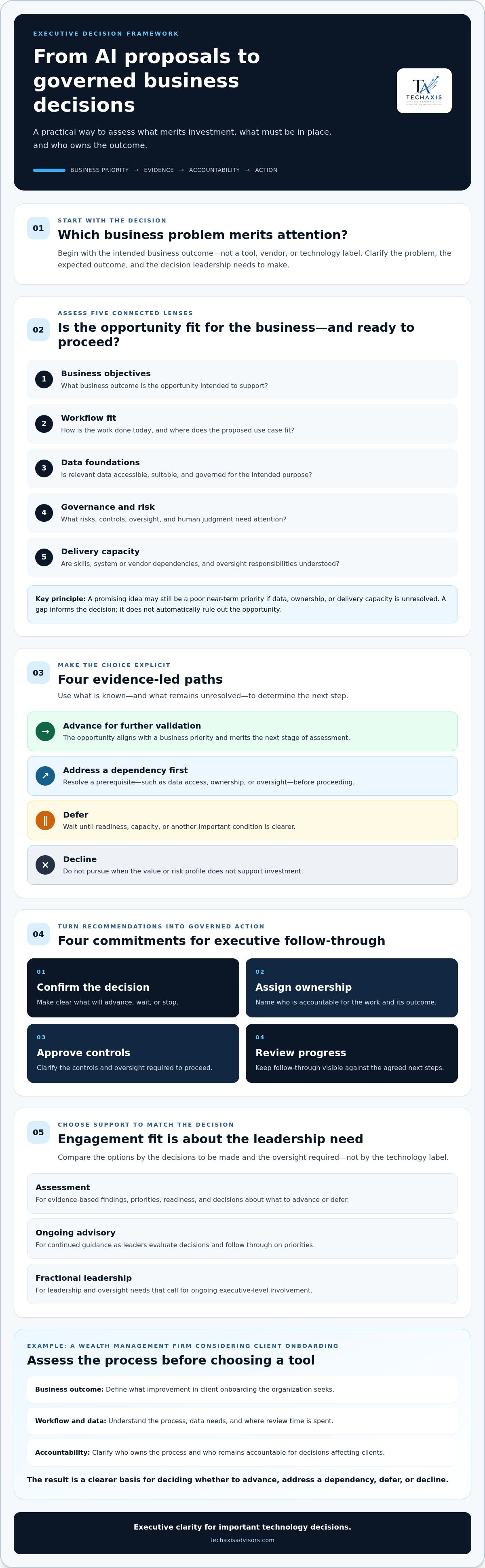
A useful assessment connects a proposed AI use case to the conditions required to pursue it. That means examining business objectives, workflows, data foundations, governance, and delivery capacity together. A use case may sound attractive but still be a poor near-term priority if the data isn’t accessible for its intended purpose, the process has no clear owner, or the organization lacks capacity to oversee the work.
AI strategy consulting for executives should turn evidence about business fit and readiness into clear choices, named accountabilities, and practical next steps. The purpose isn’t to promise a return or recommend technology before the need is understood. It’s to help leaders decide whether to advance an opportunity, address a dependency first, or defer it.
Assess business fit, data, operating capacity, and risk
Start with the intended business outcome, then examine how the work is done today. For a proposed document-review use case, for example, leaders would want to understand where review time is spent, who owns the workflow, what data the process uses, and where human judgment must remain. The assessment should also test whether relevant data is accessible, suitable, and governed for that purpose.
Then consider delivery realities: available skills, dependencies on existing systems or vendors, oversight responsibilities, and the organization’s risk tolerance. These factors help distinguish a promising idea from an actionable priority without assuming that every gap rules it out.
Look for decision-support deliverables, not a static report
Findings should make the decision visible. They should identify evidence and assumptions, open questions, priority opportunities, accountable owners, and the actions needed to move forward. A roadmap should reflect the organization’s strategy, readiness, and constraints, not simply follow current technology trends.
Board-ready assessment findings should enable leaders to decide which opportunities merit investment, what conditions or controls must be addressed, who is accountable, and what decision comes next.
Useful outputs can include evidence-based findings, a prioritized roadmap, an action register, and an executive presentation. Together, these give leadership a basis for discussion and follow-through instead of leaving recommendations disconnected from ownership. TechAxis’s structured assessments and advisory services support executive decision-making; the appropriate engagement depends on the decisions and oversight required.
Leaders looking to clarify priorities and next steps can explore an executive decision-support conversation.
How executives can compare AI strategy consulting approaches
Compare proposed engagements by how well they support the decision your organization needs to make, not by firm size or a broad list of capabilities. A large provider may bring substantial delivery resources; a smaller advisory team may offer closer senior access. Neither scale nor access alone establishes fit. Match the expertise, evidence, and level of involvement to the complexity of the decision.
Use a consistent set of criteria across potential approaches:
These criteria make tradeoffs easier to see. Strategy-led advisory can provide an independent view of priorities, but leaders should confirm how recommendations will connect to delivery. Implementation-led providers may be positioned to move into technical work, though executives should distinguish delivery recommendations from independent advice. Internal teams bring organizational knowledge and can retain ownership, but may benefit from outside perspective when assumptions are contested or expertise is limited. A combined model can connect advisory and delivery, provided accountabilities and decision rights remain clear.
Questions to ask before selecting an AI strategy advisor
Ask how recommendations will connect to business objectives and the organization’s stated risk tolerance. Confirm who leads the engagement, how evidence and assumptions are recorded, and how unresolved issues will be surfaced. Finally, clarify which executive deliverables are included and what follow-through means in practice. AI strategy consulting for executives should make decision ownership and boundaries explicit.
Compare advisory, delivery, and internal ownership
Internal leaders may be well placed to guide familiar, bounded decisions. Independent perspective can help when priorities conflict, dependencies cross business units, or leaders need to test a proposal without vendor influence. Advisory and oversight are distinct from direct software builds or cloud migrations, so clarify who is responsible for each. For sector context, executives can review the AI strategy framework for financial services.
If the right mix of assessment, advice, and leadership remains unclear, start with a confidential executive conversation.
How to turn AI consulting recommendations into governed action
Recommendations become actionable when each one leads to a defined decision, an accountable owner, and a review point. Governance makes those responsibilities visible. It supports business judgment by setting expectations for oversight, evidence, and escalation; it doesn’t replace leaders’ judgment about whether an initiative fits the organization’s priorities and risk tolerance.
AI accountability requires a named executive owner and documented decision criteria for approving, monitoring, changing, or stopping an initiative. This gives leadership a clear basis for oversight as assumptions and conditions evolve.
Set decision rights, oversight, and review points
For each initiative, identify its executive sponsor, the person accountable for the business process, and who approves material changes. Assign review responsibilities that fit the use case, including consideration of data access, security, vendors, and operational impacts. Where jurisdiction-specific legal or regulatory requirements may apply, have qualified experts verify them rather than relying on generalized guidance.
A practical sequence keeps the work grounded:
Confirm the decision: State the business problem and the decision leaders need to make.
Validate the evidence: Check assumptions, data suitability, workflow fit, and unresolved questions.
Assign ownership: Name the executive sponsor and process owner.
Approve controls: Agree on appropriate oversight, review responsibilities, and escalation paths.
Review progress: Set a point to continue, revise, pause, or stop based on what the organization learns.
Sequence initiatives around readiness and evidence
Prioritize opportunities by weighing expected business value alongside readiness, risk, dependencies, and organizational capacity. A use case may address a meaningful business need but still require foundational work, such as clarifying process ownership or confirming access to appropriate data. Addressing those prerequisites first can be more disciplined than expanding scope before the organization is ready.
Set review criteria before work begins. These might include whether the use case still supports the stated business objective, whether key dependencies are resolved, and whether oversight is operating as intended. The criteria should help leaders decide to continue, revise, pause, or stop, not create an automatic commitment to scale.
TechAxis’s workflow connects a structured diagnostic and assessment with intelligence synthesis, a strategic roadmap, and execution leadership. An executive decision-support engagement can help clarify the sequence; accountable leaders retain authority over business decisions and implementation choices.
Choosing an AI strategy consulting engagement that supports executive follow-through
The right engagement depends on the leadership gap, not a standard package. Some organizations need a clear, evidence-based decision point. Others need continuing counsel as priorities shift, or executive capacity to coordinate governance and transformation. A useful engagement should make its scope, decision role, and follow-through explicit.
Match the engagement model to the leadership gap
Focused executive assessment: Use this when leaders need a grounded view of opportunities, readiness, risks, and priorities before deciding where to invest.
Ongoing executive advisory: Consider this when decisions will continue to evolve and leadership needs strategic counsel, governance guidance, or vendor oversight over time.
Fractional executive leadership: Consider this when the organization needs experienced executive support embedded in decision-making, accountability, and transformation efforts.
An assessment can establish a decision basis; ongoing counsel can help leaders revisit choices as evidence, dependencies, or business priorities change. The models can also be sequenced. Match the level of support to the decisions ahead rather than assuming every organization needs the same duration or structure.
What a TechAxis engagement can involve
TechAxis founder Aarati Dikshit brings more than 25 years of executive experience as a CIO, CTO, and CISO. Structured Executive AI Readiness Assessments use the TechAxis Executive Intelligence Platform and produce evidence-based findings, a strategic roadmap, an action register, and an executive presentation. These outputs support leadership decisions, not substitute for them.
For organizations that need ongoing counsel, executive advisory and fractional leadership can provide continuity between assessment and follow-through. Governance and vendor oversight can support execution, while custom software development and implementation are available through a white-label partnership model. Clarify how responsibilities will work alongside existing technology and business leaders.
When considering fractional CTO leadership, clarify the executive’s decision authority, expected involvement in governance, and how responsibilities will work alongside existing technology and business leaders.
AI strategy consulting for executives should leave leadership clearer about the decision at hand, the support required, and who remains accountable. A confidential conversation can help clarify whether your organization needs an assessment, continuing advisory, or fractional leadership.
Move from AI interest to accountable decisions
AI strategy consulting for executives is most useful when it gives leadership a disciplined way to decide what to advance, what conditions must be met, and who owns the next step. Assess opportunities against business priorities and organizational readiness, then connect governance and delivery to named accountability. Not every proposal needs immediate investment; a clear decision to defer or investigate further can be just as valuable.
TechAxis founder Aarati Dikshit brings more than 25 years of CIO, CTO, and CISO experience. Structured assessments produce executive findings, prioritized roadmaps, action registers, and presentations to support leadership decisions. TechAxis holds small-business certifications, including SBA WOSB certification.
If your leadership team is weighing an AI proposal or needs clearer ownership and priorities, a confidential conversation can help clarify the decision and the kind of support that may fit.
With the right evidence, oversight, and accountable owners, your organization can move forward with greater clarity, one considered decision at a time.
Frequently Asked Questions
What does AI strategy consulting for executives include?
AI strategy consulting for executives typically helps leadership assess business priorities, potential use cases, organizational readiness, data, governance, and execution dependencies. Scope and deliverables vary by engagement, so clarify them before work begins. TechAxis’s structured Executive AI Readiness Assessments provide executive findings, a strategic roadmap, an action register, and a presentation for leadership review. These are decision-support outputs, not a guarantee that a particular AI initiative will succeed.
When should a company hire an AI strategy consultant?
Consider outside support when leaders need an objective view of AI opportunities, organizational readiness, governance, or decision ownership. This can be useful during growth, modernization, or broader transformation, particularly when stakeholders need a shared basis for prioritization. First define the decision leadership must make. Then assess whether internal expertise and capacity are sufficient or whether an independent executive perspective could help clarify options and unresolved questions.
How do executives choose an AI strategy consulting firm?
Compare relevant executive experience, evidence-gathering methods, senior involvement, deliverables, governance approach, and support after recommendations. Ask how the work will connect to business objectives and risk tolerance, who will lead it, and how assumptions and open issues will be documented. Clarify whether the provider offers advisory, implementation, or both. Broad capability claims alone aren’t enough; confirm that the proposed engagement addresses the leadership decision you need to resolve.
What is the difference between AI strategy consulting and AI implementation?
AI strategy consulting helps leaders assess priorities, readiness, governance, and the sequence of decisions. Implementation involves building, configuring, or deploying a specific solution. Organizations may use separate providers or combine advisory and delivery arrangements. Define responsibilities, ownership, and oversight before work begins. TechAxis provides executive advisory and can support execution through governance, vendor oversight, and qualified delivery partners. Custom software development and implementation are offered through a white-label partnership model, so clarify the engagement scope rather than assuming direct implementation is included in advisory work.
How can executives evaluate whether an AI use case is ready?
Start by confirming that the use case addresses a defined business need and has a responsible process owner. Then assess whether relevant data is accessible and suitable, and consider workflow dependencies, organizational capacity, governance, and risk tolerance. Readiness depends on context. A promising idea may need foundational work before it can proceed. Use the available evidence to decide whether to move forward, gather more information, revise the scope, or defer it.
What should an executive AI assessment deliver?
An executive AI assessment should make decisions easier, not simply summarize technology. Look for evidence-based findings, a prioritized strategic roadmap, an action register, and materials suited to executive or board review. Findings should reflect business objectives and risk tolerance, and make assumptions and next steps clear. TechAxis’s structured assessments provide these decision-support deliverables. Confirm the engagement’s scope and outputs in advance, since methods and deliverables can differ among providers.



Comments