

AI Readiness Checklist: 2026 Executive Framework
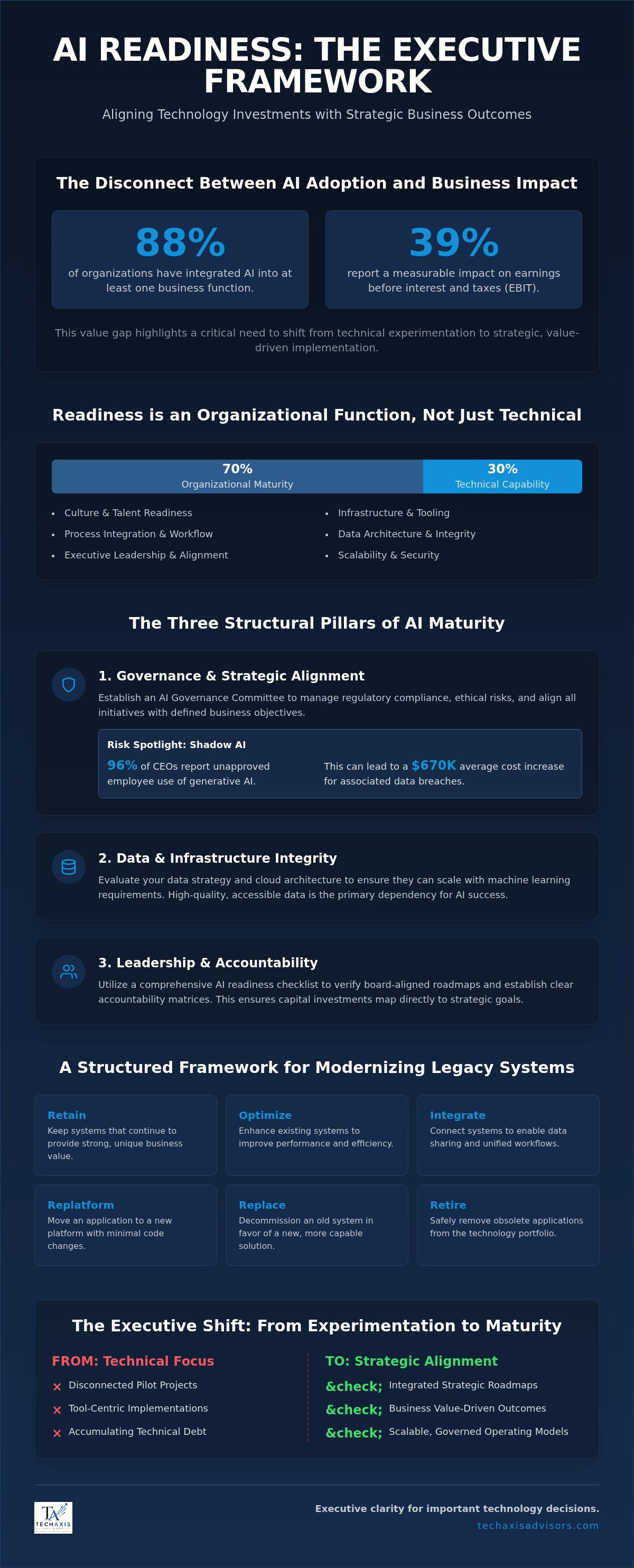
While 88% of organizations have integrated AI into at least one business function, only 39% report a measurable impact on earnings before interest and taxes. This gap reveals a critical disconnect between technical experimentation and strategic value. Most C-suite leaders recognize that the pressure to implement AI often outpaces the structural readiness required to sustain it. Without a comprehensive AI readiness checklist for leadership, organizations risk compounding technical debt or facing the $670,000 average cost increase associated with shadow AI data breaches. You understand that technology must serve the business strategy, not the other way around.
This framework provides the executive clarity needed to evaluate your current organizational maturity and align capital investments with long-term goals. We'll move beyond the hype to examine pragmatic governance, data integrity, and the essential decision-support criteria for your infrastructure. You'll learn how to apply a disciplined model to retain, optimize, integrate, replatform, replace, or retire existing systems. This guide replaces organizational anxiety with a structured, evidence-based roadmap for 2026 and beyond.
Table of Contents
Defining AI Readiness for Executive Leadership
AI readiness is the organizational capacity to deploy automation and machine learning solutions that drive measurable business value. It isn't just about software. It requires a synchronized approach across data architecture, executive governance, and operational maturity. For leadership, readiness means having the clarity to distinguish between high-impact use cases and technical distractions. Incorporating a formal AI readiness checklist for leadership into your planning ensures that the organization moves beyond curiosity into a state of execution. Executive AI readiness is the intersection of strategic intent and technical capability.
The Shift from Experimentation to Operational Maturity
August 2026 marks a turning point for growth-stage firms. The era of AI for AI's sake is over. While 88% of organizations now use AI in at least one business function, only about 39% report a measurable impact on earnings. This gap highlights the need for a scalable enterprise AI operating model. Moving from pilot projects to full-scale deployment requires a robust advisory leadership framework. Executive clarity reduces execution risk. It ensures that digital transformation efforts are not just expensive experiments but contributors to the bottom line.
Why Technical Readiness is Only 30% of the Equation
Many leaders focus exclusively on the stack. This is a mistake. Technical readiness is only 30% of the equation. The remaining 70% involves culture, process, and leadership alignment. Organizations often suffer from random acts of digital where tools are implemented without a structured strategic roadmap. A successful technology strategy must account for non-technical hurdles like data ownership and talent gaps. Without this alignment, the risk of project failure remains high.
TechAxis Advisors bridges the gap between board-level goals and technical execution. We focus on evidence-based findings rather than generic consulting reports. Our approach helps leaders avoid the 80-95% failure rate associated with poorly integrated AI projects. By utilizing an AI readiness checklist for leadership, executives can verify that their organizational foundations are solid before committing significant capital. This disciplined oversight replaces anxiety with controlled, professional progress.
Strategic Alignment and Governance: The First Gate
Governance is the non-negotiable entry point for any scalable AI initiative. It serves as the primary gate to ensure that technology serves the business rather than creating liabilities. An effective AI readiness checklist for leadership prioritizes the creation of an AI Governance Committee. This group oversees ethics, bias, and regulatory compliance, particularly as a growing body of state-level legislation mandates transparency and risk reporting in 2026. Without this oversight, organizations risk non-compliance in various jurisdictions nationwide, where auditing for discriminatory outcomes is now a requirement.
Establishing an Executive AI Governance Framework
Effective oversight requires clearly defined roles at the C-suite level. Accountability shouldn't be buried in the IT department. Instead, it must reside within a committee that includes legal, risk, and operational heads. This group must establish a formal policy for Shadow AI. Research indicates that 96% of CEOs believe employees use generative AI tools without official approval. This unsanctioned usage increased the average cost of a data breach by $670,000 in a 2025 study. Integrating AI risk management into your existing technology risk framework is a pragmatic necessity. A structured AI readiness assessment provides the baseline data needed to build this framework with confidence. Leaders should treat this as a decision-support engagement rather than a simple technical audit.
Mapping AI Use Cases to Long-term Business Outcomes
Alignment requires a disciplined evaluation of business objectives. Leaders must decide if the primary goal is cost reduction, revenue growth, or risk mitigation. Capital should only be allocated to initiatives that match the firm’s risk tolerance and long-term strategic goals. In wealth management and lending, it’s easy to succumb to technical distractions. Avoid this by prioritizing use cases based on business value versus implementation complexity. Each initiative should be evaluated through a framework to retain, optimize, integrate, replatform, replace, or retire existing systems.
Successful implementation is directly linked to your current operational maturity. If a process is broken, adding AI will only accelerate the failure. Decisions must be based on evidence-based findings rather than generic consulting reports. This level of rigor allows for board-ready decisions that stand up to scrutiny. High-performing companies redesign workflows around AI instead of simply layering tools on top of legacy systems. Using an AI readiness checklist for leadership ensures that your initiatives remain aligned with your risk profile. If you're uncertain where your governance currently stands, you might consider a confidential executive conversation to evaluate your roadmap.
The Structural Pillars of AI Maturity
Technical maturity is the foundation of execution. An AI readiness checklist for leadership should prioritize structural readiness across four specific domains: data, infrastructure, systems, and talent. High-performing firms recognize that AI models are becoming commodities. Proprietary data and operational agility are the real differentiators. Without these pillars, even the most expensive software implementation will fail to deliver a return on investment.
Data as a Strategic Asset, Not a Liability
In private equity and wealth management, data is often fragmented. Silos prevent a unified view of value across portfolios. Modernizing your data architecture is essential for real-time business intelligence and AI ingestion. You must ensure data privacy and compliance within regulated environments, particularly as new state laws mandate stricter oversight. Accurate, accessible, and structured data is the prerequisite for any machine learning initiative. Applying a structured AI Readiness Framework helps identify where your data quality currently falls short of executive requirements.
Modernization Framework: Retain, Optimize, or Replace?
Legacy technology often creates structural bottlenecks. Leaders must evaluate the business case for keeping existing systems versus replatforming. We utilize a disciplined framework to determine whether to retain, optimize, integrate, replatform, replace, or retire legacy assets. This prevents the common mistake of assuming replacement is the only solution. Reducing technical debt clears the path for AI automation. A structured Executive Intelligence Assessment provides the evidence-based findings needed to identify these bottlenecks without the bias of a vendor.
Human oversight remains a legal and practical necessity. You must determine if your current team has the bandwidth for this transformation. Often, growth-stage companies don't need a full-time executive hire immediately. Instead, Fractional CTO leadership provides the necessary governance and technical oversight to manage these transitions. This model allows you to bridge the gap between strategic intent and technical execution while maintaining a lean operational structure. Using an AI readiness checklist for leadership ensures you have the right expertise in place before you commit significant capital to new infrastructure.
The AI Readiness Checklist for Leadership
Execution requires more than a vision statement. It demands a disciplined audit of current capabilities. Pragmatic oversight ensures that capital is allocated to initiatives with the highest probability of success. A comprehensive AI readiness checklist for leadership helps boards verify that their roadmap aligns with 2026 goals while managing the inherent risks of rapid deployment. Use these five criteria to evaluate your current state:
Strategy: Do you have a board-approved AI roadmap that specifically maps to your 2026 revenue or efficiency targets?
Governance: Is there a clear accountability matrix that defines who owns AI decisions, risk mitigation, and ethical oversight?
Data: Have you completed a data analytics assessment to identify which internal and external sources are viable for machine learning?
Operations: Are your core business processes documented and stable? Automation won't fix a broken workflow; it will only accelerate its failure.
Talent: Do you have the internal executive oversight necessary to manage complex vendor delivery partners and technical teams?
Category 1: Strategic and Financial Readiness
Budgeting for AI must look beyond the initial build. You need to account for ongoing operational costs, including model maintenance, data refreshes, and API usage fees. While 65% of enterprises increased their AI budgets in 2026, 79% experienced significant cost overruns. This happens when leaders fail to forecast the total cost of ownership. Defining KPIs is equally critical. Move past vanity metrics like "number of pilots" to bottom-line impacts such as reduced customer churn or increased loan processing speed. When considering custom software development, evaluate the "Build vs. Buy" trade-off through the lens of long-term scalability and proprietary advantage. If the solution doesn't provide a unique competitive edge, buying or integrating an existing platform is often the more pragmatic choice.
Category 2: Operational and Risk Readiness
Vendor management is a primary leadership function. You must evaluate AI startups against established platform providers, focusing on their financial stability and data handling practices. Utilizing this AI readiness checklist for leadership allows you to scrutinize whether a vendor's roadmap aligns with your compliance needs. For NJ-based financial firms, technology governance must meet specific state regulatory standards in 2026. This includes proving that AI systems don't produce discriminatory outcomes. Your current cybersecurity framework must also evolve. Verify that your CISO or SOC can handle AI-specific threat vectors like prompt injection or data poisoning. As a WOSB and MWBE certified firm, we emphasize that structural integrity and transparency are the only ways to satisfy both board requirements and regulatory auditors.
From Assessment to Execution: The TechAxis Perspective
Moving from a conceptual roadmap to tangible execution requires a disciplined framework. A structured Executive AI Readiness Assessment serves as the most effective starting point for boards. It provides the objective data needed to validate your current position against the AI readiness checklist for leadership. We provide evidence-based findings through our proprietary TechAxis Executive Intelligence Platform. This ensures that every recommendation is grounded in your specific operational reality and risk profile. This clarity allows you to allocate capital with confidence, knowing that your investments are protected by a rigorous governance framework.
Our prioritized roadmaps distinguish between immediate operational wins and long-term structural changes. We identify the specific bottlenecks in your data strategy and infrastructure that hinder automation. By bridging the gap between board-level intent and technical reality, we help you avoid the common pitfalls of uncoordinated digital initiatives. This methodical approach ensures that every step of your transformation is deliberate, measurable, and aligned with your broader business objectives. It replaces organizational anxiety with a sense of controlled, disciplined progress.
The Value of Independent Executive Advisory
Growth-stage firms often face a choice between global strategy firms and specialized advisory partners. While larger firms offer scale, our model provides the senior-level access and deep expertise required for mid-market agility. We provide objective decision support without the significant cost structure often associated with global strategy firms. The focus remains on execution leadership and vendor oversight. This reduces the risk of project failure and ensures that delivery partners remain accountable to your specific business goals. We act as an authoritative partner deeply invested in the mechanics of your success.
Next Steps for Growth-Oriented Boards
The transition from assessment to mastery is a deliberate process. Boards must decide whether their current priority requires a one-time assessment, strategic advisory, or ongoing oversight. For many organizations, fractional leadership provides the necessary governance bridge during a transformation. This model offers executive oversight without the commitment of a full-time hire. It allows you to implement the framework to retain, optimize, integrate, replatform, replace, or retire legacy systems with confidence. Explore whether your priority requires a formal Executive Intelligence Assessment or a more consistent advisory presence. Start with a confidential executive conversation to evaluate your current roadmap and identify the necessary foundations for your 2026 AI initiatives.
Aligning Capital with Capability for 2026
AI success is no longer defined by experimentation but by the rigor of your governance framework. Technical readiness is only one component of a broader organizational maturity model. By utilizing a comprehensive AI readiness checklist for leadership, boards can move past the 80% failure rate typical of uncoordinated projects. This methodical approach ensures that every dollar spent contributes to measurable business value. Our approach focuses on providing evidence-based roadmaps and board-ready deliverables that replace uncertainty with a prioritized path to execution. With 25+ years of executive technology experience, we'll help you navigate the complexities of data strategy and vendor oversight with the steady hand of a seasoned partner.
A disciplined advisory engagement provides the clarity needed to bridge the gap between strategic intent and technical reality. You can transform your infrastructure without the friction of unmanaged technical debt. It's time to move from curiosity to controlled progress.
We look forward to helping you build a resilient, technology-aligned future for your organization.
Executive FAQ: AI Readiness and Governance
What is the first step in an AI readiness assessment for a mid-market firm?
Establishing a governance framework and defining business objectives is the primary step. You must determine if your goal is cost reduction or revenue growth. This ensures your AI readiness checklist for leadership begins with strategic intent rather than technical experimentation, aligning board expectations with operational capacity.
How long does a typical executive AI readiness engagement take?
A structured Executive Intelligence Assessment typically spans several weeks of discovery. This timeframe allows for deep analysis of data architecture and operational maturity. The result is an evidence-based roadmap that supports board-ready decisions for 2026 technology investments, moving beyond surface-level technical audits.
Do we need to replace our legacy systems before implementing AI?
Replacement is not always required. We evaluate the business case to retain, optimize, integrate, replatform, replace, or retire existing systems. Integrating AI with optimized legacy data is often more pragmatic than a total overhaul, provided the current infrastructure can support the necessary data ingestion and scalability.
What is the difference between an IT audit and an AI readiness assessment?
An IT audit focuses on security controls and compliance. An AI readiness assessment is an executive decision-support engagement. It evaluates organizational capacity to drive business value, focusing on strategy, data quality, and leadership alignment to ensure technology investments map to specific corporate goals.
How does a Fractional CTO help with AI implementation?
A Fractional CTO provides advisory leadership and a governance bridge without the commitment of a full-time hire. They manage vendor delivery partners and ensure technical execution remains aligned with the board’s strategic roadmap, providing the oversight necessary to reduce execution risk during complex transformations.
What are the most common AI execution risks for wealth management firms?
Risks include data privacy breaches and non-compliance with 2026 regulations like California’s SB 942. Shadow AI usage also presents a significant financial threat, increasing data breach costs. Managing these risks requires disciplined oversight and structured auditing to prevent discriminatory outcomes in automated decision-making.
How should leadership budget for AI in 2026?
Budget for the total cost of ownership, including model maintenance, API fees, and data refreshes. Many firms face cost overruns by failing to forecast ongoing operational expenses beyond the initial build. Link all spending to specific KPIs that impact the bottom line to maintain financial discipline.


Comments