

AI Readiness Assessment for Private Equity Firms: An Executive Checklist
If 86% of dealmakers are already utilizing generative AI, why do so many portfolio companies still struggle to move beyond fragmented pilots? You likely recognize that the era of experimentation has ended, replaced by a need for disciplined execution and rigorous governance. With the August 2, 2026, deadline for the EU AI Act high-risk requirements now active, the stakes for compliance and operational integrity are at an all-time high. Most PE partners agree that the primary obstacle isn't a lack of tools. It's a lack of clarity regarding data foundations and regulatory alignment across the portfolio.
This article provides a structured framework for an AI readiness assessment for private equity firms, offering a repeatable diagnostic to evaluate maturity and identify hidden execution risks. It's designed to replace organizational anxiety with a controlled, evidence-based roadmap for your board. We'll explore the essential checklist items required to move from technical debt to measurable value creation in a complex regulatory environment.
Table of Contents
The Strategic Mandate for AI Readiness in Private Equity
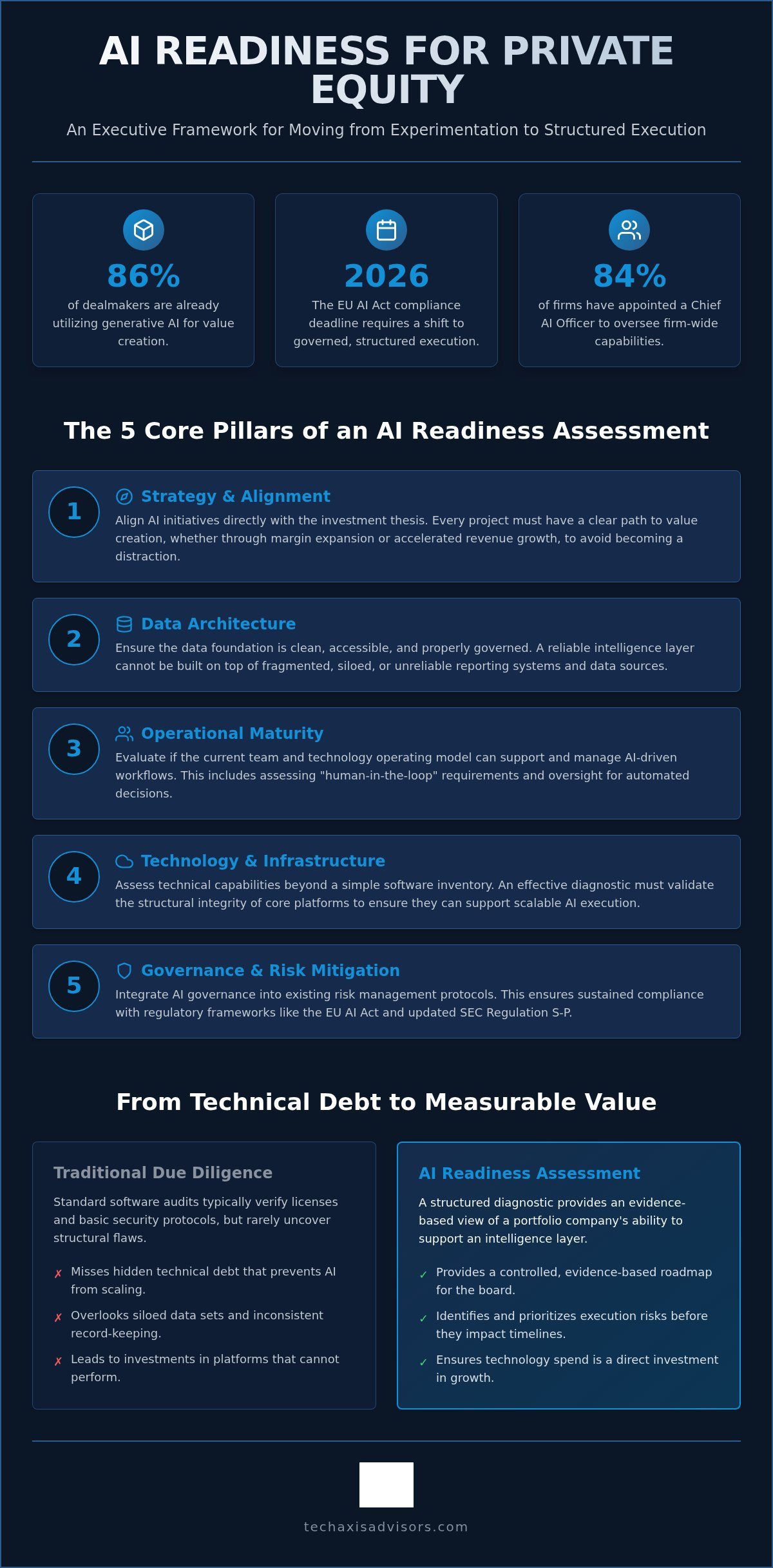
AI readiness is not a technical milestone. It's the strategic alignment of data architecture, operational maturity, and risk tolerance. For most partners, 2026 represents a pivot point. The period of ad-hoc experimentation has passed. With the August 2, 2026, compliance deadline for the EU AI Act already in effect, firms must transition to structured execution. An AI readiness assessment for private equity firms serves as the foundational diagnostic for this transition. It provides a clear view of whether a portfolio company can actually support an intelligence layer. This shift is reflected in the market; 84% of firms have now appointed a Chief AI Officer to oversee governed, firm-wide capabilities according to EY data from June 2026.
Why Traditional Due Diligence Often Misses AI Risk
Standard software audits typically verify licenses and basic security protocols. They rarely uncover the structural flaws that inhibit machine learning. A structural diagnostic identifies hidden technical debt, such as siloed data sets or inconsistent record-keeping, that prevents AI from scaling. Without this oversight, you risk investing in a platform that cannot perform because the underlying data is inaccessible or unreliable. You can read more about Why Technology Debt Slows Growth in Wealth Management Firms to understand how these underlying risks impact the bottom line and exit readiness.
AI as a Lever for Portfolio Value Creation
Value creation is shifting from simple cost reduction to "Operational Alpha." This involves using predictive analytics to drive top-line revenue and improve investment decision-making. According to Deloitte research from June 2026, 86% of dealmakers are already utilizing generative AI. However, the difference between a high-value exit and a stalled project lies in evidence-based roadmaps. A structured AI readiness assessment for private equity firms builds board confidence by replacing speculation with data. This disciplined approach ensures that technology spend is an investment in growth, not a sunk cost. For a deeper look at this trend, see The Shift to Operational Alpha: Private Equity Technology Value Creation in 2026.
We view readiness as a diagnostic process rather than a static destination. It's an ongoing effort to ensure technology supports the investment thesis at every stage of the lifecycle. By identifying gaps early, you can implement a prioritized roadmap that addresses execution risks before they impact your exit timeline. This proactive stance replaces organizational anxiety with a sense of controlled, disciplined progress.
The Executive AI Readiness Checklist: 5 Core Pillars
An effective AI readiness assessment for private equity firms must move beyond a simple inventory of software. It requires a disciplined evaluation of five distinct pillars to ensure technology investments actually move the needle on EBITDA. Without a structured diagnostic, firms risk deploying capital into projects that fail due to poor data quality or organizational resistance. This checklist serves as a framework for partners to validate that a portfolio company possesses the structural integrity required for scalable AI execution.
Pillar 1 & 2: Strategy and Data Architecture
Strategy must dictate technology, not the other way around. Every AI initiative should directly support the investment thesis, whether that involves margin expansion or accelerated revenue growth. We call this "Opportunity Discovery," a process that aligns specific AI use cases with core business objectives. If a project doesn't have a clear path to value, it's a distraction. This alignment relies entirely on your data foundation. Data must be clean, accessible, and properly governed to be useful. For firms in asset management, a robust Data Strategy for Asset Managers: 2026 Executive Framework is essential for turning raw information into real-time intelligence. You cannot build a reliable intelligence layer on top of fragmented or siloed reporting systems.
Pillar 3 & 4: Operations and Infrastructure
Technical capability is useless without operational maturity. You must evaluate if the current team and technology operating model can manage AI-driven workflows. This includes assessing the "human-in-the-loop" requirements and the governance needed to oversee automated decisions. On the technical side, cloud transformation is no longer optional; it is a prerequisite for enterprise-grade AI. A scalable infrastructure ensures that as the portfolio company grows, the AI tools don't become a bottleneck. You can explore our services for technology operating model assessments to determine if your current stack and team structure are prepared for this transition. A mismatch here often leads to significant execution risk and technical debt.
The final pillar, Risk and Governance, has become a primary concern for the C-suite in 2026. Compliance is no longer a moving target. With the EU AI Act's high-risk requirements active since August 2, 2026, and the SEC Regulation S-P compliance deadline for smaller advisers having passed on June 3, 2026, the regulatory floor has been set. A thorough AI readiness assessment for private equity firms must verify that these compliance frameworks are integrated into the existing cybersecurity risk management program. If you are unsure about your portfolio's current standing, you may want to start with a confidential executive conversation to identify potential gaps in your governance model.
Analyzing Trade-offs: Retain, Optimize, or Replatform?
Technology decisions in a private equity context must balance immediate value creation with long-term scalability. A structured AI readiness assessment for private equity firms provides the evidence needed to determine whether to retain, optimize, or replatform existing systems. This choice is rarely binary. It requires a disciplined look at the business case for each path. For many portfolio companies, the most capital-efficient route is optimizing current assets rather than undergoing a total replacement. This approach preserves capital and accelerates time-to-value; a critical factor for meeting exit timelines.
Partners must remain vigilant against unnecessary technical complexity. This occurs when firms invest in over-engineered solutions that offer high visibility but low operational impact. Identifying "low-hanging fruit" automation often yields higher immediate returns than sprawling, multi-year digital transformations. Evidence-based findings from a diagnostic assessment allow you to justify technology spend to the board with confidence. You can present a clear trade-off analysis that shows exactly why a specific path was chosen over a more expensive, less efficient alternative.
The 'Retain vs. Replace' Decision Framework
Evaluating legacy technology for AI integration potential is a core component of executive decision-support. You must determine if a legacy system can serve as a reliable data source or if its technical debt makes integration impossible. Integrating a third-party AI platform often provides a faster route to market than building custom solutions from scratch. However, custom builds may be necessary if the portfolio company's competitive advantage relies on proprietary logic. You should retain existing systems when the cost of data normalization and API integration remains significantly lower than the projected implementation and training costs of a new enterprise platform.
Managing Vendor and Platform Risk
Assessing AI vendors for long-term stability and compliance is no longer a secondary concern. Vendor oversight is a critical mechanism for reducing execution risk in AI projects. You must ensure that providers can meet defined control objectives to protect the firm from operational disruptions and regulatory penalties. You can learn more about how we solve vendor management challenges to ensure your portfolio companies aren't exposed to unnecessary platform risks. Maintaining this discipline ensures that technology remains an asset rather than a liability during the holding period.
AI Governance and Risk Mitigation for Regulated Industries
Governance is the anchor of a successful technology strategy. In highly regulated sectors like wealth management and lending, AI deployment is not merely an operational decision; it is a matter of institutional defensibility. An AI readiness assessment for private equity firms must move beyond technical capability to evaluate how automated systems align with existing compliance mandates. This requires integrating AI oversight directly into the firm's established cybersecurity risk management framework. By doing so, you ensure that innovation does not outpace your ability to manage the associated risks. This disciplined approach replaces organizational anxiety with a sense of controlled, professional oversight.
Building a Pragmatic Governance Framework
A functional AI policy for a portfolio company must be both rigorous and actionable. It should define clear boundaries for data privacy, model transparency, and ethical considerations to prevent algorithmic discrimination. This is particularly critical given the Colorado AI Act, which took effect on June 30, 2026, requiring "reasonable care" to avoid biased outcomes in financial services. For a deeper dive into these requirements, consult our Executive Guide to AI Governance Frameworks for Financial Services Leaders. Establishing these guardrails early protects the investment from future regulatory friction and potential litigation during the hold period.
Cybersecurity and Technology Risk in the AI Era
The introduction of AI fundamentally shifts the threat landscape for growth-stage firms. Beyond traditional breaches, you must now account for "shadow AI," where employees use unapproved consumer tools. Microsoft's 2025 research indicated that 71% of employees admitted to using unapproved AI at work. Managing this risk requires a structured technology risk diagnostic to identify vulnerabilities in the AI intelligence layer. This approach ensures that your technology stack remains resilient against emerging threats and complies with the SEC Regulation S-P requirements that were mandated by June 2026. You can see who TechAxis serves in regulated industries to understand how we tailor these assessments for wealth managers and asset managers.
Board-level technology advisory requires more than just a list of risks. It demands evidence-based findings and prioritized roadmaps that demonstrate a commitment to oversight. The Treasury Department's February 2026 framework provides 230 control objectives that serve as a benchmark for this reporting. By adopting a governance-driven approach within an AI readiness assessment for private equity firms, you provide the board with the transparency they need to validate technology spend. This methodical flow suggests a well-defined process, reinforcing the brand's identity as a structured and reliable partner in business transformation.
From Assessment to Execution: The Role of Fractional Leadership
An assessment without an execution roadmap is a wasted investment. Identifying technical debt and data silos is only half the battle; the real value lies in closing those gaps to drive EBITDA. Many private equity partners find that while a portfolio company understands its deficiencies, it lacks the senior leadership necessary to manage a complex AI implementation. A structured AI readiness assessment for private equity firms provides the diagnostic clarity, but fractional leadership provides the engine for progress. This approach ensures that findings don't remain stagnant in a board report but instead transform into operational reality.
Execution risk is often highest during the transition from strategy to implementation. Without veteran oversight, projects frequently suffer from scope creep or vendor misalignment. Advisory leadership mitigates these risks by providing a steady, professional hand to oversee technical workstreams and governance protocols. This disciplined oversight replaces organizational confusion with a methodical progression toward the investment goals defined at the start of the hold period.
The Fractional CTO as an AI Architect
A Fractional CTO serves as the architect of your intelligence layer. They align operational execution with the findings of the AI readiness assessment for private equity firms, ensuring every technical decision supports the investment thesis. This role is particularly critical when a portfolio company is too small to justify a full-time executive but too complex to manage without senior technical guidance. You can evaluate When Does a Growth Company Need a Fractional CTO? to determine if your current team structure can support the demands of an AI-driven roadmap. Fractional leaders bring the wisdom of a veteran executive with the agility required for growth-stage environments.
Moving Forward with TechAxis Advisors
Our process is designed to provide executive clarity for important technology decisions. It follows a logical narrative: Diagnostic, Intelligence Synthesis, and Execution Leadership. We utilize our proprietary Executive Intelligence Platform to deliver structured diagnostics that lead to board-ready roadmaps. This ensures that every finding is evidence-based and every action is prioritized for value creation. We don't just provide advice from the sidelines; we are deeply invested in the mechanics of your success through a partner-like dialogue.
The transition from assessment to execution doesn't have to be a source of organizational anxiety. You can learn more about our advisory leadership approach to see how we bridge the gap between technical audits and strategic growth. Our goal is to provide the leadership bridge that a growing company might be missing during its most critical transformation phases. If you're ready to move beyond experimentation, start with a confidential executive conversation about your portfolio's AI maturity and execution path.
Securing the Intelligence Layer: A Roadmap for 2026
The transition from AI experimentation to disciplined execution requires more than technical curiosity. It demands a rigorous alignment of your data foundations, operational workflows, and regulatory compliance. By conducting a structured AI readiness assessment for private equity firms, partners can replace organizational uncertainty with evidence-based roadmaps that provide board-level clarity. This diagnostic approach ensures that every technology investment directly supports your investment thesis while mitigating the risks of technical debt. It's about moving from "what is possible" to "what is profitable" within the holding period.
TechAxis Advisors brings the perspective of veteran former CIOs and CTOs to every engagement. As a certified WOSB and NJ MWBE, we provide the senior-level oversight necessary to bridge the gap between high-level strategy and practical implementation. Our proprietary Executive Intelligence Platform ensures that your findings are grounded in data rather than speculation. We focus on delivering prioritized action registers that allow your portfolio companies to scale with precision. This methodical approach provides the leadership bridge necessary for sustainable value creation.
We look forward to helping you build a resilient, intelligence-driven portfolio that is prepared for the unique operational challenges of the coming year.
Frequently Asked Questions
What is an AI readiness assessment for private equity?
An AI readiness assessment is an executive decision-support engagement that evaluates a portfolio company's structural preparedness for artificial intelligence. It goes beyond a standard technical audit to examine data architecture, operational maturity, and risk tolerance. This diagnostic identifies whether a company can support a scalable intelligence layer without increasing technical debt or creating regulatory friction during the holding period.
How long does a typical AI readiness diagnostic take?
A standard diagnostic typically spans four to six weeks. This timeline allows for a thorough analysis of existing data foundations, team capabilities, and infrastructure scalability. The process concludes with a board-ready roadmap and a prioritized action register that aligns with the specific investment thesis of the private equity firm. This methodical pace ensures comprehensive coverage without delaying operational momentum.
Can AI readiness be assessed during the due diligence phase?
Yes, integrating an AI readiness assessment for private equity firms into the due diligence process is becoming a standard practice for disciplined dealmakers. It allows partners to identify hidden technical risks and validate the target's ability to achieve projected EBITDA gains through automation before the transaction closes. This early evaluation provides a clearer picture of the post-close value creation requirements.
What are the biggest risks of implementing AI without an assessment?
The primary risks include unmanageable technical debt and significant regulatory non-compliance. Without a structured assessment, firms often deploy capital into over-engineered platforms that fail to integrate with legacy data systems. This results in stalled projects and potential penalties under frameworks like the EU AI Act or SEC Regulation S-P. It often leads to "shadow AI" where unapproved tools create massive security vulnerabilities.
How do AI readiness findings impact portfolio company valuation?
Findings directly impact valuation by validating "Operational Alpha" and exit readiness. A company with a governed, scalable AI intelligence layer is viewed as more mature and less risky by potential buyers. Conversely, undiscovered technical debt or fragmented data foundations can lead to significant valuation discounts during the exit process. A documented history of AI governance provides the transparency required for a premium exit.
Does TechAxis Advisors provide the software implementation after the assessment?
TechAxis supports execution through advisory leadership, governance, and vendor oversight rather than direct software builds. We act as an independent strategic partner to ensure that internal teams and qualified delivery partners follow the evidence-based roadmap. This approach maintains high-level accountability and ensures that the technical implementation remains strictly aligned with the board's strategic objectives.
How does AI governance differ in wealth management compared to other industries?
Governance in wealth management is more heavily focused on fiduciary responsibility and algorithmic transparency. It must address specific requirements like the Colorado AI Act's standards for preventing algorithmic discrimination and strict SEC record-keeping rules. These sectors require a more granular approach to data privacy and model bias prevention than less regulated commercial industries. Compliance is a matter of institutional defensibility.
What is the cost-benefit of a fractional CTO for AI projects?
A fractional CTO provides senior-level expertise at a fraction of the cost of a full-time executive hire. This model is ideal for portfolio companies that need a "Strategic Architect" to oversee an AI readiness assessment for private equity firms and the subsequent implementation without long-term overhead. It ensures high-level accountability and technical governance during critical transformation phases where junior leadership might struggle.


Comments