

AI in Private Equity: Executive Framework for 2026
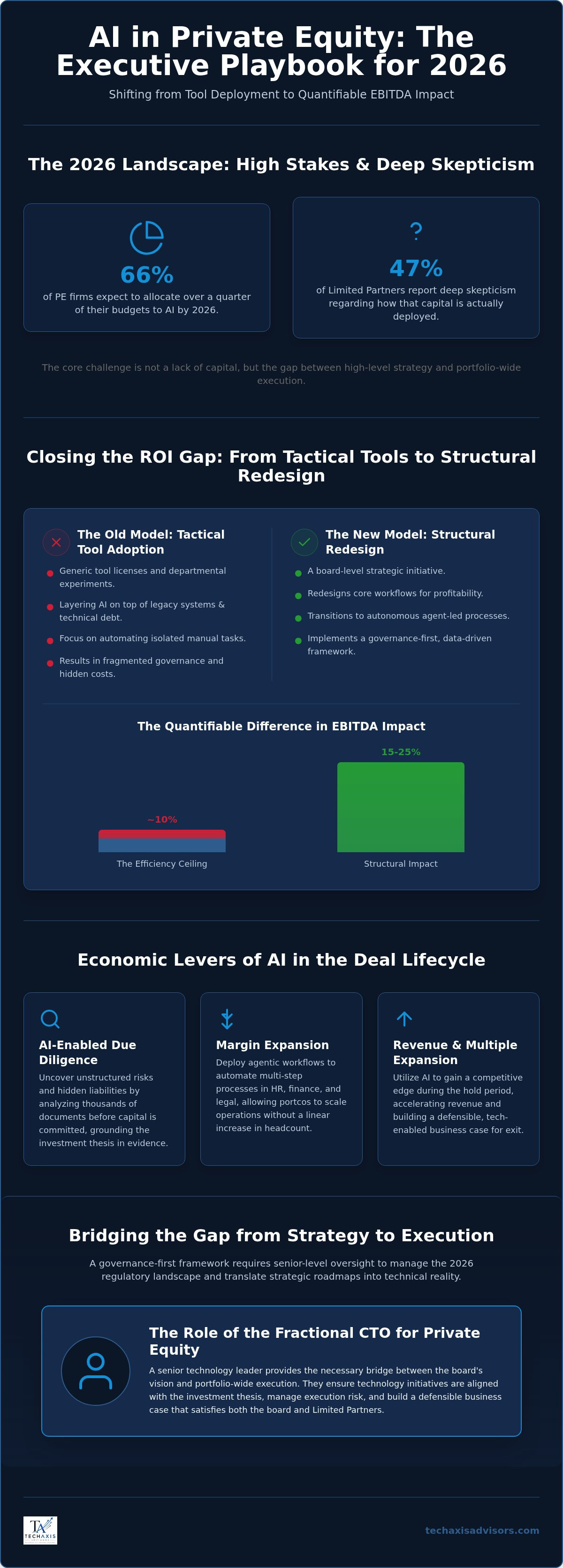
By 2026, two-thirds of private equity firms expect to allocate over a quarter of their budgets to artificial intelligence, yet 47% of Limited Partners report deep skepticism regarding how that capital is actually being deployed. Most firms have moved beyond initial experimentation, but they're now hitting a wall of technical debt and fragmented governance. You recognize that generic tool licenses don't create enterprise value; they just increase your fixed costs. Engaging a fractional cto for private equity has become a standard requirement for firms looking to bridge the gap between high-level strategy and portfolio-wide execution.
This guide provides a pragmatic, evidence-based framework for PE leaders to move beyond tool deployment and start quantifying the economic impact of AI across the portfolio. We'll address the 2026 regulatory landscape, including evolving AI legislative frameworks and the Financial Services AI Risk Management Framework, to ensure your path to growth is also a path to compliance. You'll gain a clear roadmap for operational maturity that replaces organizational anxiety with a disciplined, results-oriented execution plan designed by TechAxis Advisors to satisfy both the Board and your investors.
Table of Contents
Beyond the Hype: Why PE Firms Struggle with AI ROI in 2026
By 2026, the initial wave of AI experimentation in private equity has largely subsided. General Partners are now left with a collection of expensive software licenses but often lack measurable EBITDA growth to justify the spend. Moving from experimental tool-handouts to disciplined operating model changes requires more than just a budget; it demands a fundamental shift in how capital is allocated toward technology.
The global tech sector has absorbed an unprecedented amount of capital, yet many portfolio companies remain stuck in the exploration phase. The primary friction point isn't a lack of interest from the board. It's the gap between high-level executive vision and the actual technical execution capacity within the portfolio. This is where a fractional cto for private equity provides a necessary bridge, ensuring that technology initiatives are aligned with the investment thesis rather than operating in an IT silo.
TechAxis Advisors views AI value as a direct function of data strategy and organizational maturity. Without these two pillars, even the most advanced automation efforts will fail to scale. Success in 2026 is defined by evidence-based diagnostics that treat AI as a strategic asset rather than a departmental expense.
The Failure of Generic AI Deployment
Handing out LLM licenses to employees rarely results in structural margin expansion. While these tools might save a few hours of manual labor, they don't redesign the workflows that actually drive profitability. Many firms are discovering that layering AI on top of legacy systems only highlights existing inefficiencies.
Hidden technical debt is the primary culprit behind failed AI implementations. AI technical debt is the cumulative cost of implementing advanced automation on fragmented data architectures. When data is siloed or inconsistent, the AI cannot provide reliable outputs, leading to a cycle of manual corrections that erodes potential ROI.
Shifting from IT Projects to Executive Strategy
Effective AI adoption must be treated as a board-level strategic initiative. It's not a back-office task to be delegated to a junior IT manager. Instead, it requires Executive clarity for technology decisions to ensure every dollar spent contributes to the eventual exit multiple.
A business-first alignment ensures that AI roadmaps focus on high-impact areas like revenue acceleration and margin expansion. By starting with the desired economic outcome, PE leaders can build a defensible case for AI that stands up to the scrutiny of Limited Partners and regulatory bodies alike. This disciplined approach replaces organizational anxiety with a sense of controlled, professional progress.
Quantifying Value: The Economic Levers of AI in the Deal Lifecycle
Quantifying the impact of artificial intelligence requires moving beyond anecdotal evidence to hard financial metrics. For General Partners, the business case rests on three primary economic levers: margin expansion, revenue acceleration, and multiple expansion. In 2026, 68% of private equity firms report significant ROI from AI investments in operational efficiency, while 66% cite it as a primary driver to gain a competitive edge during the hold period.
The value creation process begins before the deal closes. AI-enabled due diligence now utilizes automated multi-stage analysis to identify unstructured risks in target companies. By scanning thousands of legal documents and historical financial records, firms can uncover liabilities that manual audits might miss. This evidence-based approach reduces execution risk and ensures the investment thesis is grounded in reality. Implementing a fractional cto for private equity during this stage ensures that technical findings are translated into clear business risks for the investment committee.
Margin Expansion through Agentic Automation
The most immediate impact on EBITDA comes from reshaping central functions. We've moved beyond basic chatbots to agentic workflows that execute multi-step business processes autonomously. These agents handle high-volume, low-complexity tasks in HR, finance, and legal departments, allowing portco leadership to scale operations without a linear increase in headcount. For a deeper look at sector-specific applications, see our guide on AI for Financial Services: 2026 Strategic Framework.
Multiple Expansion: The AI-Ready Premium
A company's "AI-readiness" significantly influences its valuation multiple at exit. In 2026, buyers prioritize companies with documented AI governance, clean data architectures, and disciplined regulatory compliance. They aren't just buying current cash flow; they're buying a scalable technology operating model that's free from technical debt. Validating these claims requires Advisory Leadership for Investors to provide the structured evidence buyers demand.
If your portfolio companies are struggling to move from pilot projects to measurable margin growth, consider how a confidential executive conversation could clarify your path forward. A fractional cto for private equity provides the senior oversight necessary to ensure AI initiatives remain focused on the exit multiple, rather than technical novelty.
The Portfolio Playbook: Reshaping Operating Models vs. Tool Deployment
Most portfolio companies find themselves trapped in the Deploy Phase. This stage involves tactical tool adoption, such as rolling out generic LLM licenses across a department. While these initiatives provide a starting point, they typically hit an efficiency ceiling of 5-10%. To move beyond this plateau, firms must focus on transforming their operating model. Significant value lives in the Reshape Phase. This phase is the structural realignment of human workflows to leverage AI-driven data synthesis. By redesigning core processes around AI agents, portfolio companies can target a 15-25% EBITDA impact.
The Invent Phase represents the final tier of the playbook. Here, the business case shifts toward developing AI-native products or services. While the upside is significant, the capital requirements and time-to-value often exceed the typical hold period. Mid-market PE firms should prioritize Reshape over Invent to manage these hold-period risks. A fractional cto for private equity can evaluate the existing portfolio tech stack using a disciplined framework: Retain, Optimize, Replatform, or Replace. This ensures capital is allocated to the most efficient path for modernization without unnecessary waste.
Deploy vs. Reshape: A Tradeoff Analysis
The Deploy approach offers low upfront capital and rapid time-to-value. It's an easy win for morale but fails to deliver the structural margin expansion required for a premium exit. In contrast, the Reshape approach requires more intentional leadership and a higher degree of organizational maturity. For growth-stage companies, the Reshape phase provides a defensible competitive advantage. It focuses on how work is done rather than just the tools used to do it. This creates a more resilient operating model that is easier to scale and more attractive to secondary buyers.
Technology Due Diligence in the AI Era
Investment committees must evaluate a target’s AI Readiness as part of the initial investment thesis. This involves identifying red flag technical debt that prevents AI scalability. Our Technology Due Diligence for Growth-Stage Companies provides a structured framework for these assessments. A fractional cto for private equity ensures these diagnostics are evidence-based rather than speculative. They look for fragmented data architectures and siloed systems that could stall future automation efforts. Identifying these issues early allows the firm to price technical debt into the deal or plan for immediate post-close remediation.
Mitigating Execution Risk: A Governance-First Approach to AI Readiness
Governance is often mischaracterized as a bureaucratic hurdle. In reality, it's a value-creation tool that prevents the erosion of equity value during the hold period. By 2026, the regulatory environment for financial services has become a complex patchwork that requires senior-level oversight. The Colorado AI Act, effective June 30, 2026, and the California CCPA automated decision-making regulations, which took effect January 1, 2026, now mandate rigorous risk assessments for high-risk systems. A structured diagnostic, such as the TechAxis Executive AI Readiness Assessment, provides the evidence-based findings PE leaders need to navigate these requirements without stalling innovation.
Protecting intellectual property is equally critical for maintaining a portfolio company's competitive moat. Without strict guardrails, proprietary data can inadvertently be used to train public models, effectively leaking trade secrets to the broader market. A fractional cto for private equity establishes the necessary protocols to ensure data remains a private asset. This involves setting disciplined vendor oversight rules and clear data residency requirements that align with the Financial Services AI Risk Management Framework released in early 2026. Managing these risks isn't just about compliance; it's about preserving the integrity of the investment thesis.
Foundational AI Readiness Checklist
Before committing significant capital to AI implementation, a portfolio company must pass a foundational diagnostic. We focus on three critical pillars of maturity:
Data Architecture: Is the data accessible, clean, and centralized? Fragmented data remains the primary barrier to AI scalability in mid-market firms.
Security & Risk: Are there clear protocols for third-party AI vendor management? Every new tool represents a potential vulnerability if not properly governed.
Talent Maturity: Does the internal team have the capacity to manage AI-driven change? Technical tools are ineffective without the leadership to guide their application.
The Role of Executive Decision Support
Moving from generic technical reports to board-ready roadmaps is where many technology initiatives fail. Executive decision support requires independent findings that translate technical jargon into business consequences and action registers. Our Technology Governance Services provide this clarity, ensuring that governance is treated as a strategic asset. By utilizing a fractional cto for private equity, firms gain senior-level technical oversight that bridges the gap between the board's vision and the portfolio company's daily execution. This disciplined approach replaces organizational anxiety with a sense of controlled, professional progress.
Strategic Execution: From AI Assessment to Fractional Leadership
The primary reason AI roadmaps fail is not a lack of vision; it's the execution gap. Many portfolio companies possess a well-defined strategy but lack the senior technical leadership to translate that strategy into operational reality. Without disciplined oversight, technical teams often drift into "feature creep" or get bogged down in technical debt, eroding the projected EBITDA gains discussed earlier. Engaging a fractional cto for private equity provides the necessary governance to bridge this gap, ensuring that every development sprint aligns with the investment committee's priorities.
Vendor oversight is a critical component of this leadership model. Delivery partners and software vendors often prioritize their own product roadmaps over the specific needs of your portfolio. A fractional leader acts as an independent advocate for the PE firm, managing these third-party relationships to ensure they deliver against the strategic roadmap. This objective layer of management prevents vendor lock-in and ensures that the technology stack remains flexible enough for a future exit. The business case for AI is ultimately only as strong as the leadership driving the execution.
Why Fractional Leadership for Private Equity?
Fractional leadership offers a level of scalability that full-time roles cannot match. Fund managers can align the intensity of technical oversight with the specific needs of the hold period, scaling up during the Reshape phase and scaling back once the operating model has stabilized. This model provides the wisdom of a veteran executive without the $400,000 plus full-time cost and long-term equity commitment.
Objectivity is another significant advantage. Unlike large global strategy firms that often rely on junior consultants, a fractional partner provides direct access to senior expertise and independent advisory. This independence is vital when evaluating whether a company is ready for its next stage of growth. For a detailed breakdown of these triggers, see our guide on When Does a Growth Company Need a Fractional CTO?
Next Steps for PE Executives
To ensure your portfolio is positioned for multiple expansion in 2026, you must move from passive monitoring to active governance. Start with a confidential executive conversation to evaluate your current portfolio priorities and identify which companies require immediate intervention. We can help you determine if your current strategy requires a structured Executive AI Readiness Assessment or ongoing advisory support.
Our process is designed to provide executive clarity without the overhead of traditional consulting models. Explore How We Work with Leadership Teams to understand our evidence-based approach to technology decision-support. By replacing organizational anxiety with a disciplined execution plan, you can protect your investment thesis and drive measurable value across your entire portfolio.
Mastering the AI-Driven Operating Model
The window for speculative AI experimentation has closed. In 2026, private equity leaders must prioritize structural operating model changes over simple tool adoption to realize measurable EBITDA gains. Success requires a disciplined approach to governance that treats regulatory compliance as a driver for exit multiple expansion. By focusing on data maturity and agentic workflows, firms can move beyond the efficiency ceiling and build resilient, scalable portfolios.
Our team of former CIOs, CTOs, and CISOs provides the executive clarity needed to navigate these complex decisions. We leverage the proprietary TechAxis Executive Intelligence Platform to deliver evidence-based findings that move the needle. As a certified SBA Women-Owned Small Business, we offer the senior technical oversight of a fractional cto for private equity without the overhead of a full-time hire.
Building a defensible, AI-ready portfolio is a methodical process. With the right leadership and a clear roadmap, you can turn technology from a source of organizational anxiety into your firm's most significant competitive advantage.
Frequently Asked Questions
What is the typical ROI for AI implementation in private equity portfolio companies?
Private equity firms typically see the highest returns in operational efficiency, with 68% of firms reporting significant ROI by 2026. While tactical tool adoption provides marginal gains, reshaping operating models can drive a 15-25% EBITDA impact. These results depend on moving beyond pilot projects to structural workflow redesigns. Success is measured by margin expansion and the ability to scale without a linear increase in headcount, ensuring the investment thesis remains intact throughout the hold period.
How does an AI Readiness Assessment differ from a traditional IT audit?
A traditional IT audit focuses on security compliance and hardware lifecycle management. In contrast, an AI Readiness Assessment is an executive decision-support engagement that evaluates data maturity and technical debt. It identifies whether a portfolio company's architecture can support advanced automation or if fragmented systems will stall progress. This forward-looking diagnostic provides a prioritized roadmap for value creation, whereas a standard audit primarily documents historical states and baseline security risks.
Can AI improve the accuracy of investment valuations and scenario modeling?
AI significantly enhances valuation accuracy by analyzing unstructured data that manual processes often overlook. Automated multi-stage analysis identifies hidden risks in target companies during due diligence, reducing execution risk for the investment committee. Additionally, AI-powered deal sourcing allows firms to process larger datasets to identify proprietary opportunities. These tools don't replace executive judgment; they provide a more robust, evidence-based foundation for capital allocation decisions and long-term scenario modeling.
How should PE firms manage the data privacy risks associated with Large Language Models?
PE firms should adopt a governance-first approach by utilizing private, siloed instances of Large Language Models. This prevents proprietary portfolio data from being used to train public models, which protects the company's competitive moat. Compliance with the Colorado AI Act and the Financial Services AI Risk Management Framework is essential. Establishing strict vendor oversight and data residency protocols ensures that intellectual property remains a private asset, reducing regulatory and reputational risks.
What is the role of a Fractional CTO in an AI transformation project?
A fractional cto for private equity provides senior-level technical oversight and bridges the gap between the board's vision and daily execution. They manage delivery partners, oversee vendor selection, and ensure that AI initiatives remain focused on the exit multiple. This role provides the strategic architect needed for complex transformations without the $400,000 plus cost of a full-time hire. It's a scalable model that matches leadership intensity to the specific needs of the hold period.
How does AI impact the exit valuation of a portfolio company in 2026?
In 2026, a company's "AI-ready" status acts as a primary driver for multiple expansion during exit. Buyers prioritize companies with clean data architectures and documented governance because they represent lower integration risk and higher scalability. Documenting your AI operating model through structured assessments validates your valuation claims. This transparency builds buyer confidence, allowing the firm to command a premium by demonstrating that the company's growth is supported by a modern, disciplined technology foundation.
Is it better to build custom AI solutions or use white-label delivery partners?
Mid-market firms should prioritize white-label delivery partners or existing platform optimizations to manage hold-period risk. Building custom AI solutions from scratch involves significant capital requirements and longer time-to-value, which may not align with the investment lifecycle. A pragmatic approach evaluates the business case to retain, optimize, or replace existing systems. Using qualified delivery partners under senior advisory oversight allows for faster implementation while maintaining the flexibility needed for a future exit.
What are the most common reasons AI initiatives fail in mid-market companies?
The most common failure point is the execution gap caused by a lack of senior technical leadership. Many companies suffer from AI technical debt, which is the cost of layering automation on fragmented data architectures. Generic tool handouts without workflow redesign also fail to produce measurable EBITDA growth. Successful initiatives require business-first alignment and a clear roadmap that prioritizes structural changes over technical novelty, ensuring that technology spend directly contributes to the firm's economic goals.



Comments