

AI in Financial Services: 2026 Strategic Framework
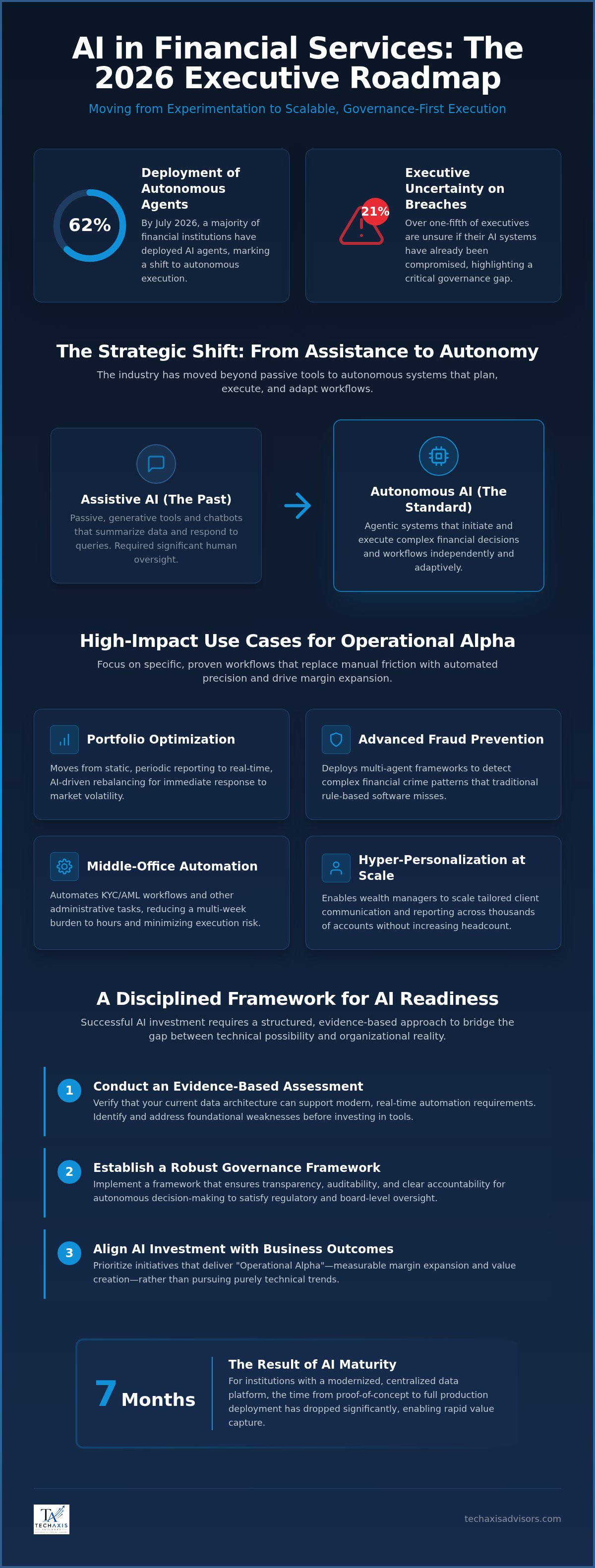
By July 2026, 62% of financial institutions have deployed autonomous agents, yet 21% of executives are unsure if their systems have already suffered a security breach. This disconnect highlights a critical tension in the adoption of ai for financial services. You likely feel the mounting pressure from investors to demonstrate immediate results while managing the inherent risks of legacy data architecture. It's a complex environment where the need for speed often conflicts with the necessity of structural integrity.
This article provides a pragmatic, evidence-based guide for C-suite leaders to move beyond experimentation and build a scalable, governance-first roadmap. We'll replace organizational anxiety with a disciplined framework for operational alpha, focusing on high-impact use cases and board-ready reporting. You'll gain clarity on the transition from assistive tools to the autonomous models outlined in the July 2026 Mills Review. We'll examine the specific trade-offs between innovation and compliance to ensure your firm's automation strategy is both defensible and productive.
Table of Contents
The 2026 AI Landscape in Financial Services: Moving Beyond Generative Hype
The era of curiosity-driven AI experimentation has ended. For C-suite leaders, the focus has shifted from what large language models can say to what they can do. We define ai for financial services as a strategic layer for decision augmentation and operational execution. It's no longer a peripheral experiment. It's a structural requirement for any firm seeking to maintain its competitive position in an increasingly automated market.
A significant "Hype Gap" persists between technical possibility and organizational readiness. While the market offers sophisticated tools, many firms struggle with legacy data architectures that cannot support real-time processing. This gap creates execution risk. Leaders must distinguish between marketing promises and the hard mechanics of operational integration to avoid wasting capital on tools their infrastructure isn't prepared to handle. True progress requires moving beyond the interface to the underlying data layer.
From Assistance to Autonomy
The industry is moving rapidly toward Agentic AI. Unlike passive chatbots that merely summarize data, these autonomous systems plan, execute, and adapt workflows with minimal human oversight. Research from July 2026 indicates that 62% of financial services firms have already deployed AI agents. This shift is particularly evident in wealth management and private equity, where the speed of execution is a primary differentiator. Traditional rule-based automation is no longer sufficient for competitive scaling. Modern firms require systems that can navigate complex, non-linear workflows without constant manual intervention.
The mainstream adoption of artificial intelligence across financial services has forced a regulatory evolution. The July 2026 Mills Review by the FCA highlights this transition, signaling that "agentic AI" is now a supervisory priority. This regulatory focus confirms that autonomy is not a future trend; it's a current operational reality. High-stakes decision-making now relies on the ability to audit these autonomous paths. Firms must prove they have the oversight to manage systems that initiate and execute financial decisions independently.
The Business Case for AI Maturity
Successful AI investment requires alignment with long-term business outcomes rather than technical trends. We're seeing the rise of the "Operational Alpha" imperative. This involves using technology to drive margin expansion and create value that isn't dependent on market movements. For asset managers, AI maturity means moving beyond cost-cutting to revenue-generating capabilities. It's about building a foundation that allows for rapid deployment. The time from proof-of-concept to production has already dropped to seven months for institutions with centralized platforms. Achieving this level of maturity requires a disciplined approach to AI advisory and automation readiness to ensure investments translate into tangible results.
High-Impact Use Cases: Where AI Delivers Strategic Value
Identifying value is the first step toward achieving operational alpha. In 2026, the most successful implementations of ai for financial services are those that address specific structural bottlenecks. We see four primary areas where technology is currently driving measurable margin expansion. These aren't theoretical applications. They are proven workflows that replace manual friction with automated precision. The goal is to convert technical potential into a sustainable competitive advantage.
Portfolio optimization has moved from static reporting to real-time, AI-driven rebalancing. This allows for an immediate response to market volatility. In fraud prevention, firms are deploying multi-agent frameworks to detect complex financial crime patterns. These systems identify anomalies that traditional rule-based software often misses. By automating middle-office tasks, organizations significantly reduce execution risk. Hyper-personalization enables wealth managers to scale client communication across thousands of accounts without increasing headcount. It's about doing more with the same resources.
Wealth Management and Client Experience
AI functions as an advisory multiplier. It frees senior advisors to focus on high-value client interactions by handling the heavy lifting of data synthesis. Agentic processes now automate client onboarding and KYC/AML workflows. This reduces a multi-week administrative burden to a matter of hours. Leaders must prioritize responsible and ethical AI use when deploying these narratives. This ensures that personalized portfolio reports remain transparent and fully compliant with evolving standards.
Asset Management and Private Equity
In the private equity sector, AI-enhanced due diligence has become a necessity. Systems analyze vast data rooms to identify hidden technical debt or subtle growth signals that human analysts might overlook. Once an acquisition is closed, portfolio company monitoring provides real-time visibility into operational performance. This continuous oversight allows investment committees to make decisions based on live data rather than lagging indicators. If you're unsure which use case offers the highest ROI for your firm, you might start with a confidential executive conversation to explore your options.
The Executive AI Readiness Assessment: Evaluating the Foundation
Implementation without a prior assessment is a high-risk gamble. An objective, evidence-based evaluation must precede any deployment of ai for financial services to ensure capital is allocated efficiently. Leaders often face intense pressure to show immediate results. However, moving too quickly on a fractured foundation leads to execution failure and wasted investment. We focus on evaluating the structural integrity of your current environment before recommending specific automation paths.
Information architecture is the primary determinant of AI success. Is your data scalable or siloed? If your legacy systems cannot communicate effectively, even the most sophisticated autonomous agents will fail to deliver value. Infrastructure and cloud strategy must also be scrutinized for compatibility. While 98% of financial institutions operate cloud services, only 64% process regulated data in public cloud environments. This gap indicates a need for rigorous architectural alignment. Our structured Executive Intelligence Assessments provide board-ready roadmaps that bridge the gap between technical reality and strategic goals.
The Retain vs. Replace Framework
Modernization doesn't always require a total overhaul. We use a pragmatic framework to evaluate whether to retain, optimize, integrate, replatform, replace, or retire legacy systems. This approach avoids the unnecessary complexity and inflated overheads often introduced by global strategy firms. Mid-market firms benefit from a senior-led advisory model that prioritizes practical execution over abstract theory. You can explore our specific AI advisory and automation readiness services to see how this framework applies to your organization's unique constraints.
Addressing Technical Debt
Hidden technical debt is a significant growth inhibitor. It creates friction that prevents the seamless integration of autonomous workflows. In wealth management, this debt often manifests as manual workarounds for outdated reporting tools or fragmented client data. Identifying these bottlenecks is essential for scaling operations without increasing headcount. The U.S. GAO report on AI in financial services underscores the importance of addressing these foundational risks to maintain regulatory compliance. To understand the broader impact on your firm's valuation, see our analysis on why technology debt slows growth in wealth management firms.
Governance and Risk: Building a Framework for Responsible AI
Governance shouldn't be treated as a secondary concern. For C-suite leaders, a robust framework is the primary driver of trust and long-term scalability. Establishing an AI Governance Committee is the first step toward institutionalizing oversight. This body must define clear roles and responsibilities, ensuring that board members have the visibility required for fiduciary accountability. The committee's objective is to align technical execution with the firm's strategic risk appetite. It provides the steady hand needed to move from experimentation to enterprise-grade deployment.
Mitigating "black box" risk is a non-negotiable requirement for ai for financial services. Transparency and auditability are essential for regulatory compliance and internal security. If an autonomous model cannot explain its decision-making path, it introduces unacceptable systemic risk. You must implement tools that provide a clear audit trail for every initiated action. This level of oversight protects the firm from unintended biases and operational failures that could lead to significant reputational damage. Reliable systems require a clear line of sight into how data is processed and interpreted.
Data privacy and cybersecurity remain paramount in a high-threat environment. As AI agents handle more regulated financial data, the attack surface expands. Protecting client information requires a defense-in-depth strategy that integrates AI-specific security protocols. You're operating in an environment where regulators increasingly focus on model diversity and third-party concentration risks. Staying compliant requires a proactive approach to these shifting mandates. Effective governance ensures that your adoption of ai for financial services doesn't outpace your ability to protect the firm's most valuable assets.
The Trust-First Architecture
A trust-first architecture prioritizes evidence-based finding summaries for regulatory reviews. This ensures that every AI implementation aligns with your firm’s ethical standards and operational risk tolerance. By focusing on transparency from the outset, you build a defensible position for future audits. This structured approach replaces organizational anxiety with a sense of controlled progress. For a deeper dive into policy implementation, see our Executive Guide to AI Governance Frameworks.
Vendor and Platform Management
Executive oversight is critical during third-party AI platform selection. Avoid vendor lock-in by maintaining a platform-agnostic approach. This flexibility allows you to pivot as the technology evolves without being tethered to a single provider's roadmap. Advisory leadership plays a vital role here, managing qualified delivery partners to ensure that implementations meet your specific operational requirements. This disciplined approach to technology governance and compliance ensures that your AI strategy remains both resilient and scalable.
From Roadmap to Execution: The Role of Advisory Leadership
The transition from a strategic roadmap to operational reality is where most technology initiatives fail. Having a list of high-impact use cases is a starting point, but it isn't a solution. Execution defines the winner in the race for operational alpha. Many growth-stage firms find themselves caught in a leadership gap. They possess the vision for ai for financial services but lack the internal senior capacity to manage the complex mechanics of a multi-year transformation. This is where independent advisory leadership becomes a critical asset.
Moving from diagnostic findings to operational results requires a disciplined hand. You need someone who can translate board-level objectives into technical requirements without getting lost in the granular details. Executive decision support provides the clarity needed during high-stakes technology pivots. It ensures that every dollar spent aligns with the broader business strategy. The goal is to secure the depth of experience required to navigate the complexities of 2026's regulatory and technical environment, avoiding the execution risks that often arise when complex strategy is delegated to teams without sufficient senior oversight.
Fractional Executive Leadership
A Fractional CTO provides senior-level oversight without the full-time executive cost. This model is particularly effective for mid-market wealth management and private equity firms that need sophisticated guidance for specific initiatives. It bridges the gap between business strategy and technical execution. Your firm gains the wisdom of a veteran executive who understands the mechanics of scaling. You can explore how this model supports your growth through our Advisory Leadership services.
The TechAxis Engagement Model
Our approach is built on a structured process designed to provide executive clarity for important technology decisions. We don't believe in abstract theory. We focus on tangible execution. Our model follows a logical progression:
Structured Diagnostics: Identifying the current state of your data and infrastructure.
Intelligence Synthesis: Using our Executive Intelligence Platform to provide evidence-based findings.
Strategic Roadmap: Prioritizing initiatives based on ROI and risk tolerance.
Execution Leadership: Providing the oversight needed to manage qualified delivery partners.
This methodology ensures traceability and accountability throughout the entire lifecycle of your project. It replaces organizational anxiety with a sense of controlled, disciplined progress. You don't have to navigate the complexities of ai for financial services alone. Explore whether your current priority requires a structured assessment or ongoing advisory to ensure your roadmap delivers the expected operational results.
Converting Technical Potential into Operational Alpha
The successful adoption of ai for financial services requires a shift from experimentation to structured governance. It demands an objective assessment of your underlying data architecture and the implementation of a trust-first framework. Leaders who prioritize structural integrity over technical trends will secure a sustainable competitive advantage in an increasingly automated market. This approach replaces organizational anxiety with a sense of controlled, disciplined progress.
Our methodology is led by a founder with over 25 years of experience as a CIO, CTO, and CISO. We utilize a proprietary Executive Intelligence Platform to deliver evidence-based findings that move your firm from a diagnostic state to measurable execution. As a certified WOSB, we provide the senior-level advisory needed to bridge the gap between business strategy and technical reality without the overhead of global strategy firms.
Replacing confusion with executive clarity ensures your automation roadmap remains both defensible and scalable. You don't have to navigate these high-stakes technology pivots without the steady hand of a seasoned professional.
Frequently Asked Questions
What is the first step for a wealth management firm considering AI?
An objective readiness assessment is the essential first step. This diagnostic identifies existing technical debt and evaluates whether your data architecture is truly scalable. Without this evidence-based foundation, firms risk committing capital to tools their infrastructure cannot support. The goal is to move from organizational anxiety to a disciplined, prioritized roadmap for execution.
How do we ensure AI governance meets financial regulatory standards?
Establishing an AI Governance Committee with board-level oversight is critical for regulatory alignment. This body must enforce model transparency and maintain clear audit trails for all autonomous actions. Aligning your internal policies with frameworks like the July 2026 Mills Review ensures that your firm remains compliant as supervisory priorities shift toward agentic systems.
Can AI help reduce operational costs in asset management without sacrificing quality?
AI reduces operational costs by automating middle-office friction and high-volume data synthesis. This allows asset managers to achieve margin expansion without increasing headcount. Implementing ai for financial services converts technical potential into "Operational Alpha," ensuring that quality remains consistent while execution speed increases across the portfolio.
What is the difference between Generative AI and Agentic AI in finance?
Generative AI focuses on content creation and summarization while Agentic AI focuses on autonomous execution. Generative tools act as passive assistants that require human prompting. Agentic systems are independent agents that plan, adapt, and initiate workflows to achieve specific business objectives with minimal manual intervention.
How do we assess if our data architecture is ready for AI automation?
Assessment requires evaluating the connectivity and integrity of your current information architecture. Siloed data and legacy workarounds act as friction points that inhibit modern automation. A structured Executive Intelligence Assessment determines if your tech stack can handle the real-time processing requirements of autonomous agents or if it requires optimization first.
Why should growth-stage firms choose boutique advisory over the Big Four for AI strategy?
Boutique advisory provides direct access to veteran executives who prioritize practical execution over abstract theory. This model avoids the high overhead and junior staffing often found at global strategy firms. Mid-market organizations benefit from a partner who operates with agility and is deeply invested in the mechanics of the client's specific success.
What are the common pitfalls in financial services AI implementation?
Common pitfalls include ignoring technical debt and rushing into technical pilots without a governance framework. Firms often fail when they treat AI as a standalone tool rather than a structural layer. This leads to "black box" risks where autonomous decisions lack the transparency required for regulatory reviews and board-level reporting.
How does a Fractional CTO help with AI roadmap execution?
A Fractional CTO provides the senior leadership required to manage qualified delivery partners and vendor oversight. They ensure that your adoption of ai for financial services remains aligned with board-level strategic goals. This model provides growth-stage firms with veteran executive wisdom to bridge the gap between technical possibility and operational results.



Comments