

2026 Data Strategy Framework for Financial Executives
What if your data architecture, currently managed as a mounting operational expense, is actually your firm's most undervalued capital asset? For many, the reality of a data strategy for financial services executives is often reduced to managing fragmented silos across legacy systems while storage costs climb without a clear return on investment. You likely recognize that your organization possesses a wealth of information, yet the path to extracting measurable business value remains obscured by technical debt and execution risk.
It's time to shift the conversation from cost containment to strategic intelligence. This guide provides an executive-grade framework for 2026, designed to transform your data infrastructure into a disciplined revenue driver through rigorous governance and monetization models. We'll examine how to make evidence-based decisions on technology spend and build the operational maturity required to support advanced reporting and AI. By the end of this article, you'll have a clear roadmap to move beyond storage and toward a state of mastered organizational data.
Table of Contents
The Executive Shift: From Data Management to Strategic Monetization
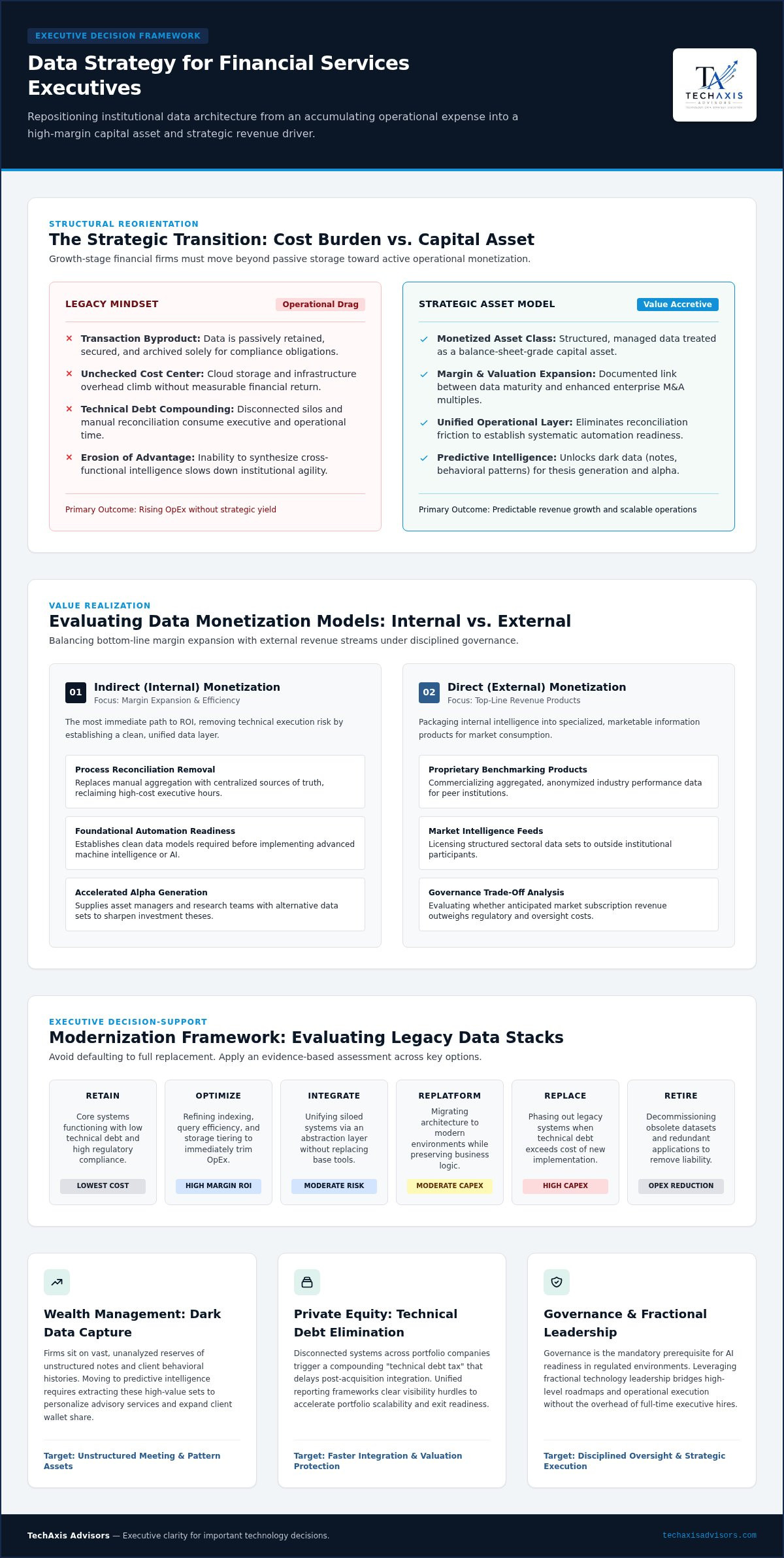
For decades, financial institutions treated data as a byproduct of transactions. It was something to be stored, secured, and eventually archived. This legacy mindset views data as a cost center, a necessary burden for compliance and basic record-keeping. In the 2026 landscape, this perspective isn't viable. A modern data strategy for financial services executives flips this paradigm, repositioning data as a high-margin capital asset that directly influences the bottom line.
Growth-stage firms often fall into the trap of over-investing in storage and cloud infrastructure without a defined roadmap. They accumulate massive volumes of information but lack the governance to make it usable. This results in rising operational expenses without a corresponding increase in revenue. Evidence suggests a strong correlation between data maturity and corporate valuation. Firms that successfully transition to an intelligence-led model often command higher multiples during M&A because their revenue streams are more predictable and their operations are more scalable.
Data as an Asset Class in Wealth Management
Wealth management firms are frequently sitting on vast reserves of "dark data." This includes unstructured information like client meeting notes and historical behavioral patterns that remain unanalyzed. Achieving executive clarity means identifying which of these data sets hold the highest potential for monetization. It's about moving beyond basic historical reporting toward predictive business intelligence. Identifying these high-value data sets is a core component for the wealth management and private equity firms we advise.
The Cost of Inaction: Erosion of Competitive Advantage
In the private equity sector, fragmented data silos are a primary barrier to rapid scaling. When portfolio companies operate on disconnected legacy systems, the "technical debt tax" compounds, making it difficult to achieve a unified view of performance. This friction slows down integration and obscures the path to exit. A data strategy for financial services executives is a business-first framework, not an IT project. Without this disciplined approach, firms don't just lose efficiency; they risk losing their competitive edge to agile, data-fluent competitors who can execute faster and with greater accuracy.
Evaluating Data Monetization Models: Internal vs. External
A balanced data strategy for financial services executives evaluates two distinct paths to value: internal optimization and external commercialization. While many firms focus exclusively on one, the most resilient organizations build frameworks that support both. Internal monetization focuses on margin expansion by removing operational friction. External monetization seeks top line growth by packaging data as a proprietary product. Choosing between these requires an objective look at your firm's current technical debt and its appetite for regulatory complexity.
Asset managers often provide the clearest logic for this transition. They don't just use data for historical reporting; they leverage alternative data sets to sharpen investment theses. This internal application increases the alpha generated per researcher, effectively monetizing data through superior performance. However, the move to external products introduces a different set of challenges. Speed to market often conflicts with the rigorous governance required for external data sharing. Executives must decide if the potential revenue from a data product outweighs the oversight costs required to maintain it.
Indirect Monetization: Operational Excellence
Internal monetization is often the most immediate path to ROI. It involves using data to reduce technical execution risk, a common concern for CEOs overseeing digital transformation. When data is clean and accessible, it creates a foundation for automation readiness. You can't have effective AI without high quality data. By establishing a unified data layer, firms can eliminate the manual reconciliation processes that currently drain executive time. This shift is essential for improving operational maturity through technology and ensuring that every dollar spent on infrastructure contributes to a leaner organization.
Direct Monetization: Data as a Product
Direct monetization turns your internal intelligence into a marketable asset. This often takes the form of market intelligence or anonymized benchmarking for institutional clients. While the revenue potential is significant, the governance requirements are high. Financial services firms must navigate strict privacy laws and ethical considerations before sharing information externally. Evaluating the business case for "Retain vs. Monetize" requires a deep understanding of your firm's unique data moats. If your data is truly proprietary, it may be more valuable as a tool for internal competitive advantage than as a standalone product. If you're unsure where your data assets currently sit on this spectrum, you might start a confidential executive conversation to explore your options.
The Decision Framework: Retain, Optimize, or Replace Legacy Data Stacks
Legacy systems often act as the primary bottleneck in a data strategy for financial services executives. The decision to decommission a platform is rarely straightforward. It requires weighing historical investment against future scalability. Many global strategy firms default to suggesting a total digital transformation. This "rip and replace" approach often ignores the capital constraints and operational risks inherent in growth-stage organizations. It can lead to high execution risk without a guaranteed return on investment.
Effective leadership requires a more nuanced methodology. We utilize a structured Executive Intelligence Assessment to categorize data assets into specific paths: retain, optimize, integrate, replatform, replace, or retire. This evidence-based approach ensures that technology spend aligns with the firm's specific risk tolerance. It moves the conversation from technical desire to business necessity. By evaluating the business case for each system, you can prioritize investments that drive the most significant operational impact.
Retain and Optimize: Leveraging Existing Foundations
Not every legacy system is a liability. Many provide stable performance for core functions. In these scenarios, the focus should be on identifying "quick wins" in data cleanup and reporting frameworks. You can often achieve significant results by integrating disparate systems via modern API layers. This creates a unified data view without the disruption of a full migration. Using evidence-based findings to justify incremental spend allows for controlled, disciplined progress. It ensures you aren't over-spending on infrastructure that already meets your current operational needs.
Replatform and Replace: When Legacy Becomes a Liability
There is a threshold where optimization yields diminishing returns. Signs that your current data stack is hindering operational scalability include excessive manual reconciliation and an inability to support advanced reporting. When these friction points occur, you must build a board-ready business case for transformation. This case should focus on the mechanics of scaling rather than technical features. It's about removing structural barriers to growth to ensure your firm remains competitive. For a deeper look at sector-specific applications, review our data strategy for asset managers 2026 executive framework. This transition is less about the technology itself and more about ensuring the architecture supports your long-term revenue drivers.
Mitigating Risk: Governance and AI Readiness in Regulated Environments
Governance is often mischaracterized as a roadblock to innovation. In a regulated environment, it's actually a prerequisite for any sustainable data strategy for financial services executives. Attempting to monetize data or implement advanced automation without a rigorous governance framework is a high-stakes gamble. It invites regulatory scrutiny and increases the probability of project failure. Effective leadership treats governance as a value-add that ensures structural integrity and long-term compliance.
A disciplined approach begins with Executive Cybersecurity & Technology Risk Assessments. These engagements identify vulnerabilities before they become liabilities. In the context of data monetization, "Compliance by Design" is essential to meet evolving SEC and FINRA requirements. This means building oversight directly into the architecture rather than treating it as an afterthought. By utilizing independent advisory leadership, firms can reduce execution risk and ensure that vendor oversight remains objective and focused on business outcomes.
Building an AI-Ready Data Foundation
The "garbage in, garbage out" problem remains the most significant hurdle for financial AI models. You cannot have reliable AI without clean, governed data. Establishing documented data lineage and quality controls is mandatory for board-level reporting and regulatory audits. Without these foundations, your AI outputs are effectively un-auditable and potentially misleading. For a deeper analysis of these requirements, see our AI in financial services 2026 strategic framework. Ensuring data quality at the source is the only way to move from experimental pilot programs to operational maturity.
The Governance Bridge: CFO and CTO Alignment
Successful data initiatives require a bridge between technical possibility and financial reality. This alignment is best achieved through a shared "Action Register" that tracks specific governance tasks against business milestones. It ensures that the CFO and CTO are working toward the same objective: turning data into a measurable asset. Growth-stage firms often struggle to maintain this level of oversight without full-time executive overhead. This is where fractional leadership provides a pragmatic solution. It offers the wisdom of a seasoned professional to manage governance and vendor relationships without the long-term cost of a permanent hire.
Implementing Strategy through Fractional Technology Leadership
Growth-stage financial firms often reach a critical inflection point where they require a sophisticated data strategy for financial services executives but don't yet need the permanent overhead of a full-time, enterprise-grade CTO. This leadership gap often leads to stalled initiatives or a reliance on junior staff to make high-stakes architecture decisions. Fractional technology leadership solves this by providing the wisdom of a veteran executive on a part-time basis. It ensures that your data roadmap is driven by business outcomes rather than technical preferences.
The TechAxis methodology follows a disciplined progression: Diagnostic, Assessment, Roadmap, and Execution. This structured flow moves your organization from identifying immediate friction points to mastering its data assets. By bridging the "Executive Intelligence" gap, mid-market firms gain access to the same level of strategic oversight found at Tier-1 institutions. This approach replaces organizational anxiety with a sense of controlled, evidence-based progress, allowing the C-suite to focus on growth while we manage the mechanics of scaling.
The Value of Executive Advisory and Decision Support
One of the primary benefits of fractional leadership is the objective management of delivery partners. Fractional CTOs act as your internal advocate, overseeing white-label development teams and third-party vendors to ensure they meet documented requirements. This oversight eliminates the "prestige tax" associated with large consulting firms while maintaining high standards of accountability. We provide board-ready briefs and findings that translate complex technical milestones into clear business metrics. You can learn more about how we support these initiatives through our Fractional CTO services.
Next Steps for the C-Suite
Moving from a cost-center mindset to a revenue-driven data model requires a deliberate first step. For many organizations, this begins with a confidential executive conversation to identify where legacy systems are hindering performance. From there, we can evaluate whether your current priorities require a structured Executive Data & Analytics Assessment or ongoing fractional leadership. Our goal is to provide the clarity you need to make important technology decisions with confidence. Explore our full range of TechAxis Advisory Leadership options to determine the best path forward for your firm's specific operational needs.
Moving from Data Management to Strategic Intelligence
Transforming your data architecture from a recurring expense into a strategic asset requires more than technical upgrades. It demands a disciplined governance framework and a clear path to monetization. Organizations that successfully bridge this gap often command higher valuations and operate with significantly greater agility.
A successful data strategy for financial services executives relies on evidence-based decisions rather than abstract technical debt. Whether you're optimizing legacy stacks or preparing for AI integration, the focus must remain on business outcomes. TechAxis Advisors supports this transition with 25+ years of executive CIO and CTO experience and a proprietary Executive Intelligence Platform designed for the mid-market. As a certified WOSB and MWBE firm, we provide the independent oversight needed to manage vendors and drive operational maturity.
You don't have to navigate these structural shifts alone. We're here to help you turn your data into a measurable driver of growth and long-term success.
Frequently Asked Questions
What is the primary difference between data management and data strategy?
Data management involves the tactical processes of storing, securing, and maintaining information. In contrast, a data strategy for financial services executives focuses on aligning those assets with specific business outcomes and revenue goals. Management treats data as a resource to be controlled, whereas strategy treats it as a capital asset to be leveraged. One ensures the infrastructure stays functional, while the other ensures the data architecture drives a measurable competitive advantage.
How much should a mid-market financial firm spend on data monetization?
Investment levels vary based on your firm's current technical debt and specific growth objectives. Rather than a fixed dollar amount, mid-market firms should focus on value-based allocation that prioritizes high-impact "quick wins" before committing to large-scale infrastructure changes. This approach ensures that capital is deployed toward initiatives with the highest probability of margin expansion. Evaluating spend through a structured assessment helps align your budget with actual risk tolerance and operational needs.
Can we implement an AI strategy if our data is still in legacy silos?
You can begin developing an AI strategy while legacy silos exist, but implementation will be limited until those silos are integrated. High-quality AI requires a unified data layer to prevent inaccurate outputs. A pragmatic approach involves using modern API layers to bridge disparate systems without a full replacement. This allows your firm to build automation readiness while simultaneously addressing the structural barriers in your current data architecture.
What are the biggest regulatory risks when monetizing financial data?
The primary regulatory risks involve data privacy, lineage, and compliance with SEC and FINRA standards. Monetizing financial data requires "Compliance by Design" to ensure that anonymized benchmarking or external data products don't violate client confidentiality or ethical guidelines. Failure to establish clear data provenance can lead to significant legal exposure and reputational damage. A robust governance framework acts as a safeguard, ensuring that monetization efforts remain within the bounds of current financial regulations.
How does a Fractional CTO help with data strategy compared to a full-time hire?
A Fractional CTO provides senior strategic oversight without the permanent overhead of a full-time executive hire. This model is ideal for growth-stage firms that need high-level leadership to drive a data strategy for financial services executives while maintaining capital efficiency. Unlike a full-time hire who may get caught in daily operations, a fractional leader remains focused on high-level strategy and vendor oversight. This ensures that your technology roadmap remains aligned with long-term business objectives.
What is an Executive Data & Analytics Assessment?
This is a structured, evidence-based engagement powered by the proprietary TechAxis Executive Intelligence Platform. It provides a comprehensive diagnostic of your current data architecture, governance, and reporting capabilities. The result is a board-ready brief that includes a prioritized strategic roadmap and an action register. This assessment serves as a precursor to any major technology investment, ensuring that your firm's data initiatives are anchored to tangible business objectives and measurable results.
How do we calculate the ROI of a new data reporting framework?
Calculating ROI involves measuring the reduction in manual reconciliation hours and the acceleration of executive decision cycles. In wealth management, a new framework can also be measured by its impact on client retention and the ability to identify new revenue opportunities through predictive analytics. By quantifying the time saved and the increase in operational efficiency, firms can justify the incremental spend required to modernize their reporting infrastructure and improve overall margin performance.
Does TechAxis Advisors perform the actual software implementation?
TechAxis Advisors supports execution through advisory leadership, governance, and vendor oversight rather than performing direct implementations like software builds. We bridge the gap between strategy and results by managing qualified delivery partners through our specialized white-label partnership model. This ensures that your technical projects remain aligned with the original strategic vision. By providing this layer of executive leadership, we help firms turn insights into results without the risks often associated with unmanaged technical teams.


Comments