

2026 AI Strategy Framework for Growth-Stage Companies
In 2026, global AI investment is forecast to exceed $1 trillion according to Goldman Sachs, yet many executive teams still struggle to move beyond fragmented experimentation. Developing an effective AI strategy for growth-stage companies is no longer about acquiring the most advanced tools. It's about aligning technical capabilities with operational maturity. You likely feel the pressure of relentless vendor hype and the persistent anxiety of data privacy risks while your internal leadership is already stretched thin. It's a difficult balance to maintain when the stakes for your capital and organizational reputation are this high.
We recognize that the primary barriers to adoption are operational rather than technical. This guide provides a pragmatic, evidence-based framework to help CEOs and investors transition from reactive adoption to disciplined, high-impact growth. We'll examine how to build a prioritized roadmap that focuses on measurable business outcomes, structural integrity, and the mechanics of scaling your operations. By the end of this article, you'll have a clear decision framework to evaluate investments and ensure your technology architecture supports your long-term business goals.
Table of Contents
Why Growth-Stage Companies Struggle with AI Adoption
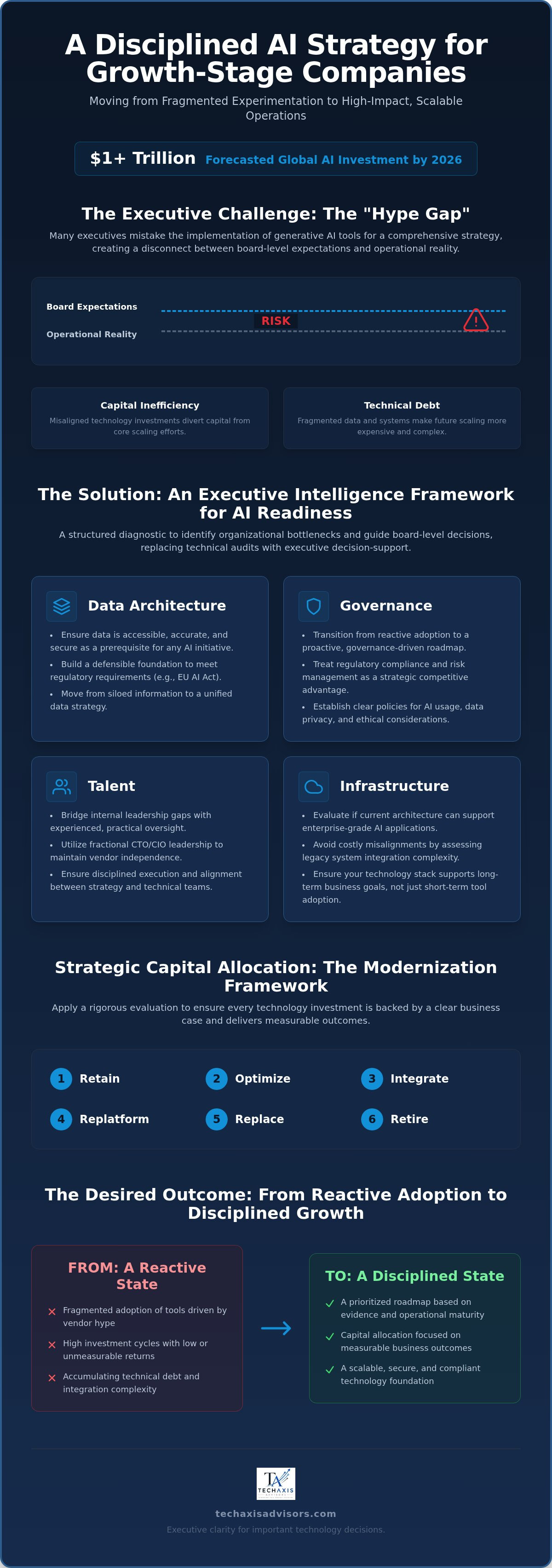
Many executives mistake the implementation of generative AI tools for a comprehensive AI strategy for growth-stage companies. This "Hype Gap" creates a significant disconnect between board-level expectations and operational reality. While individual employees may save an average of 5.6 hours per week using isolated tools, these gains rarely scale into enterprise-wide efficiency without a foundational technology strategy. Success requires moving beyond reactive tool adoption toward a proactive, evidence-based approach that respects the current state of your infrastructure.
Operational maturity often lags behind technical ambition. In 2026, research indicates that the most common reasons for initiative failure include persistent data quality issues and the complexity of integrating AI with legacy systems. For growth-stage firms, capital inefficiency is a high-stakes risk, especially as global AI investment is forecast to exceed $1 trillion this year. Every dollar spent on misaligned technology is a dollar diverted from core scaling efforts. Transitioning to a disciplined AI strategy for growth-stage companies means identifying these bottlenecks before capital is deployed, ensuring every investment is backed by a clear business case and measurable outcomes.
The Business Issue: Technical Execution Risk
A primary risk for leadership is the widening gap between C-suite vision and technical execution. Fragmented data foundations often stall initiatives before they generate value, creating a cycle of high investment with low return. Leaders must rely on evidence-based diagnostics rather than vendor-led promises to identify where their systems are actually ready for automation. Without this clarity, technical debt accumulates, making future scaling more expensive and complex. You cannot automate a process that isn't first standardized and visible.
The Problem with Generic Consulting Models
Standard consulting models frequently fail to address the specific resource constraints of wealth management and private equity-backed firms. These organizations don't need abstract theories or high-level slide decks from firms with high overhead costs. They require advisors who have personally managed the responsibilities of a CIO or CTO. Effective advisory focuses on senior-level access and practical experience to bridge the leadership gap. This ensures your roadmap is not just a document, but a disciplined path toward operational mastery and sustainable growth that respects your budget and timeline.
The Executive Intelligence Framework: Assessing AI Readiness
An effective AI strategy for growth-stage companies requires a shift from technical curiosity to executive oversight. You don't need a technical audit that merely lists hardware specifications. You need a structured diagnostic that identifies specific organizational bottlenecks. This Executive Intelligence Framework provides the clarity required for board-level decisions. It focuses on four essential pillars: Data Architecture, Governance, Talent, and Infrastructure. Each pillar represents a critical failure point if left unaddressed. By evaluating these areas, leadership can move from reactive tool adoption to a disciplined, results-oriented investment roadmap.
Strategic decision-support engagements replace the need for massive internal research teams. They provide board-ready findings that emphasize business outcomes over specific tool features. For example, knowing that 89% of small businesses now use AI in some capacity (U.S. Chamber of Commerce) is less important than knowing if your specific infrastructure can support an autonomous agent. The goal is to replace organizational anxiety with a sense of controlled progress. Clarity in these four pillars ensures that your capital allocation is both evidence-based and aligned with your operational maturity.
Evaluating the Data Foundation
Data strategy is the prerequisite for any AI roadmap. You cannot automate workflows if your data is siloed, inaccessible, or inaccurate. Growth-stage firms often face significant technical execution risks when their data foundations aren't ready for enterprise-grade AI. Security and compliance are also paramount. With the EU AI Act becoming enforceable on August 2, 2026, and California's transparency laws already in effect, your data architecture must be defensible. Reviewing your Data & Reporting Strategy ensures your foundation is robust enough to support scaling without creating new liabilities.
The TechAxis Proprietary Diagnostic Process
Structured diagnostics lead to evidence-based findings. Our process utilizes the Executive Intelligence Platform to synthesize disparate data points into a cohesive strategic view. This avoids the complexity of generic consulting models that often lack the agility required for growth-stage environments. AI Readiness is a measure of operational maturity. It defines your organization's ability to integrate autonomous systems into core workflows without disrupting existing service levels. This approach aligns with a Practical Guide to Operationalizing AI, focusing on tangible execution over abstract theory. If you're ready to evaluate your firm's standing, start with a confidential executive conversation to determine your next steps.
Strategic Tradeoffs: Aligning AI Investment with Operational Maturity
Building an AI strategy for growth-stage companies involves more than selecting software. It requires a disciplined assessment of your current technology operating model. You must determine where to allocate capital to achieve the highest impact while managing the accumulation of technical debt. This process starts with a clear understanding of your strategic tradeoffs. It's about moving from a "buy" mentality to a "build an operating model" mindset.
Balance is critical. You need "Offensive AI" to drive revenue growth and "Defensive AI" to manage risk and governance. For wealth management and private equity firms, high-impact use cases often reside in the middle and back office. Automating complex report generation or data analysis can save significant manual labor. Utilizing a structured AI Strategy Framework for Leaders helps ensure these initiatives remain business-led rather than technology-driven. Every decision should be evaluated through a rigorous framework:
Retain: Maintain systems that perform well without AI integration.
Optimize: Enhance existing workflows with targeted automation tools.
Integrate: Bridge legacy data foundations with new autonomous agents.
Replatform: Update the underlying architecture to support advanced scaling.
Replace: Switch to new solutions when legacy maintenance costs inhibit growth.
Retire: Sunset functions or tools that no longer provide measurable value.
The "Retain vs. Replace" Business Case
Calculating the ROI of modernization requires a nuanced business case. Don't assume replacement is the only path. Integration costs are often lower and provide faster results for growth-stage firms. You must weigh the long-term benefits of custom-built agentic AI against the deployment speed of off-the-shelf software. Custom solutions offer structural integrity tailored to your specific workflows, but they demand higher levels of internal oversight and delivery partner management.
Operational Scalability and AI
Your AI strategy for growth-stage companies should directly support your Operational Scalability Consulting goals. Back-office automation allows your team to handle increased volume without a proportional increase in headcount. Practical examples include automated data reconciliation and AI-driven compliance monitoring. These improvements strengthen your organizational maturity. They transform technical ambition into tangible business outcomes that support your exit or expansion strategy.
Designing a Governance-Driven AI Roadmap for Scale
Governance is often viewed as a constraint. In 2026, it is a strategic necessity. A successful AI strategy for growth-stage companies treats compliance as a competitive advantage rather than a checklist. This approach ensures that as you scale, your technical architecture remains defensible and resilient against regulatory shifts. You must replace organizational confusion with a disciplined framework that prioritizes oversight and structural integrity.
Automated decision-making and data privacy are the primary friction points for leadership. You should align your AI governance with existing Technology Governance & Compliance frameworks to maintain accountability. This alignment prevents the risks associated with "Shadow AI," where employees utilize third-party tools without official approval. Such practices create significant vulnerabilities related to intellectual property leakage and data security that can stall a company's progress during critical growth phases.
AI Compliance in Regulated Industries
Wealth management and financial services face unique scrutiny from global regulators as AI moves from experimentation to core operations. The EU AI Act became enforceable on August 2, 2026, setting a global precedent for high-risk systems that most firms must now navigate. Domestically, California's Transparency in Frontier AI Act and Illinois's Safety Measures Act, which took effect on July 6, 2026, impose strict risk management and incident-reporting obligations. Your roadmap must account for these transparency requirements to avoid the costs of reactive replatforming or legal remediation later.
The Prioritized Action Register
A strategic roadmap is a living document, not a static report. It translates a 3-year vision into 90-day execution sprints with clear action registers. This methodical rhythm allows your team to achieve quick wins while building toward long-term operational mastery. Accountability is maintained through rigorous oversight and transparent reporting. Each sprint should include specific milestones for vendor oversight and data quality improvements. By breaking down complex organizational needs into digestible, categorized areas of focus, you reduce the cognitive load on your leadership team.
Executive briefs and deck presentations must focus on these prioritized items, ensuring the board sees tangible progress in both efficiency gains and risk mitigation. This disciplined flow suggests a well-defined process that reinforces your firm's reliability as a partner in transformation. It provides the necessary leadership bridge that a growing company might be missing during rapid technical shifts.
Execution Leadership: Turning AI Strategy into Results
Strategy is only as valuable as the execution that follows. For many, the most significant challenge in maintaining an AI strategy for growth-stage companies is the lack of internal leadership to oversee complex vendor relationships and technical transitions. You need more than a roadmap; you need a seasoned professional who can translate board-level objectives into operational reality. This leadership bridge ensures that your technology investments remain aligned with your long-term business outcomes rather than getting lost in granular technical details.
Independent oversight is also vital when managing vendor and platform selection. Internal teams often carry biases toward existing tools or familiar vendors, which can lead to suboptimal architecture decisions. A fractional partner provides an objective perspective, evaluating delivery partners based on evidence-based findings rather than historical preference. This ensures that your technical stack is built for structural integrity and future transparency. It replaces organizational anxiety with a sense of controlled, disciplined progress.
Fractional Executive Leadership vs. Full-Time Hires
Hiring a full-time CTO with deep AI specialization is often cost-prohibitive or unnecessary for the initial implementation phase. Utilizing a fractional executive provides senior-level access and the wisdom of a veteran leader without the long-term overhead of a permanent C-suite position. This model allows you to maintain agility while ensuring that your AI strategy for growth-stage companies is executed with precision and accountability. It's about having the right architect at the right time. Understanding when a growth company needs a fractional CTO is a critical decision that impacts your firm's ability to scale efficiently.
The TechAxis Perspective on Execution
Our approach prioritizes advisory leadership and governance over direct implementation tasks like software builds or cloud migrations. We support execution by providing the necessary vendor oversight and delivery partner management to ensure your roadmap stays on track. This disciplined, no-nonsense methodology values tangible results over abstract theory. We don't just offer advice from the sidelines; we're deeply invested in the mechanics of your success through structured Executive Intelligence Assessments and prioritized roadmaps. If you're ready to move from planning to performance, start a confidential executive conversation to explore how advisory leadership can support your priorities.
Scaling with Structural Integrity
Execution requires clarity. Building a sustainable AI strategy for growth-stage companies requires a shift from technical experimentation to disciplined execution. Success depends on aligning your data architecture with high-impact use cases while maintaining a governance-first approach to mitigate regulatory risks. By utilizing structured Executive Intelligence Assessments, you can replace organizational confusion with a prioritized roadmap that supports tangible scalability.
Our advisory team, led by Aarati Dikshit with over 25 years of CIO and CTO experience, provides the oversight necessary to turn these frameworks into results. We utilize proprietary diagnostics to deliver evidence-based roadmaps that respect your capital constraints. As a certified WOSB and MWBE firm, we act as a fractional partner invested in your firm's mechanics of success.
The complexity of the 2026 technical landscape shouldn't stall your progress. With the right leadership bridge, your organization can master the transition to an automated future with confidence.
Frequently Asked Questions
What is the first step in creating an AI strategy for a growth-stage company?
The first step is conducting a structured diagnostic to determine your organization's current operational maturity. This Executive AI Readiness Assessment identifies gaps in your data architecture, talent, and governance before you commit capital to specific tools. By focusing on evidence-based findings early, leadership avoids the technical execution risks that stall AI strategy for growth-stage companies. This diagnostic ensures that your roadmap aligns with measurable business outcomes rather than vendor-led promises.
How much does an Executive AI Readiness Assessment typically cost?
The cost of an executive decision-support engagement depends on the complexity of your existing infrastructure and the scope of the assessment. Every growth-stage firm has a unique technology stack and data foundation, making a standardized price list impractical. We recommend starting with a confidential executive conversation to define your priorities. This allows us to provide a proposal tailored to your firm's specific needs, ensuring you receive clarity for technology decisions without paying for unnecessary services.
Do we need a full-time CTO to implement our AI roadmap?
You don't always need a full-time executive to manage your technical transition. Many firms utilize fractional CTO leadership to bridge the talent gap during the implementation phase. This model provides senior-level access and the wisdom of a veteran executive at a fraction of the cost of a full-time hire. It allows your organization to maintain agility while ensuring disciplined oversight and vendor independence. This approach is particularly effective for managing the mechanics of scaling your technology architecture.
How does AI strategy differ for regulated industries like wealth management?
In regulated sectors, your AI strategy for growth-stage companies must be governance-driven from the start. Compliance is a competitive advantage rather than a mere constraint. You must navigate a complex patchwork of regulations, including the EU AI Act enforceable as of August 2, 2026, and state-level laws in California and Illinois. Success requires aligning AI initiatives with existing technology risk frameworks to ensure transparency, fairness, and data privacy across all automated decision-making workflows.
What is technical debt, and how does it impact AI adoption?
Technical debt is the implied cost of future rework caused by choosing an easy solution now instead of a better approach that takes longer. In growth-stage environments, this often manifests as siloed data or legacy systems that aren't compatible with modern autonomous agents. High levels of technical debt significantly stall AI adoption by creating integration complexities. Addressing these foundational issues through a "retain, optimize, or replace" framework is essential for achieving long-term operational maturity.
How can a growth-stage company compete with larger firms using AI?
Growth-stage companies compete by leveraging agility to implement targeted use cases faster than larger firms. As 89% of small businesses now report using AI in some capacity (U.S. Chamber of Commerce), smaller organizations can achieve a 3.7x return on investment by focusing on specific efficiency gains. Automating middle and back-office tasks allows your team to save an average of 5.6 hours per week, effectively scaling your technology operating model without a proportional increase in headcount.
What are the risks of implementing AI without a governance framework?
Implementing AI without a formal governance framework exposes your firm to Shadow AI risks and intellectual property leakage. Employees often use third-party tools without official oversight, creating significant vulnerabilities in data security and privacy. Without clear accountability, you face the risk of non-compliance with the 2026 regulatory landscape, including the EU AI Act enforceable as of August 2, 2026. A governance-first approach ensures that your autonomous systems are secure, transparent, and aligned with your firm's structural integrity.
How do we measure the ROI of our AI technology investments?
Measuring ROI requires tracking both Offensive AI metrics like revenue growth and Defensive AI metrics like risk mitigation. You should focus on measurable business outcomes, such as the number of hours saved in report generation or the reduction in data reconciliation errors. Research from Salesforce and McKinsey indicates that 91% of small businesses using AI report measurable increases in revenue. By utilizing a prioritized action register, leadership can monitor progress through 90-day sprints to ensure technology delivers value.



Comments