

How to Modernize Legacy Technology for Growth: An Executive Decision Framework
Enterprises currently allocate between 60% and 80% of their IT budgets simply to maintain legacy systems. This technical debt creates a significant drag on capital efficiency, as developers spend nearly 40% of their work week managing outdated codebases instead of driving innovation. When your architecture is too rigid to integrate new AI or data tools, modernizing legacy technology for growth becomes a strategic necessity rather than a technical preference.
It's frustrating to watch maintenance costs eat into R&D budgets while talent shortages make supporting old infrastructure increasingly difficult. You likely recognize that while your current systems are functional, they've become a barrier to operational scale. This article provides a structured executive decision framework to help you transform outdated infrastructure into a scalable growth engine. We'll examine an evidence-based modernization roadmap that prioritizes business outcomes and risk reduction, moving your organization from identification to mastery through disciplined progress.
Table of Contents
Understanding 'Legacy Drag': How Outdated Systems Inhibit Growth
Legacy technology is often misunderstood as simply old hardware or software. In an executive context, legacy is defined by utility rather than age. Any system that creates a functional bottleneck for strategic objectives qualifies as legacy. This friction is what we call "Legacy Drag," a state where the weight of inflexible infrastructure actively pulls against your growth targets. It's the silent inhibitor of capital efficiency.
As of 2026, this drag has reached a critical point. Research indicates that enterprises allocate between 60% and 80% of their IT budgets to maintaining existing systems. This leaves very little capital for innovation. For leadership, the process of software modernization is no longer a back-office IT project. It's a strategic mandate. You can identify growth-inhibiting technology through three primary signs. Innovation stagnation occurs when maintenance consumes the R&D budget. Integration failure happens when you can't connect new tools to your core database. Finally, talent attrition rises as your best engineers refuse to work on ancient codebases.
The Hidden Costs of Technical Debt
Technical debt carries three distinct types of costs that erode enterprise value. Direct costs include rising maintenance fees and the premium paid for specialized talent capable of maintaining legacy code. Developers currently spend approximately 33% to 42% of their work week on technical debt and maintenance. These hours are essentially stolen from your growth roadmap.
Opportunity costs are even more damaging. When your architecture is rigid, you can't enter new markets or launch products at the pace the market demands. Risk costs have also escalated. With new 2026 regulations like the California DROP platform and updated COPPA requirements, legacy systems often lack the granular data controls needed for compliance. Security vulnerabilities in unpatched environments represent a liability that most boards are no longer willing to tolerate.
AI Readiness and the Modernization Mandate
The most significant barrier to AI adoption in 2026 is the legacy data silo. AI requires clean, accessible data to provide value. Outdated systems often trap information in proprietary formats that modern tools can't ingest. This makes modernizing legacy technology for growth the essential first step toward automation. You can't build a predictive organization on a foundation of fragmented, inaccessible data.
Leadership teams are shifting their focus. They're moving away from simply "keeping the lights on" and toward building an AI-ready foundation. This transition is critical for improving data driven decision making for executives. By removing silos, you gain the transparency needed to lead with evidence rather than intuition. Modernization isn't just about replacing code; it's about restoring the mechanical ability to scale.
The Executive Technology Assessment: A Diagnostic Approach
Modernization often fails because it begins with a solution looking for a problem. Vendors present polished demos that promise efficiency, but these presentations ignore the unique structural debt and specific operational needs of your organization. Effective modernizing legacy technology for growth requires a diagnostic-first approach. This process treats technology as a strategic capital asset rather than a simple line-item expense. Without a clear baseline, you're simply guessing at the potential ROI of a transformation project.
A structured diagnostic provides the necessary leadership bridge between technical complexity and business outcomes. By using an Executive Intelligence Platform, firms can synthesize complex technical data into business-relevant insights. This isn't a technical audit designed for IT managers. It's a decision-support engagement for the C-suite and board members. It provides the evidence-based findings necessary to secure board-level buy-in by translating "technical debt" into "operating performance risk." This approach replaces organizational confusion with a sense of controlled, disciplined progress.
Step 1: Inventory and Criticality Mapping
Leadership must identify every component of the current stack and evaluate its direct business impact. We differentiate between core systems that provide a competitive advantage and commodity applications that can be easily replaced. Mapping dependencies prevents the "cascade failure" that happens when a legacy update breaks a critical, hidden business process. Legacy system modernization requires this level of granular visibility before a single dollar is committed to development. You cannot manage what you haven't mapped.
Step 2: Assessing Technical Execution Risk
This step evaluates the gap between current capabilities and future growth requirements. We identify single points of failure in the legacy architecture, such as unsupported software versions or "tribal knowledge" dependencies where only one person understands a critical system. Reviewing the problems we solve helps align these technical risks with specific growth goals. It ensures that the modernization roadmap is prioritized by business value rather than technical novelty. This objective evaluation reduces the risk of project overruns and ensures the final architecture supports long-term operational scale.
If you need to establish a clear baseline for your next move, you can request a structured assessment to discuss your specific infrastructure needs.
Modernization Pathways: Strategic Options and Trade-offs
Modernization is not a monolithic event. It is a spectrum of capital allocation and risk management. Executives must evaluate the "7 Rs" framework to determine which pathway aligns with their strategic objectives. These options include Retain, where you maintain the status quo for stable systems; Rehost, involving a move to the cloud without code changes; and Replatform, which makes minor adjustments to leverage cloud features. More intensive paths include Refactor, Rearchitect, Rebuild, and Replace. Each path carries distinct implications for your balance sheet and your long-term operational agility.
Choosing the right path requires balancing immediate time-to-market needs against long-term structural integrity. Modernizing legacy technology for growth often involves an incremental approach rather than a "Big Bang" replacement. While a total system overhaul might seem appealing, it frequently introduces unacceptable operational risk and project fatigue. An incremental roadmap allows for a phased ROI; the breakeven point for modernization investments typically occurs between 18 and 24 months. This methodical progression ensures that the most critical bottlenecks are removed first without destabilizing the entire enterprise.
Rehosting vs. Rearchitecting: A Growth Perspective
Rehosting, or "lift and shift," is often the fastest way to reduce immediate infrastructure costs. It moves applications to the cloud with minimal changes. However, it rarely addresses the underlying rigid architecture that prevents innovation. Rearchitecting is significantly more intensive, often costing three to ten times more than a simple rehost. Despite the higher upfront cost, it is often the only way to unlock advanced AI and automation capabilities. Executives often utilize fractional cto services to analyze these trade-offs and ensure the chosen path supports a scalable growth engine rather than just a cheaper version of the status quo.
The Build vs. Buy Decision in 2026
The decision to build custom software or buy a SaaS solution has become more complex in 2026. SaaS alternatives offer rapid deployment but bring significant risks of vendor lock-in and limited data portability. You should buy your context and build your core. Commodity functions like payroll or basic accounting are best served by established platforms. Conversely, custom software should be reserved for the proprietary processes that define your competitive advantage. By maintaining a "clean core" and using custom development for your unique differentiators, you create a flexible architecture that can adapt as market conditions shift. This strategy prevents the rigid dependency that characterizes legacy drag.
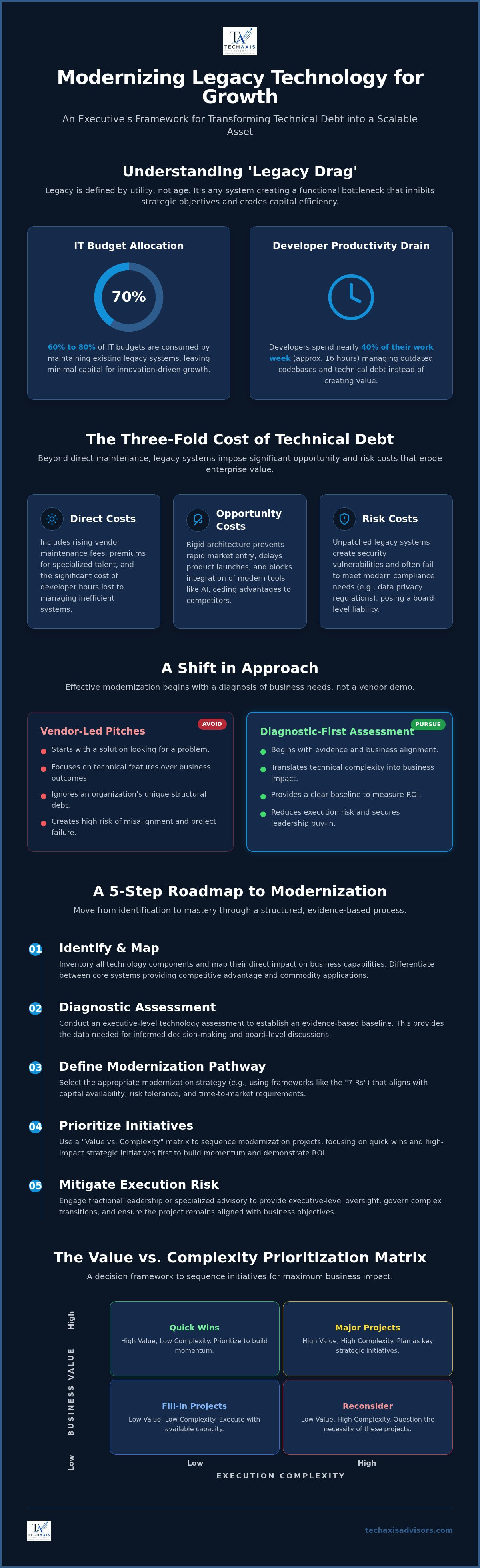
A 5-Step Roadmap for Modernizing Technology for Growth
Successful modernization is a disciplined capital allocation exercise. It requires a clear vision aligned with your 3-year growth targets. You can't fix everything at once. Instead, you must prioritize initiatives using a 'Value vs. Complexity' matrix. This allows you to identify high-impact projects that can be executed with manageable risk. Modernizing legacy technology for growth is about removing the specific bottlenecks that prevent you from scaling, not just updating software for the sake of novelty.
Execution requires the right balance of internal knowledge and external oversight. While your internal teams understand the current systems, they're often too close to the problem or lack the capacity for major transformation. Utilizing Advisory Leadership provides the objective, executive-level guidance needed to manage these complex transitions. This approach ensures that technical decisions always serve business outcomes like risk reduction and operating performance. Measurement must focus on business KPIs, such as cost per transaction or speed to market, rather than technical milestones that don't reflect enterprise value.
Phase 1: Establishing the Governance Framework
Governance isn't just about oversight. It's about ownership. You must define who owns the decision-making process, whether it's the CEO, the Board, or a dedicated steering committee. This phase sets the success metrics that will guide the entire project. We focus on tangible outcomes like data accuracy and transaction throughput. Creating a structured action register ensures accountability and provides the transparency required for disciplined progress. This framework replaces operational uncertainty with a predictable cadence of improvement.
Phase 2: Agile Execution and Continuous Feedback
Waterfall projects often fail in legacy modernization because they're too rigid to adapt to hidden technical debt. We favor agile execution. This involves using 'pilot' programs to prove value in a controlled environment before a full-scale rollout. These pilots provide the evidence needed to justify continued investment. Maintaining a continuous feedback loop between technical teams and executive leadership is essential. It ensures that modernizing legacy technology for growth remains aligned with strategic goals and allows for rapid adjustments when new risks are identified.
Reducing Execution Risk with Fractional Leadership
Growth-stage companies often face a talent paradox. While internal IT teams are excellent at maintaining daily operations, they frequently lack the specialized architectural experience required for a large-scale transformation. Modernization is a high-stakes pivot that demands a different skill set than routine maintenance. Without objective oversight, internal teams may inadvertently rebuild legacy problems into new systems. This is where the role of a Fractional CTO becomes essential. They provide the seasoned, executive-level guidance necessary for modernizing legacy technology for growth without the overhead of a full-time hire.
TechAxis Advisors works with executive leadership teams to bridge this expertise gap. By using a structured Executive Intelligence Platform, the firm provides the mechanical clarity needed to turn complex roadmaps into tangible business results. This partnership allows organizations to move beyond a "fix-it" mindset and toward an operational maturity model. In this model, technology is no longer a cost center to be managed but a scalable engine that supports long-term enterprise value. The focus shifts from technical survival to disciplined, strategic expansion.
Bridging the Gap Between Strategy and Execution
Advisory leadership acts as a safeguard against the two most common project killers: scope creep and budget overruns. When technology decisions are left solely to technical teams, they often gravitate toward the latest trends rather than the most pragmatic business solutions. A Fractional CTO ensures every initiative is anchored in your specific business strategy and risk tolerance. This oversight maintains the integrity of the original vision throughout the execution phase. You can explore our full range of services to see how this leadership model fits within a mid-market growth strategy.
Next Steps for Executive Leadership
Initiating a modernization project doesn't require an immediate, massive capital commitment. It starts with asking the right questions of your current technology leadership. CEOs should ask: "If our transaction volume tripled tomorrow, which system would break first?" and "How much of our current budget is trapped in maintenance rather than innovation?" These questions clarify the current state of "legacy drag" within the organization.
The next practical step is to initiate a low-pressure technology assessment. This engagement provides an evidence-based findings report and a prioritized roadmap for the board. Preparing the organization for this shift is as much about culture as it is about code. Leadership must communicate that modernization is an investment in the team's future capacity, not just a replacement of their current tools. This transparency reduces internal friction and aligns the entire company behind the goal of sustainable, technology-enabled growth.
Transforming Technical Debt into Strategic Capital
Modernization isn't a technical project; it's a capital allocation strategy. By shifting focus from maintenance to building an AI-ready foundation, you restore your organization's mechanical ability to scale. This transition requires a move away from vendor-led demos and toward a diagnostic-first approach. You don't need to fix everything at once. You must align technology investments with 3-year growth targets to ensure every dollar spent reduces operational risk and improves performance.
Success in modernizing legacy technology for growth depends on having a clear, evidence-based roadmap. TechAxis Advisors works with executive leadership teams to provide the structural clarity needed for these high-stakes decisions. We use a proprietary Intelligence Platform to deliver structured diagnostics and board-ready deliverables that turn technical complexity into actionable strategy. Replacing organizational confusion with disciplined progress allows your team to focus on innovation instead of maintenance.
You now have the framework to begin this transition. It's time to turn your outdated infrastructure into a scalable growth engine.
Frequently Asked Questions
What is the biggest risk in modernizing legacy technology?
The primary risk is a lack of strategic alignment that leads to project fatigue and wasted capital. Modernization fails when leadership treats it as a technical chore rather than a business transformation. This results in new systems that still replicate old, inefficient processes. Disciplined governance ensures that every architectural change directly supports a specific business outcome like risk reduction or improved operating performance.
How much should we budget for legacy system modernization?
Budgeting is driven by the complexity of your current debt and your desired time to market. For mid-market companies with 100 to 500 servers, cloud migration costs typically range from $100,000 to over $500,000. Full enterprise re-architecture projects can exceed $5 million. It's essential to prioritize initiatives based on a value versus complexity matrix to ensure capital is allocated to the most critical bottlenecks first.
How do I know if my company needs a Fractional CTO for modernization?
You should consider fractional leadership if your current head of technology is overwhelmed by keeping the lights on. Many growth-stage companies lack the internal architectural expertise to oversee a complex infrastructure pivot. A Fractional CTO provides the necessary leadership bridge to manage vendor selection and execution risk. This ensures that modernizing legacy technology for growth remains a disciplined commitment rather than an open-ended technical audit.
Can we modernize our tech stack without replacing our core systems?
Replacement is only one of the strategic pathways available to leadership. You can often achieve significant growth by replatforming or refactoring specific modules to improve data flow. By creating a clean core and using APIs to bridge legacy data silos, you can integrate modern AI and automation tools. This approach allows you to leverage existing stability while removing the functional bottlenecks that inhibit operational scale.
How long does a typical modernization project take for a mid-market firm?
Most mid-market firms see the first phase of modernization completed within six to twelve months. While the entire roadmap may span several years, a phased approach provides immediate wins. The goal is to reach a breakeven point on the investment within 18 to 24 months. This methodical pace respects the organization's cognitive load and ensures that business continuity is maintained throughout the transition.
What is the difference between technical debt and legacy technology?
Technical debt represents the accumulated cost of past shortcuts; legacy technology is defined by its inability to meet current business demands. You can have a brand-new system that is legacy if it doesn't support your strategic objectives. Conversely, technical debt is a financial metaphor for the rework required to fix rigid code. Both contribute to legacy drag, but they require different diagnostic approaches to resolve.
How does modernization impact our cybersecurity posture?
Modernization is often the only way to comply with new 2026 data privacy laws in states like Kentucky and Rhode Island. Older systems frequently lack the granular access controls and encryption standards required by modern regulations. By modernizing legacy technology for growth, you remove unpatchable vulnerabilities and single points of failure. This proactive approach reduces the risk of compliance failures and protects the structural integrity of your data.
Should we move everything to the cloud to achieve growth?
Moving everything to the cloud is rarely the most pragmatic choice. Many successful firms adopt a hybrid cloud strategy that balances scalability with cost efficiency. You should migrate workloads that benefit from cloud-native features like AI readiness and auto-scaling. Stable, high-volume processes may remain on-premise if the cost of migration doesn't justify the ROI. The decision should be based on evidence-based findings rather than technical trends.



Comments