

Assess Cost and Risk in a Legacy System Modernization Strategy
Replacing a legacy system isn’t automatically the right modernization move. A legacy system modernization strategy assesses a system’s business value, operating costs, risks, and constraints, then determines whether to retain, optimize, integrate, replatform, replace, or retire it. The right choice depends on what the system enables and how much change the organization can manage.
It’s reasonable to hesitate before changing technology that still supports critical work. However, ongoing maintenance, limited integration, and difficulty adapting can constrain performance and future decisions. Modernization addresses those issues deliberately; it doesn’t require rebuilding everything.
This article explains what modernization involves and how to assess systems by business fit, cost, risk, and complexity. It covers when code refactoring or cloud migration may make sense, the tradeoffs to consider, and how a services partner can help shape an evidence-based roadmap.
Table of Contents
What is legacy system modernization?
Modernization changes how an existing system is maintained, connected, or operated to improve its fit with business needs. A sound strategy weighs transformation benefits against delivery effort, operational exposure, and the system’s continuing ability to support critical work.
Legacy Application Risks
A legacy application relies on aging technology, limited integration, or code that’s difficult to change without disrupting established functions. These characteristics can increase maintenance demands, slow performance as usage grows, and make security updates harder to apply.
COBOL systems add a knowledge-retention concern. The average COBOL programmer is 55 years old, and about 10% of COBOL programmers retire annually. In a 2025 survey, 60% of COBOL-dependent organizations cited finding skilled developers as their biggest operational challenge. If key personnel leave, 42% of critical business logic in legacy systems is at risk. That risk matters even when the application itself still runs reliably.
Keeping a system unchanged can also limit integration with newer applications and leave reporting dependent on manual data extraction. Gartner estimates that companies will spend about 40% of their IT budgets on technical debt this year. The business case for change should compare this ongoing burden with the effort, disruption, and operational risk of modernization.
Modernization Roadmap Steps
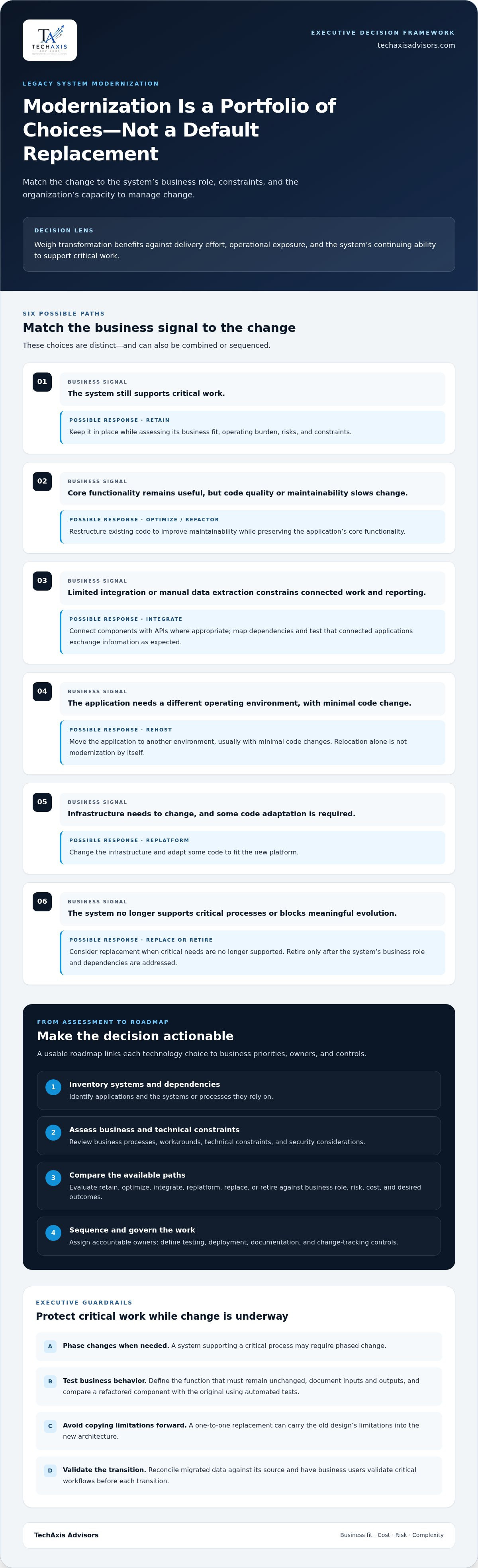
A modernization roadmap ranks systems by business role, risk, cost, and desired outcomes. To create one, inventory applications and dependencies, assess technical and security constraints, identify business processes and workarounds, then compare whether to retain, optimize, integrate, replatform, replace, or retire each system.
Next, sequence the selected changes, assign accountable owners, and define testing, deployment, documentation, and change-tracking controls. These steps make the roadmap usable for executive decisions, not just an engineering backlog. A system that still supports a critical process may need phased change; one that blocks essential work may warrant a different path. For financial-services organizations, the roadmap should connect each technology decision to its operational and governance implications.
Data Migration and Integrations
Manage data migration and integration by mapping source data and system dependencies, defining how records should transfer, and testing the results before deployment. Reconcile migrated data against the source and confirm connected applications continue exchanging information as expected.
APIs can connect modernized components with existing applications, while automated comparison tests can verify that replacement components preserve the legacy functions they replace. Begin testing, documentation, and change tracking early, especially when compliance evidence matters. Then deploy in controlled stages, with business users validating critical workflows before each transition. This reduces the risk that a technically successful migration disrupts reporting or day-to-day operations.
Refactoring legacy code
Refactoring restructures existing code to improve maintainability without changing an application’s core functionality. It can suit a critical system whose business purpose remains sound but whose architecture makes routine changes difficult. Rehosting, replatforming, refactoring, replacement, and retirement are distinct choices, not interchangeable labels. The right approach depends on what must change and what must keep working.
Refactoring targets code quality inside the existing application. For example, a team might simplify a tightly coupled billing function while preserving its established outputs. Stripe’s Developer Coefficient study found developers spend roughly 17 hours a week on maintenance, technical debt, and bad code. That finding illustrates the capacity refactoring may address, but it doesn’t prove every system needs a rewrite. Teams should first identify recurring maintenance work and the business function it affects.
Other approaches change different parts of the operating model. Rehosting moves an application to another environment, usually with minimal code changes. Replatforming changes its infrastructure and adapts some code. Re-architecting redesigns the application’s structure, often in phases. Encapsulation places an interface around an existing function, such as exposing a legacy calculation through an API. A rebuild or replacement creates a new system; retirement removes one after its business role and dependencies are addressed.
These choices can work together. An organization might rehost a stable application, encapsulate a critical function for integration, then refactor that function as requirements evolve. Functional decomposition can separate independent system areas, limiting the scope of each change. Full replacement may make sense when a system no longer supports critical processes or blocks meaningful evolution. Replicating the old design one-to-one risks carrying its limitations into the new architecture.
Sequence work around business impact and testability. First, define the function that must remain unchanged. Next, document its inputs, outputs, dependencies, and exceptions. Then refactor a bounded component and compare its behavior against the original using automated tests. For a broader rebuild, map data and process changes alongside technical work. Large refactoring or re-architecture projects can take 18 to 36 months, so staged delivery helps leaders track scope and operational exposure.
Refactoring and re-architecting can support release cycles that are 40 to 60 percent faster after completion. Treat that as a possible result, not a planning assumption. Set measures around the specific constraint, such as change effort, defect patterns, or deployment readiness. Choose replacement when incremental work cannot meet the business need; choose retirement when the system’s function is no longer required. A disciplined modernization decision matches each component to its purpose.
Evaluating systems by business fit, value, agility, risk, cost, and complexity
Evaluate each system against its business purpose, operating burden, and ability to support change. A consistent comparison helps leaders distinguish necessary modernization from change that adds effort without business value.
Assessing Business Fit and System Value
System evaluation compares business contribution with the cost, risk, and complexity of continued operation. Start by identifying the processes each application supports and the teams that depend on it. Then assess how readily the software can adapt to new requirements, connect with other environments, and scale as demand changes.
Score impact factors on a 1 to 10 scale, then document the evidence behind each rating. For example, a reporting system with manual data work may rate poorly for agility but highly for business importance. That distinction helps leaders preserve essential capability while addressing its constraints.
Business fit: Does the system support a critical process or an obsolete workflow?
Value: Which business outcomes depend on its data or functions?
Agility: How much effort do routine software changes require?
Risk: Could failures, security gaps, or dependencies disrupt operations?
Cost and complexity: Include infrastructure, support, integrations, and workarounds.
Costs can be spread across infrastructure, support, and business teams. Organizations may undercount total legacy-system costs by 40 to 60 percent when those expenses sit in separate budget lines. Include manual processing and delayed change in the comparison, not just the application’s direct operating expense.
Choosing an Approach by Business Role and Risk
Modernization choices should reflect what a system does and how much disruption the organization can accept. A system supporting a critical transaction may require phased change and strict continuity controls. A low-value application with overlapping functions may be a candidate for retirement.
Match the approach to the objective: retain a stable system with controlled risks; optimize or refactor one that remains useful but is difficult to change; integrate it when information must flow across applications; replatform it when infrastructure is the constraint; replace it when it can no longer meet business needs; or retire it when its role has ended. Different components can take different paths.
Define business benefits before selecting technology. If growth requires faster reporting, assess whether current source data supports timely decisions. If expansion increases transaction demand, evaluate scalability and dependencies across environments. Modernization can support growth when it removes a specific constraint, but moving software alone won’t fix a flawed process or unclear ownership. Tie each proposed change to an outcome, an accountable owner, and a risk threshold.
Cloud migration and modern engineering practices
Cloud migration changes where a legacy application runs, while engineering modernization changes how teams build, test, and release it. The decisions are related, but moving platforms alone won’t correct outdated architecture or processes.
Cloud, On-Premise, and Hybrid Models
On-premise environments keep infrastructure under an organization’s direct operational control; cloud platforms shift infrastructure management to a cloud environment. A hybrid model combines both and can help organizations balance control, compliance needs, and flexibility across systems.
The right model depends on an application’s dependencies and operating requirements. For example, a financial firm might keep a sensitive system on-premise while connecting it to cloud-based reporting. This arrangement can support a staged digital transformation, but it also creates integration and governance work across environments. Account for those responsibilities alongside infrastructure changes.
Cloud environments can provide elastic computing, allowing resource use to scale with demand. That can help when workloads vary, but it doesn’t automatically improve a legacy application’s performance. If inefficient code or a constrained database remains unchanged, the system may carry those limits into its new environment.
Cloud Migration and Replatforming
Rehosting moves a legacy application to a new environment, usually with minimal changes to its code and functionality. Replatforming also changes its infrastructure but involves some code adaptation. The distinction matters: rehosting prioritizes relocation, while replatforming adjusts the application to fit its target platform better.
Before choosing, map the application’s dependencies, data flows, and operational requirements. A system tied to on-premise databases or scheduled jobs may need adaptation before migration. A phased move can test these dependencies in controlled stages rather than shifting every component at once. Hybrid operation may help during the transition, provided ownership and support are clear.
Modern engineering practices can make the resulting environment easier to change. Continuous integration and continuous delivery (CI/CD) establish repeatable processes for testing and releasing updates. Automated tests compare application behavior after a change; containerization packages code with its libraries and dependencies. These practices improve delivery discipline, but teams still need to understand the legacy application’s business logic.
Microservices can separate a large, tightly coupled application into smaller services. They can make selected functions easier to manage, but also introduce interfaces and operational dependencies that teams must govern. An incremental approach, such as the strangler pattern, builds new functionality alongside the existing system and retires old components gradually. This allows migration to proceed in cycles while the legacy application continues supporting its remaining functions.
Set migration measures around business continuity, data accuracy, release control, and the original objective. A cloud move should have a defined reason, such as scaling a specific workload or addressing infrastructure constraints. Without that reason, relocation alone may add platforms and operating complexity without meeting the system’s underlying needs.
Choosing a modernization services partner
A modernization partner should connect technical choices to business outcomes, operational constraints, and accountable execution. The key test is whether its work helps leaders decide what to retain, optimize, integrate, replatform, replace, or retire, and why.
Start with decision quality. An executive decision-support engagement should establish the current state, surface evidence, and prioritize consequential choices. For example, an outdated application may support a critical process but have weak integration. A useful assessment separates process risk from the technology problem, then compares practical options instead of defaulting to replacement.
Look for a clear method that includes business stakeholders, technology owners, and affected operations. The work should identify application dependencies, data flows, manual workarounds, and ownership gaps. If a reporting platform depends on extracts from several systems, the analysis should show how those connections affect migration and reporting continuity. A roadmap should link each proposed change to a business objective, accountable owner, sequence, and decision point.
Delivery governance matters as much as technical design. Establish who approves scope changes, how progress is reported, and how risks reach executive attention. For phased application modernization, track each release against agreed acceptance criteria, testing evidence, and operational readiness. Regular communication helps business teams prepare for process changes rather than discover them during deployment.
Assess whether the engagement can work with the organization’s existing teams and delivery partners. A sound partner clarifies responsibilities across architecture, integration, testing, data migration, and operations. For example, if a software vendor owns implementation, advisory leadership can still help executives evaluate tradeoffs, monitor dependencies, and keep decisions aligned with the roadmap. Make the division of responsibility explicit before work begins.
Scrutinize commercial and delivery assumptions, too. A proposal should define scope, outputs, exclusions, decision rights, and conditions that could change the plan. Compare those commitments with the organization’s internal capacity and system complexity. A narrow initial scope may leave out data quality or operating-model work that later becomes essential. Clear assumptions make tradeoffs visible before they affect delivery.
Finally, define what evidence will show progress. Measures might include reduced manual handling in a named process, improved release readiness, or successful reconciliation of migrated records. Choose measures tied to the original business case, not activity counts alone. The right partner makes risks, dependencies, and decisions visible so executives retain control as modernization proceeds.
TechAxis Advisors: Fractional CTO Services
TechAxis Advisors provides Fractional CTO Leadership for leaders who need executive oversight of modernization decisions and delivery priorities. The work can include clarifying business requirements, assessing technology tradeoffs, and aligning internal teams and delivery partners around a prioritized roadmap.
Turn to this support when ownership is unclear, competing priorities are slowing decisions, or a modernization program needs stronger technology leadership. Data & Reporting Strategy can help address decision-making needs tied to information quality, while Vendor & Platform Management supports oversight of external platforms and delivery relationships. The focus is practical governance and alignment, not a promise of a particular implementation outcome.
For a conversation about your modernization priorities, contact TechAxis Advisors.
Make the Next Decision Deliberate
A legacy system modernization strategy becomes actionable when leadership turns its preferred direction into an owned decision. Record the business outcome, accountable executive, and next approval required. This gives stakeholders a clear starting point and keeps the work connected to organizational priorities.
To discuss moving from a modernization decision to a governed plan, Start the Conversation with TechAxis Advisors.
A clear decision today gives your team a stronger basis for the work ahead.
Frequently Asked Questions
What are legacy applications?
Legacy applications are software still used to support business work despite relying on older technologies or design decisions. To identify one, examine its dependencies: for example, a reporting tool may require a specific database, operating environment, or staff workaround to remain usable. Mapping those dependencies clarifies which business functions rely on the application and where knowledge or operational continuity needs attention.
When Should a Company Consider Modernization?
Consider modernization when leaders can identify a concrete business decision or operating constraint that current technology impedes. Useful evidence may include recurring incidents in service records, delayed initiatives in delivery plans, or unresolved application-support ownership gaps. Reviewing these signals together helps distinguish a material business issue from discomfort with older technology. The decision can then be weighed against other planning priorities.
Which Strategy Should You Choose?
Choose a strategy that fits the desired outcome, the organization’s capacity to manage change, and the consequences of interruption. Also consider reversibility: can the organization pause or adjust the work without losing access to essential functions? For example, changing one reporting component may offer a controlled opportunity to learn before a broader program. A decision record should explain the chosen path, alternatives considered, and conditions that would prompt reconsideration.
What is a legacy system modernization strategy?
A legacy system modernization strategy is an executive decision framework for managing change to technology that continues to support business operations. It connects business priorities with decisions about system scope, sequencing, accountability, and oversight. For instance, leadership can establish which outcomes a modernization program must protect, who approves material changes, and how exceptions are escalated. These governance decisions keep technology work aligned with organizational priorities.
How do you assess a legacy system and prioritize modernization candidates?
Prioritize candidates using evidence from business owners, technology teams, and operational records. Ask process owners which decisions or services depend on each application, then compare their input with incident histories, change requests, and support documentation. A prioritization session can also record constraints such as contract renewals, planned acquisitions, or business deadlines. This context can change the order of work, even when applications have similar technical concerns.
How much does legacy system modernization cost, and what affects the budget?
Modernization costs depend on the scope of change and the work required to move safely from the current environment to the intended one. Budget planning should distinguish discovery, design, development, testing, migration, operational transition, and ongoing support. Estimates also depend on internal team capacity, vendor responsibilities, data condition, and the number of connected processes. Track assumptions separately so leadership can see what is driving any revised estimate.
How do you compare cloud migration, replatforming, and rebuilding a legacy system?
Compare options against the organization’s target operating model, not just their technical descriptions. Ask whether the desired outcome depends on a new hosting environment, changes to application behavior, or different product capabilities. Then define acceptance criteria for performance, access, data reconciliation, and support ownership. A limited technical validation can expose platform constraints before executives commit to a broader scope or operating change.
What are the risks and common causes of failure in legacy modernization projects?
Modernization efforts can lose control when decision rights, scope boundaries, and post-release ownership remain unclear. Before a release, assign an accountable business approver, define what evidence permits cutover, and document who can authorize a pause or rollback. After launch, identify the team responsible for support and unresolved issues. These controls address a risk distinct from code quality: an organization can deliver a working system without being ready to operate it.



Comments